



Ferramentas B vs Ferramentas D: Dimensões, Capacidade, e Compatibilidade
B tooling and D tooling are dimensional families of tablet press punches and dies. B tooling has a smaller punch barrel and die envelope, which can allow more stations on a given turret. D tooling is physically larger and commonly accommodates a larger tablet envelope and different dwell configurations.
Neither is universally better. The correct choice depends on the installed press and turret, Geometria de tablets, Comportamento de formulação, required dwell and compression conditions, Padrão de Ferramentas, and production target. For broader context on B, D, BB, and DB configurations, Veja Tipos de ferramentas para press de tablets.
“Capacity” also needs a clear definition. In a B tooling vs D tooling comparison, it can refer to:
- The size of tablet the tooling can accommodate;
- the number of stations and potential production output;
- the compression and dwell conditions available to form an acceptable tablet.
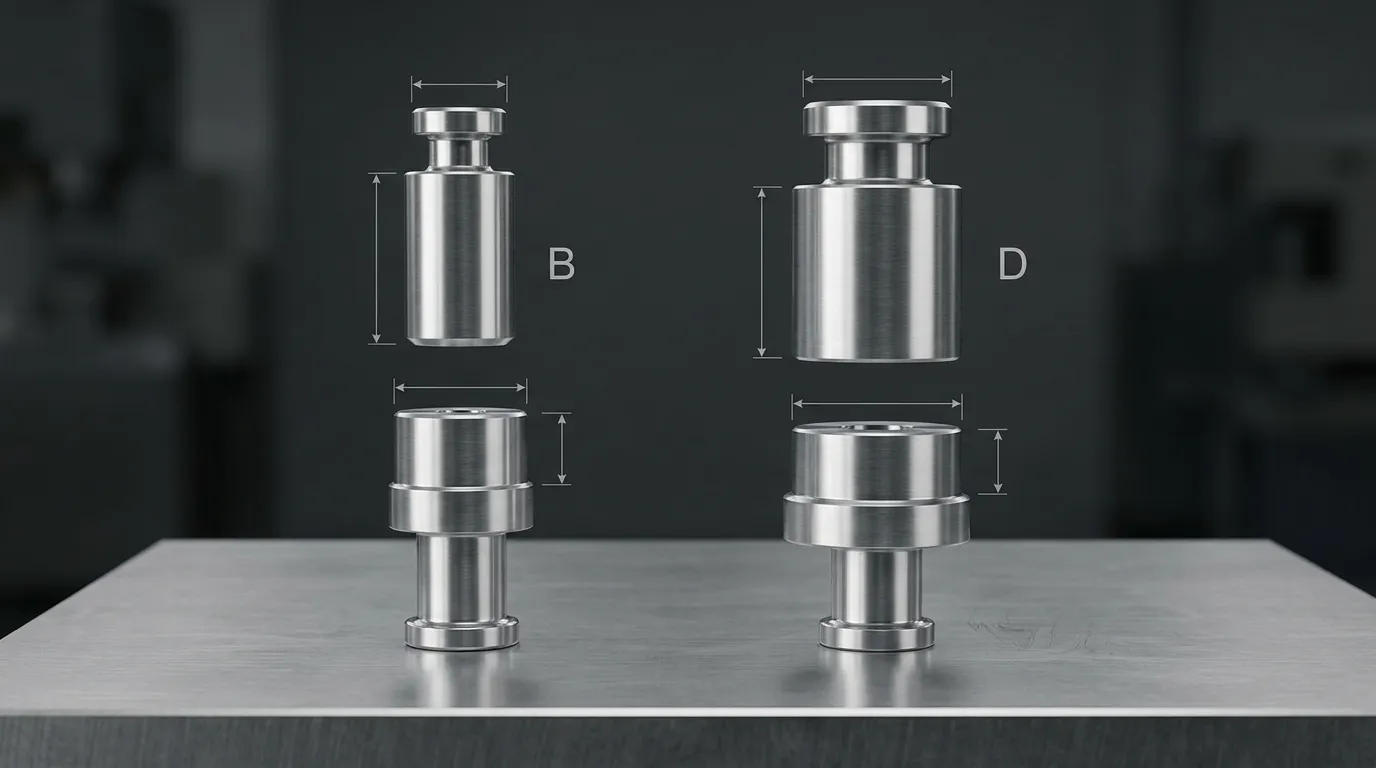
Ferramentas B e Ferramentas D Comparadas em Resumo
| Critério de comparação | Ferramentas B | Ferramentas D |
|---|---|---|
| Diâmetro nominal do cano do punção | Cerca de 19 mm | Cerca de 25,35 mm |
| Diâmetro externo nominal da cabeça de punção | Cerca de 25,27 mm | Cerca de 31,6 mm |
| Diâmetro externo comum do die | Cerca de 30,16 mm | Cerca de 38,10 mm |
| Altura comum do dado | Cerca de 22,22 mm | Cerca de 23,81 mm |
| Referência máxima comum para tabletes redondas | Até cerca de 16 mm | Até cerca de 25 mm |
| Tendência de densidade da estação da torre | Mais alto, where the turret is designed for B tooling | Menor que uma torre B comparável porque cada estação precisa de mais espaço |
| Tendência de morar | Depends on head form, Geometria da prensa, and speed | Often associated with a larger head-flat or longer dwell opportunity, but not universally |
| Direção típica de seleção | Envelope menor de tablete ou maior densidade de estação | Envelope maior de tablete ou um processo que exige uma cabeça diferente e configuração de permanência |
| Intercambiabilidade direta | Não | Não |
These are common reference dimensions, not a complete purchase specification. ISO 18084 defines principal punch-and-die dimensions, Tolerâncias, Características, and interchangeability-related measures. A KORSCH technical paper also lists 19 mm and 25 mm nominal punch barrels, with 30.16 mm and 38.10 mm die diameters for B and D configurations respectively. The approved tooling and turret drawings must control the final order. Padrões Tepha 4Itech 4Itech Padrões 4
Diferenças dimensionais que determinam o ajuste das ferramentas
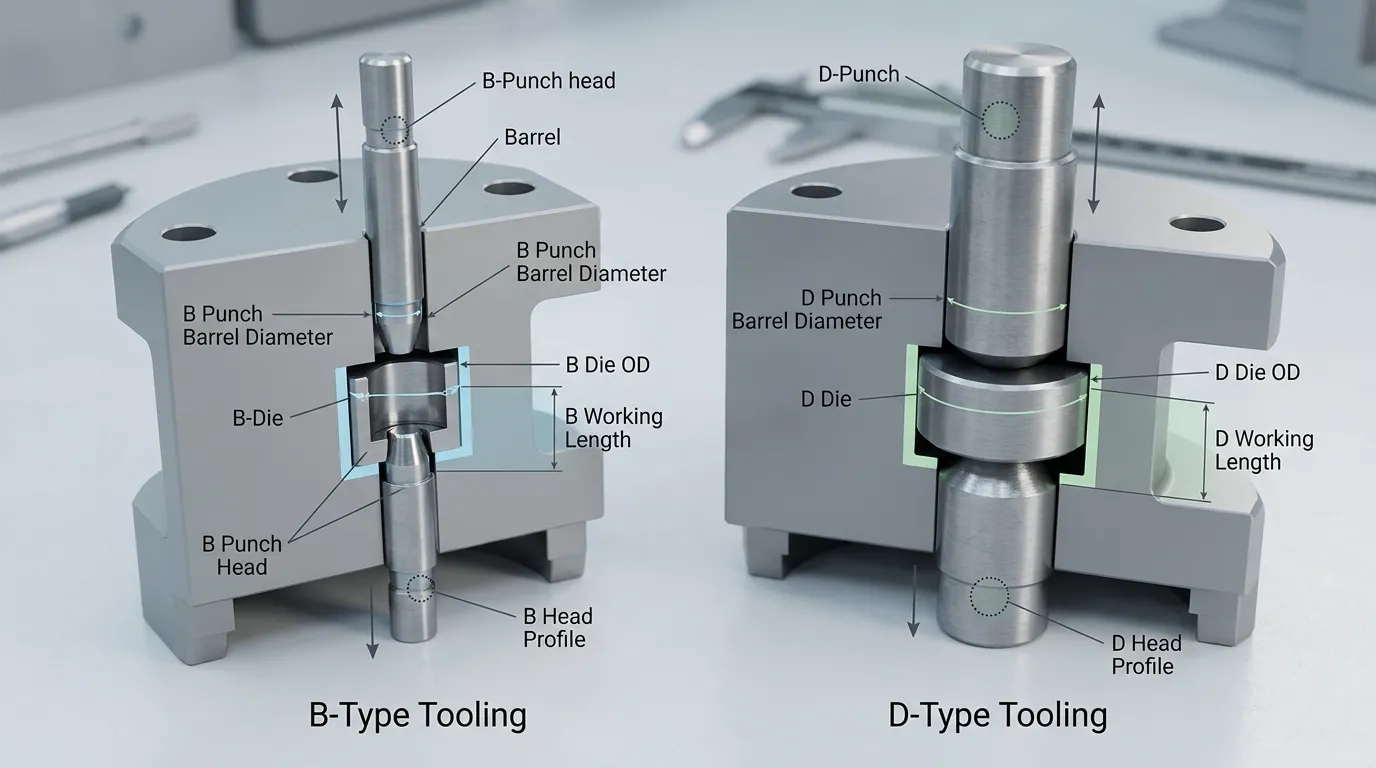
The visible size difference between B and D tooling is not merely a capacity preference. It determines whether the components can physically run in a particular turret.
A punch barrel travels through a precisely sized punch guide. A B punch with a nominal barrel near 19 mm cannot simply replace a D punch designed for a guide near 25.35 mm. The same restriction applies to dies: a common B die outside diameter is approximately 30.16 mm, while a common D die is approximately 38.10 mm. The turret die pockets and retention system must match those dimensions. Padrões Itech 1
Punch-head geometry also matters. The head contacts the tablet press cams and compression rollers, so its diameter, Espessura, Raio, flat, and under-head geometry influence how the punch travels through the compression cycle. Two punches can share a B or D designation and still be incompatible because they follow different standards or machine-specific designs.
Dimensões de Punch and Die que Devem Coincidir
A supplier normally needs more than the words “B tooling” or “D tooling.” The critical dimensions and features include:
- Superior- and lower-punch barrel diameter;
- punch-head outside diameter and profile;
- Upper- e comprimento total de punção menor;
- Comprimento de trabalho;
- punch-tip dimensions and cup depth;
- die outside diameter and height;
- Dimensões do Die-Bore;
- die groove, Afunilamento, or retention features;
- anti-turn key location and angle;
- tablet press turret rotation.
Working length is especially important because variation within a tooling set can affect the final tablet thickness and consistency. Comprimento total, barrel diameter, die OD, O Furo, and head form are also treated as critical inspection dimensions in established tooling-management guidance. I Holland Ltd
Por que um rótulo nominal B ou D não garante a intercambiabilidade
B and D describe tooling-size families. Eles não fazem, sozinhos, confirm the complete standard.
Euro/ISO and TSM configurations may differ in punch-head form, head flat, Espessura da cabeça, under-head cam angle, nominal overall length, e keying. Those differences can restrict interchangeability even when both tools are described as B tooling or both as D tooling. Shaped and multi-tip upper punches also require the correct anti-turn key position for the turret’s rotation and tablet take-off arrangement. I Holland Ltd
O que "capacidade" significa em uma comparação B versus D
Tooling capacity should be evaluated in three separate categories. A family that offers more tablet-size capacity does not automatically provide more production capacity, and a larger tool does not establish a universal safe compression-force rating.
Capacidade do Tamanho do Tablet
D tooling provides a larger physical envelope for the punch tip and die bore. A common industry reference is approximately 25 mm for a round tablet under D tooling and approximately 16 mm under B tooling. These figures are useful for preliminary screening, but they are not universal design limits. KORSCH 1
The supplier must also consider:
- Major and minor tablet dimensions;
- round or shaped profile;
- Profundidade do copo;
- edge land and web thickness;
- score-line geometry;
- Relevo;
- tablet thickness and target weight;
- punch-tip strength;
- clearance between the tip and die bore.
A shaped, Pontuado, embossed, or multilayer tablet does not inherently require D tooling. Those features depend on tablet design, punch-tip geometry, Chaveamento, machine capability, and mechanical loading. The B-or-D decision concerns the available tooling envelope and press configuration, not whether the tablet face is simple or complex.
Capacidade de produção e densidade das estações de torres
Because B tooling uses a smaller barrel and die envelope, a turret of a given pitch-circle size can often accommodate more B stations than D stations. More stations can increase theoretical output when the press runs at the same speed.
For a single-tip, single-sided press, the basic relationship is:
Tablets teóricos por hora = velocidade da torre em rotações por minuto × número de estações × 60
For multi-tip tooling, multiply the result by the number of tablet tips at each station. KORSCH uses this relationship in its technical discussion of turret selection and multi-tip production. KORSCH
That does not mean B tooling guarantees higher real production. Actual validated output also depends on:
- Maximum sustainable turret speed;
- formulation flow and die filling;
- compression dwell requirements;
- Desempenho do alimentador;
- tablet weight-control capability;
- ejection and take-off behaviour;
- Condição da Ferramenta;
- rejection and inspection requirements;
- single-tip or multi-tip configuration.
A difficult-to-compress formulation may require slower operation. Nesse caso, the station-count advantage can be partly or completely offset by the lower sustainable speed.
Força de compressão e capacidade de permanência
Dwell time is the period during which the punch tips remain at or near the minimum separation under compression. It is influenced by punch-head geometry, head-flat size, Geometria de rolo de compressão, turret pitch-circle velocity, and press speed.
D tooling is often associated with a larger head geometry and longer dwell opportunity, but the relationship is not absolute. Both B and D tools can use modified or extended head flats, and the exact result depends on the selected standard and press.
A peer-reviewed study comparing B and D tooling found that head-flat diameter and tooling type affected tablet mechanical properties, but the results also changed with formulation composition and compression force. The study therefore supports a formulation-dependent decision—not the claim that D tooling always produces stronger tablets. Pesquisa sobre ferramentas B/D e geometria de cabeça de punção reported interactions among tooling type, Viver, Força, Resistência à tração, Friabilidade, and capping behaviour. ResearchGate+2Taylor & Francis Online+2
Natoli’s technical guidance similarly explains that increasing the punch-head flat can lengthen dwell at the same turret speed for both TSM-B and TSM-D tools. Formulation strain-rate sensitivity can determine whether that additional dwell improves production performance. Engenharia de Natoli
A safe maximum force cannot be selected from the B or D label alone. It also depends on the press rating, punch-tip area and shape, tool material, Tratamento térmico, Design da cabeça, Condição da ferramenta, Formulação, and approved engineering calculations.
A compatibilidade exige mais do que escolher B ou D
A correct tooling order must satisfy several compatibility layers:
- Tooling family: B or D;
- Padrão de Ferramentas: EU/ISO, TSM, or another machine-specific specification;
- Geometria da torre: Guias de punção, die pockets, station layout, e retenção;
- Geometria do punção: Forma de cabeça, Comprimentos, Comprimento de trabalho, e keying;
- Geometria de tablets: Dica, Taça, Pontuação, Relevo, Terra, and die bore;
- process requirements: fill depth, Força, Viver, Ejeção, and output.
Família de ferramentas e padrão de ferramentas são decisões diferentes
B tooling is not synonymous with TSM tooling, and D tooling is not synonymous with European tooling. Both B and D families may be configured under TSM or EU/ISO conventions.
The standard adds dimensional details beyond the barrel and die envelope. Differences in overall length, Forma de cabeça, Ângulo sob a cabeça, and keying can prevent a tool from running correctly in another press. For a dedicated treatment of that second compatibility layer, Veja Padrões de ferramentas para tablets da UE vs TSM. I Holland Ltd
Detalhes da prensa e torre para verificar
Before approving either family, confirmar:
- Tablet press manufacturer and model;
- turret model, Desenho, or identification number;
- number of turret stations;
- B or D punch-guide size;
- die-pocket diameter, Altura, and retention design;
- Upper- and lower-punch overall lengths;
- tooling working length;
- punch-head profile and under-head geometry;
- Padrão de Ferramentas;
- key location and key angle;
- clockwise or anticlockwise turret rotation;
- existing tooling drawing or physical reference sample.
A machine advertised as supporting several tooling families may use exchangeable turrets or another purpose-designed arrangement. That does not make ordinary B and D components interchangeable within one fixed turret.
Como Escolher Entre Ferramentas B e D
The existing tablet press and turret should be the first selection constraint. If the machine already uses a fixed B or D turret, changing the tooling family may require a replacement turret or more extensive machine engineering.
| Requisito | As ferramentas B podem ser o melhor ponto de partida | Ferramentas D podem ser o melhor ponto de partida |
|---|---|---|
| Equipamentos instalados | Prensa e torre são projetadas para ferramentas B | Prensa e torre são projetadas para ferramentas D |
| Geometria de tablets | O tablet cabe confortavelmente dentro do envelope verificado da B-tool | O tablet requer o envelope maior verificado da ferramenta D |
| Prioridade de produção | Maior densidade de estações é valiosa | A produção necessária pode ser alcançada com a contagem disponível de estações D |
| Comportamento de formulação | A qualidade aceitável do tablet é alcançada dentro do tempo disponível em vivo | A formulação se beneficia da cabeça D selecionada e da configuração de permanência |
| Requisito de compressão | Cálculos de força e resistência da ponta são aceitáveis para a ferramenta B proposta | Proposed tablet and process require a larger tool envelope, subject to engineering verification |
| Status de compatibilidade | B family, Padrão, Comprimentos, o, and keying are confirmed | D family, Padrão, Comprimentos, o, and keying are confirmed |
Ferramentas B geralmente são o melhor ponto de partida quando
Consider B tooling when the press already has a compatible B turret, the tablet fits within its verified design envelope, and higher station density offers a useful production advantage. The formulation must still achieve the required tablet properties at the press speed and dwell available.
As ferramentas D geralmente são o melhor ponto de partida quando
Consider D tooling when the press has a compatible D turret, the tablet requires a larger tip and die envelope, or the selected head geometry provides a more suitable compression window. The process must still meet its output target with the available station count and operating speed.
Pare e verifique antes de escolher qualquer um dos dois
Do not choose from a generic size chart alone when:
- The tooling standard is unknown;
- the turret drawing is unavailable;
- the tablet is close to the assumed size limit;
- unusually high force or long dwell is required;
- shaped or multi-tip tooling needs precise key orientation;
- a replacement tool must match an existing set;
- a B-to-D or D-to-B conversion is being considered;
- the press contains proprietary or modified tooling geometry.
Equívocos comuns de ferramentas B-vs-D
| Equívoco | Interpretação mais precisa |
|---|---|
| D tooling is European tooling. | D is a tooling-size family. EU/ISO and TSM are separate standards layers. |
| B tooling always produces more tablets. | It can allow more stations, but real output also depends on speed, Viver, alimentação, Formulação, tips per punch, e requisitos de validação. |
| D tooling always handles more force. | Safe force depends on the press, head and tip geometry, tool material, tablet area, Formulação, and engineering calculations. |
| Only D tooling can produce shaped, Pontuado, embossed, or multilayer tablets. | These features depend on the punch-tip design, Chaveamento, Geometria de tablets, and machine capability. |
| Any B tool fits any B press. | Comprimento total, Forma de cabeça, Ângulo sob a cabeça, die details, Chaveamento, and machine-specific geometry may differ. |
| The published maximum tablet diameter is a guaranteed limit. | It is a preliminary reference. The proposed design still needs mechanical and press-specific review. |
| Changing punches and dies converts a B press to D. | A different turret or machine configuration is normally required because punch guides and die pockets are different. |
O que incluir em uma RFQ de Ferramentas B ou D
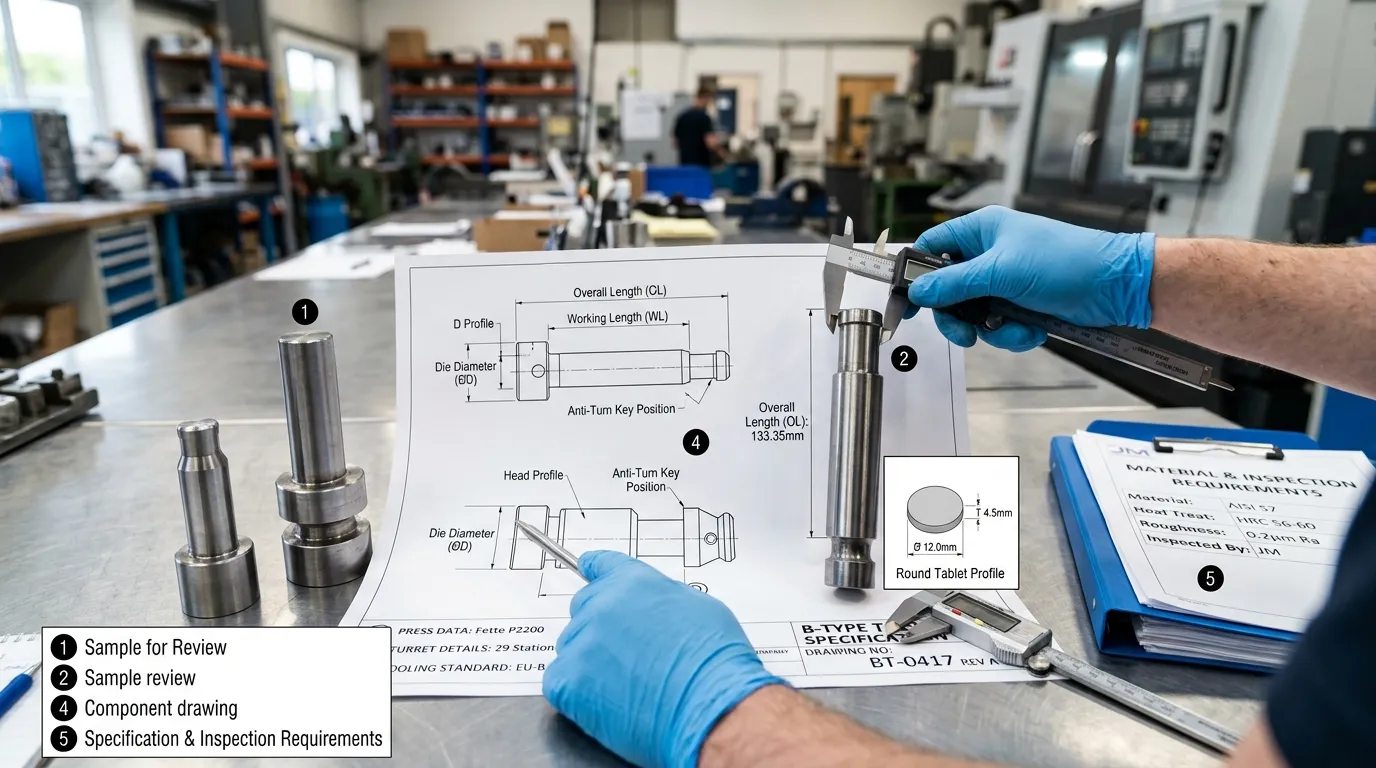
A useful tooling enquiry should contain enough information for dimensional and process review. Inclua:
- Tablet press manufacturer and model;
- turret designation and station count;
- required B or D family;
- EU/ISO, TSM, or machine-specific standard;
- Upper- e desenhos de punção inferior;
- die drawing;
- overall and working lengths;
- punch-head and under-head geometry;
- die OD, Altura, Furo, Groove, e retenção;
- anti-turn key location and turret rotation;
- tablet drawing with all major dimensions;
- Taça, Pontuação, Relevo, Terra, and tolerance details;
- tablet weight and thickness targets;
- formulation concerns such as abrasion, Corrosão, or sticking;
- required tool material, Tratamento térmico, ou revestimento;
- dimensional inspection and material-documentation requirements;
- an existing sample when an approved drawing is unavailable.
SunshinePro's Ferramentas para prensa de tablets page states that it supplies tablet press punches and dies, Listas de aço de alta velocidade, Usinagem CNC, Tratamento térmico, and customization from drawings or samples, and says material inspection reports can be provided. These verified statements support a drawing-led enquiry, but the required B or D family, Padrão, Dimensões, Material, and tolerance scope should be confirmed for the specific order. SunShinePro
Princípio da Seleção Final: Match the Tooling to the Press, Tablet, e Processo
Choose B or D tooling by working in this order:
- Confirm the installed press, Torre, e padrão de ferramentas.
- Verify that the tablet geometry fits the available tooling envelope.
- Check the formulation’s dwell and compression requirements.
- evaluate output using the actual station count and sustainable press speed.
- Control the final order with approved tooling and tablet drawings.
For a custom or replacement requirement, prepare the press data, turret details, Desenhos, Padrão, key orientation, and existing sample where applicable. Então entre em contato com a SunshinePro for a specification and manufacturing review rather than relying on the B or D designation alone.
Compartilhe:


Escrito por Sunshine
Em Sol, Somos um fabricante e fornecedor profissional de componentes de moldes de precisão, oferecendo uma ampla variedade de produtos para aplicações de estampagem e molde por injeção. Nosso foco principal inclui a formação de matrizes, pinos e mangas ejetor, e postes guia e buchas. Com usinagem CNC avançada, Controle rigoroso de qualidade, e fortes capacidades de produção, Garantimos confiabilidade, Peças de alta precisão, juntamente com componentes padrão em estoque para fornecimento global rápido e eficiente.
NOTÍCIAS
RECEBA O SERVIÇO
Com peças de qualidade para todos os orçamentos e equipe amigável treinada para tornar sua visita informativa e sem complicações.
