



TiN vs Revestimento DLC para Pinos de Punção: Atrito, Wear, e Custo
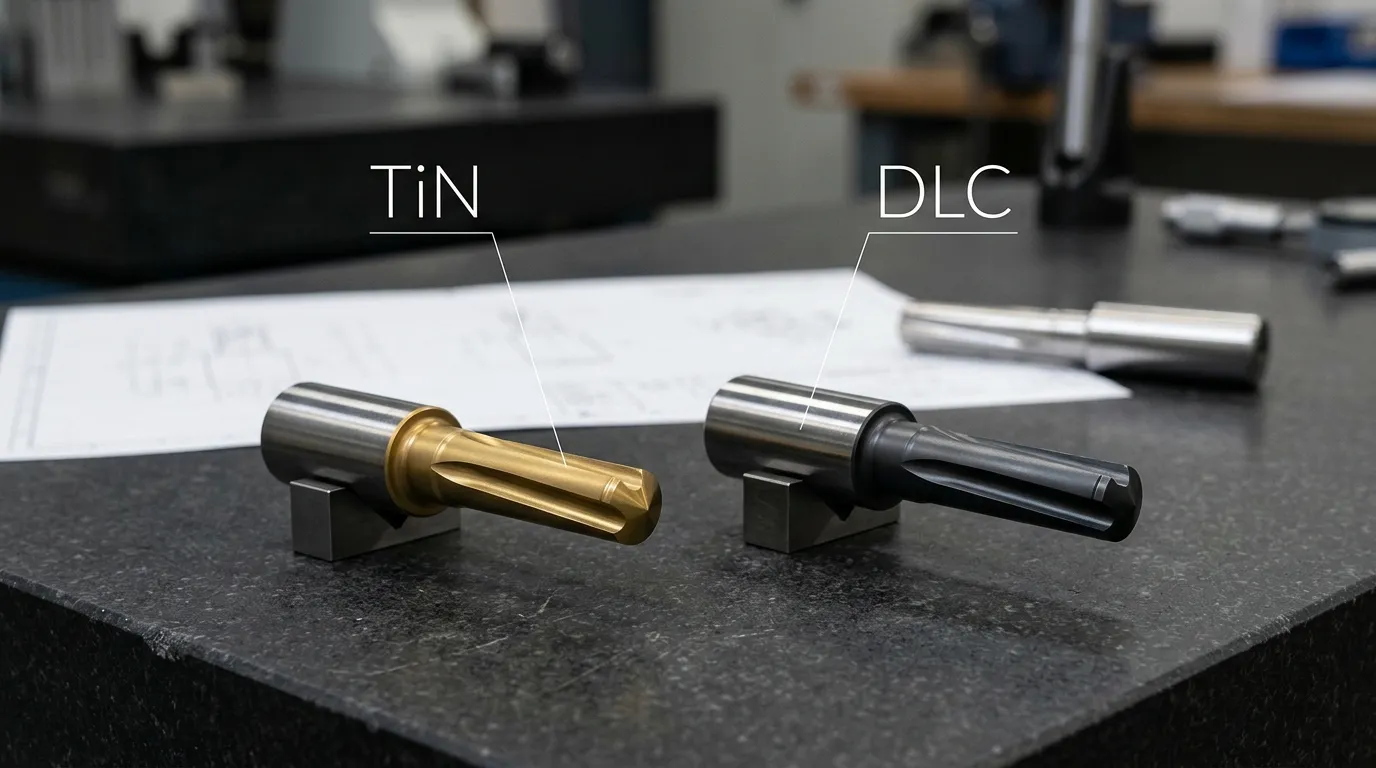
Neither coating is automatically better. The correct choice depends on the punch substrate, Material da peça, Lubrificação, die clearance, Carga por impacto, Preparação de superfície, and the exact coating system being offered. Coating is also only one part of the tooling decision; the broader relationship between punch material, die design, Autorização, and maintenance is covered in this Guia de matrizes de punção (inferido).
TiN vs DLC for Punch Pins: The Practical Answer
The most useful comparison begins with the punch’s actual failure mode rather than one hardness or friction figure.
| Fator de comparação | TiN | DLC |
|---|---|---|
| Categoria de revestimento | Revestimento cerâmico de nitreto de titânio | Família de revestimentos à base de carbono |
| Principal motivo para considerar isso | Proteção geral contra desgaste e uma superfície dura comprovada | Baixo atrito, anti-stick behavior, and adhesive-wear control |
| Tendência de atrito | Geralmente mais alto do que muitos sistemas de DLC | Often lower, depending on the DLC type and test conditions |
| Desgaste abrasivo | Comumente usado onde a resistência ao desgaste de superfícies duras é importante | Can also resist abrasion, but performance varies significantly by DLC formulation |
| Captador de galha e material | Pode reduzir o desgaste, mas normalmente não é a primeira escolha quando predomina o grudamento severo | Often considered when galling, pickup, or sliding friction is the main problem |
| Sensibilidade ao impacto | Depends on coating thickness, Aderência, and substrate support | Can be sensitive to impact, Tensão residual, and substrate deformation, depending on the DLC structure |
| Ajuste da peça | Frequentemente usado como uma opção de uso geral para perfuração e formação de metais | Frequently evaluated for aluminum, cobre, Aço inoxidável, coated sheet, and other pickup-prone applications |
| Clareza da especificação | TiN é uma categoria de revestimento mais claramente definida | "DLC" sozinho não é uma especificação técnica completa |
| Custo inicial relativo | Frequentemente, a linha de base de menor custo | Commonly more expensive, but the premium depends on the exact film and process |
| Melhor ajuste preliminar | Proteção contra desgaste amplo com custo controlado | Aplicações de baixo atrito ou anti-desgorro, onde o captador aciona o tempo de inatividade ou sucata |
Published values should not be compared without context. A friction coefficient measured against steel under dry laboratory conditions is not directly equivalent to a value measured against another material, under lubrication, or with a different load. The same caution applies to hardness and wear results.
Por que os DLCs não podem ser tratados como uma única camada
TiN refers to a recognizable titanium nitride coating system. DLC, or diamond-like carbon, is a broad family of carbon-based films.
O Classificação ISO 20523 para filmes à base de carbono exists because these coatings can differ in carbon bonding, hydrogen content, alloying elements, Estrutura das camadas, and deposition method. Common examples include:
-
a-C:H: a hydrogenated amorphous carbon coating.
-
ta-C: a non-hydrogenated, high-sp³ carbon coating.
-
Si-DLC or DLC:Si: a silicon-modified DLC system.
-
Multilayer DLC: a coating built with transition layers or interlayers to manage stress and adhesion.
These differences affect friction, Dureza, Tensão residual, Espessura do revestimento, temperature capability, Aderência, and impact behavior. Two suppliers may both quote “DLC” while offering materially different systems.
A useful DLC quotation should therefore identify:
-
The exact coating designation.
-
Whether the film is hydrogenated or non-hydrogenated.
-
The deposition method, such as PVD or PACVD.
-
Any interlayer or pretreatment.
-
Coating thickness.
-
Processing temperature.
-
Substrate requirements.
-
The conditions used to measure friction, Dureza, and adhesion.
Páginas técnicas de empresas de revestimento como Íon-ligação also describe DLC as a configurable family rather than one fixed material. Their published data apply to their own coating systems and should not be treated as universal values.
O atrito e o modo de desgaste importam mais do que um único número de dureza
A punch pin experiences several forms of contact during each stroke. The punch face enters the sheet, the cutting edge performs the shearing action, and the punch flank slides against the cut material during penetration and withdrawal.
That means a coating must do more than test well in a simple hardness comparison. It must remain attached to the substrate, tolerate repeated loading, and resist the actual wear mechanism occurring in production.
O Método ASTM G99 de teste de desgaste e atrito makes clear that friction and wear results depend on variables such as load, Velocidade, Materiais, Meio Ambiente, and test configuration. A published coefficient is useful only when the counterface and conditions are known.
Abrasive Wear: When a Hard Wear-Resistant Surface Is the Priority
Abrasive wear occurs when hard particles, scale, Detritos, or the workpiece surface gradually removes material from the punch. Typical signs include flank scratches, Arredondamento de arredondamento das arestas, progressive dimensional loss, and increased burr formation.
TiN is commonly used as a practical hard-coating baseline for tools where general wear resistance is the main requirement. A manufacturer such as voestalpine eifeler lists TiN for punching and forming applications, but its published hardness, Atrito, and temperature data describe its own TiN system rather than every TiN coating.
A DLC system may also provide strong wear resistance, but “DLC” does not tell the buyer enough. The result depends on the film structure, Espessura, Aderência, interlayer, e substrato.
For abrasive-wear applications, evaluate:
-
Coating hardness.
-
Adhesion to the punch material.
-
Surface finish before coating.
-
Thickness around the cutting edge.
-
Substrate hardness and toughness.
-
Debris and contamination in the stamping process.
-
Whether the workpiece has a hard surface layer or coating.
Hardness helps, but it is not a standalone predictor of tool life. A hard coating can still crack or detach if the substrate deforms beneath it.
Adhesive Wear and Galling: When Low Friction Becomes More Important
Adhesive wear occurs when workpiece material transfers to the punch surface. The transferred material creates rough high spots, raises friction, changes the local cutting condition, and may damage the workpiece surface.
This is the condition in which DLC often becomes more attractive. Suitable DLC systems can provide low-friction and anti-stick behavior, especially where aluminum, cobre, Aço inoxidável, or coated sheet tends to adhere to the punch.
Research on DLC-coated tools in aluminum forming has shown strong anti-galling behavior under the tested conditions. That evidence supports DLC as a serious option, but it does not prove that every DLC film will eliminate galling in every punch application.
TiN may still be sufficient where pickup is moderate, lubrication is effective, and a proven TiN process already exists. The choice should also account for polishing, Autorização, lubricant compatibility, Força de desmantelamento, and workpiece surface condition.
For the broader diagnosis and control of transferred material, Lubrificação, Fim, and process conditions, Veja Prevenção de galhas de pinos de punção.
Which Coating Fits Different Punching Applications?
Workpiece material is a useful starting point, but it should not be the only selection rule. Two grades of stainless steel, por exemplo, can behave differently because of hardness, Acabamento superficial, Espessura, Lubrificação, e velocidade de produção.
| Condição de aplicação | Direção preliminar | Por quê | Principal bandeira amarela |
| Aço carbono ou de baixa liga com desgaste gradual nas laterais | Considere TiN primeiro | Opção estabelecida de superfícies duras para controle geral de desgaste | Check debris, scale, Autorização, and substrate support |
| Aço inoxidável com captador ou galha | Considere um sistema de DLC especificado | Menor atrito pode diminuir a transferência de adesivo | Impacto, film adhesion, and lubrication still require review |
| Chapa de alumínio com acúmulo de material | DLC frequentemente merece avaliação prioritária | O comportamento antiaderente pode reduzir danos ao captador e à superfície | Confirme o tipo exato de DLC e teste sob condições de produção |
| Chapa de cobre ou liga de cobre com marcas de transferência | Considere DLCs ou teste ambos | Comportamento de baixo atrito pode ajudar a controlar a aderência | A qualidade da superfície e a interação do lubrificante podem alterar o resultado |
| Chapas galvanizadas ou pré-pintadas | Selecione pelo desgaste observado e comportamento de transferência de superfície | The sheet coating can create debris, transfer, or surface-damage concerns | Não assuma a mesma resposta para toda folha revestida |
| Chapa dura ou abrasiva com captação limitada | Considere TiN ou um sistema de DLC focado em desgaste | A abrasão pode importar mais do que o atrito | Compare coating adhesion and edge durability, not hardness alone |
| Estampagem a seco com atrito deslizante severo | O DLC pode justificar avaliação | Baixa fricção pode reduzir a resistência ao grudamento e ao desmembramento | Condições de impacto seco podem aumentar o estresse do revestimento |
| Processo lubrificado com desgaste estável | O TiN pode fornecer valor adequado | O lubrificante pode já controlar o desgaste do adesivo | Verifique a compatibilidade dos lubrificantes e os intervalos reais de manutenção |
| Mixed abrasive wear, pickup, and chipping | Teste ambos | Nenhuma propriedade geral única prevê o resultado | Fix clearance, Alinhamento, and substrate problems before testing |
Sunshine lists TiN and DLC as optional coatings for custom punch pins. That confirms both options are relevant to its punch-pin offering, but it does not establish that one option is correct for every listed material or application.
Quando um ensaio controlado de produção A/B é a decisão mais segura
A production trial is appropriate when:
-
The punch shows both abrasive wear and material pickup.
-
The DLC specification is unclear or differs between suppliers.
-
Downtime or rejected parts create a high cost.
-
The workpiece has an unusual coating or surface treatment.
-
Impact or delamination risk is uncertain.
-
Supplier friction data were measured under different conditions.
-
The operation will be standardized across a high-volume production line.
The TiN-coated and DLC-coated punches should be compared under the same press, Peça de trabalho, Autorização, Lubrificação, and inspection conditions. Useful measurements include:
-
Strokes until a defined failure point.
-
Material buildup on the flank.
-
Burr growth.
-
Deriva dimensional.
-
Workpiece surface damage.
-
Frequência de limpeza.
-
Regrinding frequency.
-
Unplanned press stoppages.
The failure criteria should be set before testing. Caso contrário, the result can be influenced by subjective inspection or inconsistent maintenance decisions.
O que TiN e DLC Não Conseguem Resolver
A surface coating cannot compensate for a structurally unsuitable punch or a poorly controlled die system.
Early wear, rachaduras, or delamination may be caused by:
-
Folga incorreta entre punção e matriz.
-
Punch and die misalignment.
-
Inadequate substrate hardness.
-
Tenacidade insuficiente do substrato.
-
Poor heat treatment.
-
Rough grinding marks.
-
A damaged or excessively sharp edge.
-
Carregamento lateral.
-
Impacto excessivo.
-
Inadequate lubrication.
-
Poor coating adhesion.
-
Excessive residual stress.
-
An unsuitable coating thickness.
If the substrate deforms, the coating must follow that deformation. A hard film may then crack, detach, or fail at the interface. Research on coated stamping tools and cyclic impact shows why adhesion, Estrutura das camadas, condição do substrato, and repeated loading must be evaluated together rather than separately.
The surrounding guide components and alignment system also affect punch loading. O Guia de componentes do die provides broader context on how punches, Pins, Buchas, and guide parts interact.
Coatings should also not be treated as a solution for every structural failure. For misalignment, overload, insufficient toughness, and other fracture-related causes, refer to Quebra de punção em matrizes de estampagem.
TiN vs DLC Cost: Compare More Than the Coating Price
TiN is often treated as the lower-cost, familiar baseline. DLC commonly carries a higher initial expense because the process may involve a specialized film structure, interlayer, additional preparation, or stricter process control.
There is no reliable universal price ratio. Cost changes with:
-
Punch size and geometry.
-
Batch quantity.
-
Preparação de superfície.
-
Requisitos de mascaramento.
-
Coating thickness.
-
Tipo DLC.
-
Interlayer design.
-
Stripping of an old coating.
-
Remoimento.
-
Inspection requirements.
-
Transport between manufacturing and coating facilities.
The more useful comparison is total tooling cost.
| Fator de custo | Por que isso importa |
| Custo inicial com revestimento | Determina a diferença imediata de compra |
| Preparação de superfície | Polimento ou acabamento corretivo pode ser necessário |
| Intervalo de serviço | Uma operação mais estável pode reduzir as trocas de ferramentas |
| Frequência de limpeza | A coleta de materiais pode exigir limpeza repetida |
| Sucata | Pickup, Crescimento da rebarba, or surface damage can reject parts |
| Tempo de inatividade para a pressão | Remoção de ferramentas e produção de interrupções de substituição |
| Remoimento | Restaura a geometria, mas afeta o revestimento e as dimensões |
| Desmontagem e repintura | Adiciona etapas do processo e pode limitar a frequência com que o punção pode ser restaurado |
| Inspeção | Dimensões críticas podem precisar de verificação após o revestimento ou repintura |
A practical comparison is:
Total coating, Manutenção, Tempo de inatividade, and scrap cost ÷ acceptable production strokes
DLC is worth the additional expense only when the reduction in pickup, Manutenção, sucata, or downtime exceeds the added coating cost. TiN remains the better value when it provides stable wear control without creating those production losses.
O que Confirmar Antes de Pedir um Punch Pin Revestido
Uma recomendação útil de revestimento requer mais do que um desenho e as palavras "TiN" ou "DLC".
Ask the supplier to confirm:
-
Exact coating designation.
-
DLC subtype, Se aplicável.
-
Deposition method.
-
Interlayer or pretreatment.
-
Coating thickness and variation.
-
Processing temperature.
-
Compatible substrate materials and hardness.
-
Required surface finish.
-
Preparação de ponta.
-
Friction test method and counterface.
-
Lubricated or dry test condition.
-
Hardness test method.
-
Adhesion or scratch-test information.
-
Areas that require masking.
-
Whether critical dimensions are inspected after coating.
-
Coating-removal process.
-
Regrinding and recoating policy.
Forneça ao fornecedor:
-
Punch drawing.
-
Tolerâncias críticas.
-
Punch material and hardness.
-
Workpiece alloy.
-
Espessura da peça.
-
Revestimento superficial da peça.
-
Folga para o punção.
-
Press speed or stroke conditions.
-
Lubrication details.
-
Current coating, se é que existe.
-
Observed failure mode.
-
Intervalo de serviço atual.
-
Photographs of flank wear, Lascamento, or material pickup.
Sunshine states that custom punch pins can be produced from drawings, Samples, ou especificações técnicas. É pino perfurador personalizado page lists SKH51, SKH9, DC53, Aço ASP, e carboneto, along with TiN and DLC as optional coatings. The website also lists CNC machining, EDM, moagem, and heat treatment for these parts.
Those listings support a technical discussion about a custom coated punch. They do not, sozinhos, establish the exact DLC subtype, coating process, post-coating tolerance, or coating-specific test method. These details should be confirmed for the individual quotation.
Guia de Seleção Final
| Considere TiN primeiro quando | Considere um sistema de DLC especificado quando | Teste ambos quando |
| A proteção geral contra o desgaste é o principal objetivo | O controle de captadores de material ou de rebotamento de materiais | Desgaste abrasivo e adesivo ocorre junto |
| O desgaste abrasivo das laterais é mais importante do que o desgaste | Baixo atrito é prioridade alta | O risco de impacto ou deslaminação não está claro |
| O custo inicial do revestimento é muito importante | Alumínio, cobre, Aço inoxidável, or coated sheet creates transfer problems | Os dados dos fornecedores usam diferentes condições de teste |
| A aplicação já possui um histórico estável de TiN | O dano na superfície da peça está ligado ao levantamento | Tempo de inatividade e sucata são caros |
| A lubrificação já controla o desgaste do adesivo | O fornecedor identifica exatamente o sistema de DLC | Uma operação de alto volume precisa de evidências de produção |
The correct decision is not “TiN or DLC in general.” It is a choice between two defined coating systems on a defined punch substrate, under a known stamping condition.
For a coating review or quotation, provide the punch drawing, Material, Detalhes da peça, condição de lubrificação, current failure mode, and service history through Sunshine’s Página de contato. That information gives the supplier a stronger basis for discussing TiN, DLC, or a controlled comparison trial.
Compartilhe:


Escrito por Sunshine
Em Sol, Somos um fabricante e fornecedor profissional de componentes de moldes de precisão, oferecendo uma ampla variedade de produtos para aplicações de estampagem e molde por injeção. Nosso foco principal inclui a formação de matrizes, pinos e mangas ejetor, e postes guia e buchas. Com usinagem CNC avançada, Controle rigoroso de qualidade, e fortes capacidades de produção, Garantimos confiabilidade, Peças de alta precisão, juntamente com componentes padrão em estoque para fornecimento global rápido e eficiente.
NOTÍCIAS
RECEBA O SERVIÇO
Com peças de qualidade para todos os orçamentos e equipe amigável treinada para tornar sua visita informativa e sem complicações.
