



Seleção de Aço para Ferramentas de Tablet por Desgaste, Corrosão, e Carga
Tablet tooling steel selection should start with the application, not a familiar grade name. The right material depends on three main pressures: abrasive wear from the formulation, corrosion from product or cleaning exposure, and mechanical load from compression, Impacto, Dobra, and tablet ejection.
Material selection also comes after the tooling format and press compatibility have been established. For that broader context, review the available Tipos de ferramentas para press de tablets. This guide focuses only on choosing the steel or material family for the punches and dies.
No single steel is best in every condition. A wear-resistant grade may chip in a high-impact application, while a tough grade may wear too quickly against an abrasive formulation. The goal is to identify the dominant risk, account for secondary risks, and specify the material condition clearly enough for a supplier to evaluate it.
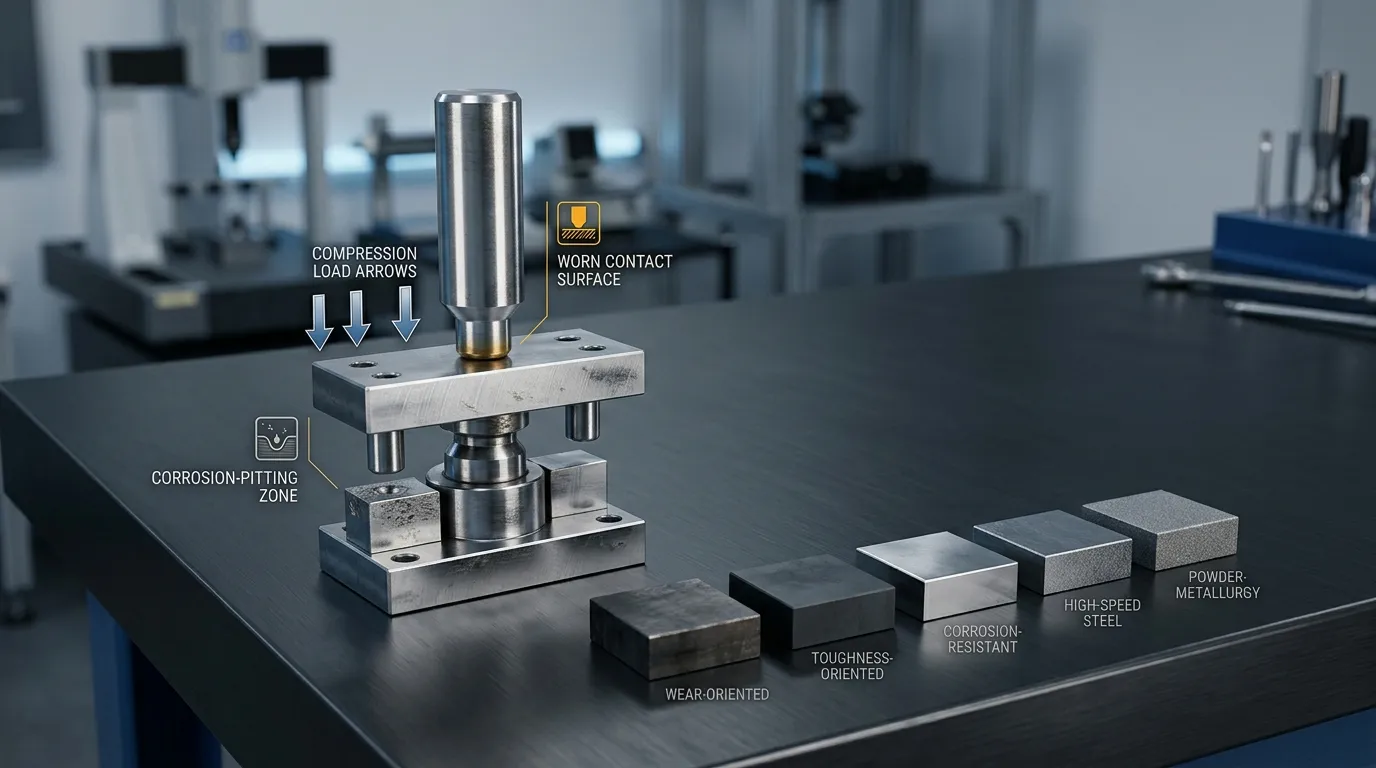
Start With the Application, Not the Steel Grade
A material name alone does not describe the conditions the tooling must survive. Before comparing D2, S7, 440C, Aço de alta velocidade, or powder-metallurgy grades, collect the application data that controls the decision.
Review the following factors:
- Formulation characteristics: Identify hard minerals, crystalline ingredients, salts, acids, chlorides, Umidade, and other substances that may cause wear or corrosion.
- Geometria de tablets: Record the cup depth, punch-tip diameter, Relevo, Placar, narrow features, and sharp transitions that may concentrate stress.
- Compression conditions: Document the operating load, Velocidade, pre-compression arrangement, and any history of overloaded or damaged tooling.
- Ejection behavior: High ejection resistance can increase stress on the lower punch and friction against the die bore.
- Cleaning exposure: Include cleaning chemicals, water quality, contact time, Método de secagem, and storage conditions.
- Current failure symptoms: Note where wear, Pitting, Lascamento, rachaduras, Deformação, or dimensional change appears.
- Production demand: Consider run length, changeover frequency, inspection intervals, and the cost of unplanned tooling replacement.
These inputs are more useful than simply telling a supplier that the tablets are pharmaceutical, Nutracêutico, or chemical products. Two formulations in the same category can create very different tooling conditions.
Identificar o Risco Dominante de Falha
The first step is deciding which failure mechanism deserves the highest priority.
| Condição observada | Risco provável | Propriedade material a priorizar | Outros fatores a serem verificados |
|---|---|---|---|
| Perda gradual do detalhe da face do punção ou do tamanho do calibre do cunho | Desgaste abrasivo | Resistência ao desgaste e dureza retida | Particle hardness, Acabamento superficial, Volume de produção |
| Borrão, Galling, or metal transfer | Desgaste adesivo | Compatibilidade de superfície e acabamento | Lubrificação, Alinhamento, Revestimento, Pressão de contato |
| Staining, rough spots, or localized pits | Corrosão | Resistência à corrosão e burbuças | Formulation chemistry, cleaning agent, Secagem |
| Lascas ou rachaduras repetidas nas pontas | Fratura | Tenacidade e resistência a tensões | Profundidade do copo, Relevo, Alinhamento, Tratamento térmico |
| Deformação permanente | Carga excessiva | Resistência à compressão e dureza final | Configurações de pressione, Dimensões da ferramenta, overload history |
| Desgaste desigual ao redor da ferramenta | Desalinhamento ou carga desigual | Não necessariamente um problema de aço | Condição de imprensa, Guias, Configuração, Geometria das ferramentas |
Wear, Corrosão, and fracture can produce similar early symptoms. A rough punch face, por exemplo, may result from corrosion, abrasive attack, poor polishing, coating damage, or adhesive transfer. Changing steel before confirming the failure mechanism may replace one problem with another.
Avaliar as Condições Combinadas
Many applications do not fit into one category.
An abrasive and corrosive formulation needs more than maximum hardness. A highly wear-resistant grade may still suffer surface attack, while a corrosion-resistant steel may lose dimensions too quickly under severe abrasion.
A high-load and abrasive application creates a different balance. Wear resistance matters, but the punch must also tolerate impact, Dobra, and local stress around deep cups, narrow tips, Placar, or detailed embossing.
Use three questions to frame the shortlist:
- Which condition is most likely to stop production first?
- Which secondary condition could eliminate an otherwise suitable grade?
- Can the risk be controlled through component-specific materials, Tratamento térmico, Acabamento superficial, or coating?
Where all three risks are high, published grade descriptions may not be enough. A supplier review, sample tooling, and controlled production trial may be more reliable than a universal recommendation.
Balance Wear Resistance, Resistência, Resistência à corrosão, and Strength
Tool steel properties interact. Improving one property does not guarantee better overall performance.
Resistência ao desgaste helps the punch face and die bore retain dimensions against hard particles and repeated contact. It is especially important when the formulation contains abrasive minerals or crystalline ingredients.
Resistência describes the steel’s ability to tolerate impact, Dobra, and stress without chipping or cracking. It becomes more important around thin punch tips, Copos profundos, sharp engraving, and other stress-concentrating features.
Resistência à compressão helps the tooling resist permanent deformation under compaction pressure. This is different from toughness: a material can resist deformation yet remain vulnerable to brittle fracture.
Resistência à corrosão matters when the tooling contacts moisture, acids, salts, chlorides, reactive ingredients, or aggressive cleaning chemicals. The actual exposure conditions matter more than a broad label such as “stainless.”
Estabilidade dimensional affects whether the tooling retains critical geometry after heat treatment and during repeated use. It also influences the consistency of tablet dimensions and tooling interchangeability.
Polimento e retenção de superfície affect friction, product release, Limpeza, embossing definition, and the tendency for material to adhere to the working surface.
Por que mais difícil não é automaticamente melhor
Hardness is easy to compare, which is why buyers sometimes use it as the primary specification. That can be misleading.
Higher hardness may improve resistance to abrasive wear, but it does not automatically improve toughness, corrosion behavior, Estabilidade dimensional, or resistance to impact. A very hard punch can still fail early if its geometry creates a sharp stress concentration or the press applies an uneven bending load.
The final decision should consider four items together:
- Grau exato do aço
- Condição de tratamento térmico
- Dureza final
- Geometria real dos componentes e função
A hardness number without the grade, Histórico de tratamento térmico, and application context is an incomplete specification.
Compare famílias siderúrgicas por suas condições de melhor ajuste
Common tablet-tooling materials are better understood as conditional options rather than a ranked list.
| Família material | Força típica de seleção | Principal limitação para a revisão | Possível sinal de aplicação | O que o comprador deve verificar |
| Aço de trabalho a frio do tipo D2 | Forte resistência ao desgaste abrasivo | Menor tolerância a trincas do que as categorias orientadas para tenacidade | Aplicação dominante no desgaste com impacto controlado | Grau exato, Tratamento térmico, Dureza, Geometria |
| Aço resistente a choques do tipo S7 | Alta tenacidade e resistência a impactos | Pode não oferecer a maior resistência ao desgaste | Lascamento, choque, Dobra, or fracture is the main risk | Final condition, wear demand, Tratamento de superfície |
| Aço inoxidável 440C | Resistência à corrosão com alta dureza alcançável | Not corrosion-proof; wear and toughness still require review | A exposição a produtos ou à limpeza cria risco significativo de corrosão | Exposure chemistry, Dureza, passivation or finish |
| Aço de alta velocidade | Useful hardness, Resistência ao desgaste, and strength depending on grade | "HSS" abrange muitas composições e condições | O fornecedor oferece uma classificação HSS definida, adequada à aplicação | Exact designation, chemistry, Tratamento térmico, reports |
| Aço para ferramentas de metalurgia em pós | Potentially strong balance of wear, Resistência, Força, e estabilidade | O custo e as propriedades variam significativamente de acordo com o grau | As condições combinadas excedem a capacidade de grau convencional | Exact PM grade, published data, trial evidence |
| Matriz de carbureto ou revestido de carboneto | Desgaste muito alto e resistência à compressão | Fragilidade e compatibilidade de aplicações | O desgaste severo do diário é o problema dominante | Insert design, impact risk, formulation compatibility |
Documentação técnica oficial para uma classificação equivalente a D2, como Uddeholm Sverker 21 describes a profile centered on abrasive-wear resistance, with cracking resistance remaining an important limitation. An S7-based grade such as Uddeholm Compax Supreme places more emphasis on toughness and heavy-duty impact conditions.
That distinction is useful, but it should not become a universal D2-versus-S7 verdict. A more focused comparison belongs in D2 vs aço S7 para punções de tablet.
For corrosion-oriented applications, BÖHLER N695 e Carpenter 440C provide useful reference information for 440C-type martensitic stainless steel. The material can achieve high hardness while offering stainless characteristics, but its suitability still depends on the specific chemical exposure and final condition.
Powder-metallurgy steel is also not one uniform category. A specific grade such as Uddeholm Vanadis 4 Extra is designed around a particular balance of ductility, Resistência ao desgaste, Resistência à compressão, e estabilidade dimensional. Those attributes cannot be assumed for every steel produced through a PM process.
Trate os rótulos genéricos como especificações incompletas
Terms such as “HSS,” “stainless steel,” and “PM steel” identify broad families, not complete tooling specifications.
Peça ao fornecedor para confirmar:
- Grau exato ou equivalente reconhecido
- Whether the material applies to the punch, o, Inserir, or complete tooling set
- Rastreabilidade por calor ou lote
- Condição de tratamento térmico
- Dureza final
- Acabamento superficial
- Revestimento ou outro tratamento de superfície
- Requisitos de inspeção dimensional
SunshinePro's Ferramentas de Prensa Tablet page lists Premium High-Speed Steel, Usinagem CNC, Tratamento térmico, e processamento personalizado a partir de desenhos ou amostras. The page does not identify the exact HSS grade, so that detail should be confirmed for the specific application rather than assumed.
Selecione os materiais de perfuração e matriz por função de componente
Punches and dies operate as a set, but they do not experience identical conditions.
| Área dos componentes | Função principal | Preocupação típica com materiais |
| Ponta superior do punção | Comprime e forma a face superior do comprimido | Face wear, Lascamento, embossing damage, local stress |
| Ponta inferior do punção | Suporta compressão e ejeta o tablet | Wear, ejection load, Atrito, Dano nas bordas |
| Braço e cano do punção | Transfere carga e mantém o alinhamento | Dobra, Fadiga, Precisão dimensional |
| Cabeça de punção | Contatos, cames de pressão e rolos | Impacto, Uso de contato, head-profile accuracy |
| O furo | Contém pólvora e guia a compressão e ejeção | Desgaste abrasivo, Pressão radial, Corrosão, dimensional enlargement |
A punch with a deep concave cup or narrow tip may require greater fracture resistance than a broad, shallow punch used under similar compression conditions. Detailed embossing and break lines can also create local stress concentrations.
The die bore has a different priority. It experiences repeated contact with powder and the tablet edge, radial pressure during compression, and friction during ejection. Gradual die-bore wear may change tablet diameter and ejection behavior even when the punches remain usable.
For severe applications, the most suitable solution may involve different material priorities for punches and dies rather than one grade for the entire set.
Check Heat Treatment, Acabamento de Superfície, Revestimento, and Press Condition
A correct nominal grade can still perform poorly when its final condition or operating environment is unsuitable.
Tratamento térmico develops the steel’s working hardness, Resistência, Estabilidade dimensional, and residual-stress condition. Two tools made from nominally the same grade may behave differently if their heat treatment differs.
Lixamento e polimento influence friction, Aderência, Limpeza, and local stress. Dano de moagem, sharp transitions, or an unstable polished finish can shorten service life.
Revestimentos superficiais may reduce friction, adhesive pickup, Desgaste, or corrosion under appropriate conditions. They remain part of a material system, not a replacement for the base steel. A coating cannot correct inadequate substrate toughness, poor heat treatment, Geometria inadequada, or press misalignment.
Condição de imprensa can overload an otherwise appropriate tool. A revisão revisada por pares Uma atualização sobre os avanços na tecnologia de ferramentas para tablets discusses the interaction among tooling design, aço, Revestimentos, Desgaste, Corrosão, e desalinhamento. That interaction is why material changes should follow a root-cause review rather than replace one.
Não culpe o aço antes de verificar o alinhamento e a geometria
Repeated breakage in the same location may indicate an alignment, Configuração, or geometry problem.
Verifique por:
- Desgaste desigual ao redor do soco ou morte
- Marcas de contato em um dos lados das ferramentas
- Falhas repetidas em uma ponta estreita ou transição acentuada
- Copos excessivamente profundos
- Relevo fino ou linhas de quebra que criam estresse local
- Guias danificadas ou configuração inconsistente da prensa
A tougher steel may tolerate more abuse, but it cannot correct misalignment. Similarly, a harder steel may slow surface wear while making a stressed punch feature more vulnerable to chipping.
Use uma matriz de desgaste–corrosão–carga para montar a lista de finalistas
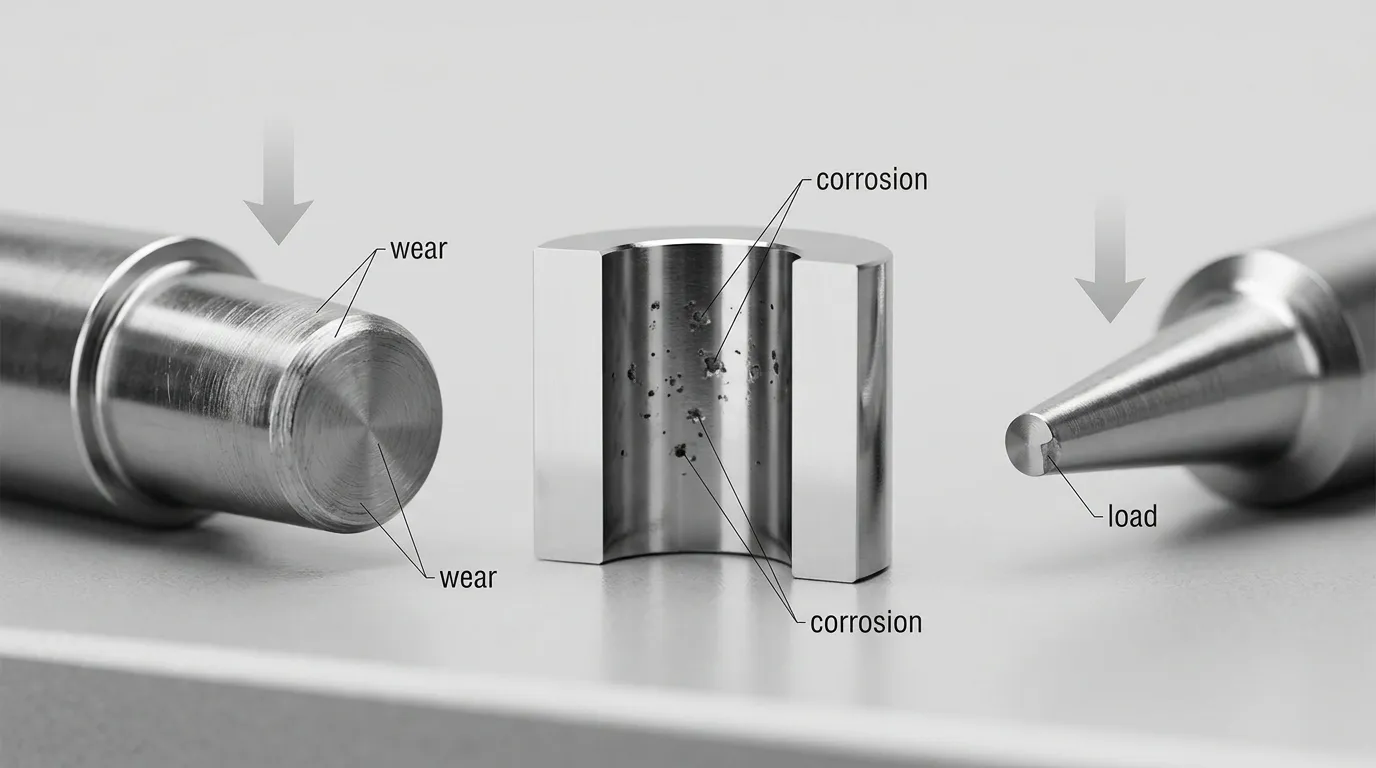
The following matrix is a practical starting point. It does not replace an application-specific material review.
| Risco de desgaste | Risco de corrosão | Risco de carga | Direção inicial de seleção |
| Alto | Baixo | De baixo a moderado | Investigate wear-oriented tool steel; confirm adequate toughness |
| De baixo a moderado | Baixo | Alto | Investigue o aço orientado para tenacidade e revise a geometria do punção |
| Baixo | Alto | De baixo a moderado | Investigate corrosion-resistant steel; verify hardness and wear demand |
| Alto | Alto | Moderado | Investigate balanced stainless or PM options, surface strategy, and trial tooling |
| Alto | Baixo | Alto | Balance wear with toughness; consider component-specific materials |
| Moderado | Alto | Alto | Prioritize corrosion behavior and fracture resistance; validate under actual cleaning and load conditions |
| Alto | Alto | Alto | Require supplier engineering review, documented properties, and controlled testing |
Use the matrix in five steps:
- Rate the relative wear, Corrosão, and load risks.
- Identify the condition most likely to stop production first.
- Remove materials that cannot tolerate the secondary risk.
- Check whether punches and dies need different priorities.
- Confirm the shortlist through documentation, Inspeção, and testing.
The matrix should produce a shortlist, not an automatic approval. Tratamento térmico, Geometria, Fim, Revestimento, Condição da prensa, and supplier process control can still change the result.
Prepare a RFQ e verifique as provas do fornecedor
A supplier can make a more defensible recommendation when the RFQ includes the actual operating conditions rather than only the tablet dimensions.
Enviar com a RFQ
Fornecer:
- Desenho de ferramentas, tablet drawing, or physical sample
- Press make, Modelo, and tooling format
- Tablet diameter, Formato, Profundidade do copo, score, and embossing
- Abrasividade da formulação e exposição química conhecida
- Produtos químicos de limpeza e procedimento de secagem
- Condições de compressão e ejeção
- Demanda de produção esperada
- Current tooling material, se conhecido
- Fotografias e locais de falhas anteriores
- Acabamento ou revestimento de superfície exigido
- Inspeção aplicável e requisitos dimensionais
SunshinePro states that its tablet tooling can be customized from drawings or samples and that material-selection advice is available. Those capabilities can support the discussion, but the exact grade and final specification still need to be confirmed for the order.
Solicitação do Fornecedor
Ask for:
- Grau exato de aço ou designação equivalente
- Certificado de material ou relatório de inspeção de materiais
- Identificação por calor ou lote
- Condição de tratamento térmico
- Relatório final de dureza
- Relatório de inspeção dimensional
- Especificação de acabamento superficial
- Coating specification, Quando aplicável
- Confirmação do padrão dimensional utilizado
- Quaisquer limitações de aplicação identificadas pelo fornecedor
O escopo oficial de ISO 18084:2011 covers the main dimensions, Tolerâncias, Características, e intercambiabilidade de perfuradores e matrizes para tablets. It should not be treated as approval of a particular steel grade.
For pharmaceutical manufacturing, 21 CFR 211.65 requires product-contact surfaces to avoid being reactive, additive, or absorptive in a way that affects the drug product. The regulation does not provide a universal list of “FDA-approved” tablet-tooling steels. Material, Revestimento, lubrificante, Limpeza, and contamination risks still require application-specific assessment.
Quando Solicitar um Teste em Vez de uma Recomendação Universal
Trial tooling is appropriate when:
- Wear, Corrosão, and load are all significant
- A causa atual da falha é incerta
- Uma nova formulação está sendo introduzida
- É proposto um grau proprietário ou desconhecido
- As ferramentas incluem geometria altamente estressada
- Os dados de material publicados não representam o ambiente operacional real
Define the trial criteria before production starts. Inspect dimensional change, Condição da superfície, Corrosão, Lascamento, rachaduras, coating damage, ejection behavior, and tablet quality at agreed intervals.
Do not evaluate the trial using an unsupported cycle-life expectation. Compare it against a documented baseline under controlled conditions.
Lista de Verificação Final de Seleção
Before approving the material, confirme isso:
- The dominant wear, Corrosão, or load risk has been identified.
- Secondary risks have been documented.
- Punch and die duties have been considered separately.
- The exact grade or accepted equivalent is stated.
- Heat treatment and final hardness are defined.
- Surface finish and coating are specified separately from the base steel.
- Tablet geometry and press alignment have been reviewed.
- Material traceability and inspection evidence are available.
- Standards are applied within their actual scope.
- A trial is planned where combined conditions create uncertainty.
The strongest specification is not the one with the hardest or most expensive material. It is the one that connects formulation, component duty, Geometria, Condição da prensa, Propriedades do material, and supplier evidence.
For a tooling review or quotation, submit the drawing or sample together with the application details above through the Página de contato SunshinePro. This gives the supplier enough information to discuss a suitable material and manufacturing approach without relying on a generic grade recommendation.
Compartilhe:


Escrito por Sunshine
Em Sol, Somos um fabricante e fornecedor profissional de componentes de moldes de precisão, oferecendo uma ampla variedade de produtos para aplicações de estampagem e molde por injeção. Nosso foco principal inclui a formação de matrizes, pinos e mangas ejetor, e postes guia e buchas. Com usinagem CNC avançada, Controle rigoroso de qualidade, e fortes capacidades de produção, Garantimos confiabilidade, Peças de alta precisão, juntamente com componentes padrão em estoque para fornecimento global rápido e eficiente.
NOTÍCIAS
RECEBA O SERVIÇO
Com peças de qualidade para todos os orçamentos e equipe amigável treinada para tornar sua visita informativa e sem complicações.
