



Pinos de punção para estampagem de aço de alta resistência: Resistência e Desgaste
Punch pins for high tensile steel stamping must resist two competing problems: progressive wear and sudden fracture. Choosing the hardest available material may slow edge wear, but it can also leave a slender or heavily loaded punch more vulnerable to chipping. Choosing a tougher material may reduce breakage while allowing faster abrasive wear.
The correct specification starts with the exact sheet grade and the observed failure mode. Punch material, Tratamento térmico, Geometria, Autorização, Alinhamento, Acabamento superficial, Revestimento, Lubrificação, and stripping conditions must work as one system. Para informações mais amplas sobre tipos de matriz, Materiais, and punch-to-die relationships, ver o Guia de matrizes de punção (inferido).
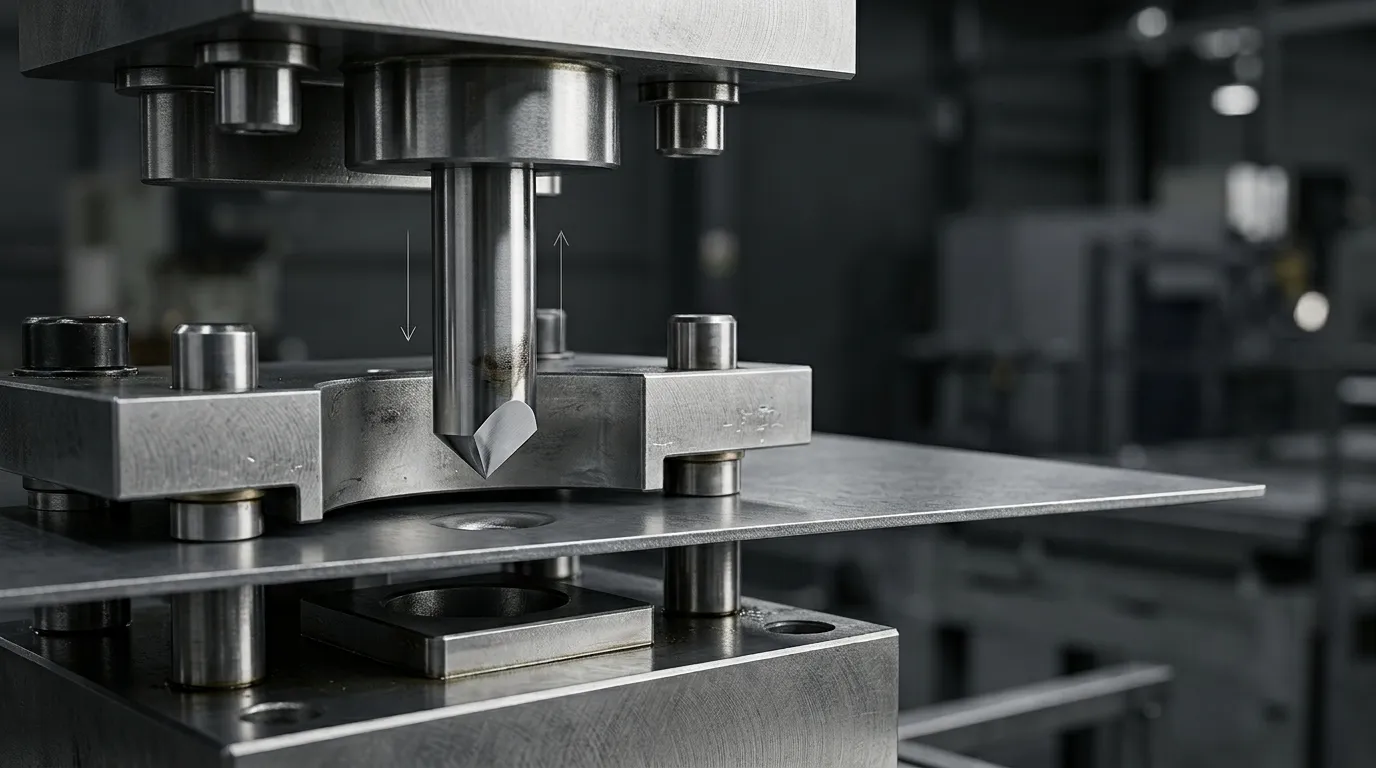
Por que o aço de alta resistência altera os requisitos do pino de perfuração
Higher-strength sheet places greater demands on the punch, O botão, stripper, Sistema de guias, e imprensa. The punch must penetrate the sheet without deforming, survive the sudden release of stored energy as the material fractures, and withdraw without excessive adhesion or side loading.
The workpiece description should include more than “high-tensile steel.” Important inputs include:
- Grau exato do aço
- Escoamento e resistência à tração
- Espessura da folha
- Revestimento ou revestimento superficial
- Condição de lubrificação
- Tamanho e formato do furo
- Qualidade de borda exigida
- Taxa de produção e duração da produção
These factors influence cutting load, desgaste abrasivo, Atrito, Galling, Formação de rebarbas, and stripping force. Two steels with similar tensile-strength ratings can behave differently because their microstructures and surface conditions are not identical.
High-Tensile Steel, AHSS, and UHSS Are Not Interchangeable Specifications
“High-tensile steel” is a broad commercial term. Advanced high-strength steel, or AHSS, includes several material families such as dual-phase, complex-phase, and martensitic steels. UHSS generally refers to the higher-strength portion of this wider group, although terminology can vary by supplier and industry.
The label alone is not enough to select a punch. A tooling supplier needs the complete grade designation, mechanical properties, Espessura, e condição da superfície. Technical overviews of Classificações avançadas de aços de alta resistência also show why strength numbers should be considered alongside the steel’s metallurgical type.
Cargas mais altas podem causar desgaste e fratura ao mesmo tempo
A punch used on higher-strength sheet may experience more than one failure mechanism.
A hard, wear-resistant edge can still chip if it receives uneven loading. A tougher punch may survive impact but lose dimensional accuracy through abrasive wear. Material pickup can increase friction during withdrawal, adding bending stress to a small-diameter punch.
This is why punch life cannot be predicted from hardness alone. Hardness and compressive strength help resist deformation and wear. Toughness and ductility help the tool tolerate impact, Dobra, stress concentrations, and crack propagation.
Diagnostice o modo de falha antes de trocar o material do punção
Before upgrading the punch material, inspect the failed tool and the parts it produced. Look at the cutting edge, Flanco, Corpo, cabeça, Material aderido, scoring direction, burr trend, and the location of any cracks.
The following table provides a practical starting point.
| Condição observada | Likely mechanism | Primeiras checagens | Propriedade ou direção de correção |
|---|---|---|---|
| Arredondamento gradual da borda e rebarba crescente | Desgaste abrasivo | Sheet grade, Autorização, Condição da superfície, Duração da corrida | Greater wear resistance, improved finish, revised clearance or coating |
| Material de trabalho preso ao perfurador | Desgaste adesivo ou galha | Lubrificação, sheet coating, punch finish, withdrawal condition | Menor atrito, better surface finish, suitable coating or process correction |
| Pequenos pedaços faltando na aresta de corte | Lascamento de borda | Alinhamento, Autorização, Geometria das arestas, Tratamento térmico | Greater toughness, lower stress concentration, improved support |
| Fissura principal ou fratura completa | Rachaduras ou quebras grossas | Carga lateral, Comprimento sem suporte, Orientação, Dureza, Geometria do punção | Maior resistência à fratura mais correção do sistema |
| Edge rolls, mushrooms, or changes shape | Deformação plástica | Cutting load, substrate hardness, Tratamento térmico, Resistência à compressão | Maior resistência à compressão ou tratamento térmico corrigido |
| Um dos lados desgasta ou lasca mais rápido | Carga desigual | Die-button position, Uso guia, Desvio da imprensa, Cêntrica | Restaure o alinhamento e até a folga antes de trocar o material |
O Discussão das Diretrizes AHSS sobre ferramentas e desgaste dos matrizes separates abrasive wear, Desgaste adesivo, Lascamento, rachaduras, and plastic deformation because they do not have the same cause or corrective action.
Desgaste abrasivo, Desgaste por adesivo, and Galling
Abrasive wear removes punch material progressively. Common signs include edge rounding, Pontuação, Perda dimensional, and a gradual increase in burr height. Hard phases in the workpiece, Escala, surface contamination, and repeated contact can contribute to this type of deterioration.
Adhesive wear involves material transfer between the sheet and punch. The workpiece may stick to the punch surface, creating pickup, smearing, ou pontuação. Severe adhesion can develop into galling, where rough transferred material increases friction and damages both surfaces.
Before specifying a harder substrate, confere:
- Acabamento da superfície do punção
- Tipo e consistência do lubrificante
- Revestimento em folha
- Folga para o punção
- Direção de moagem
- Condição de desmontamento
- Danos existentes no revestimento
A coating may reduce friction or pickup, but it cannot compensate for severe misalignment, unstable geometry, or an unsuitable base material.
Edge Chipping, Gross Cracking, and Plastic Deformation
Edge chipping is a localized fracture. It may result from inadequate toughness, excessive edge stress, folga irregular, a sharp stress concentration, Apoio ruim, or an unsuitable heat-treatment condition.
Gross cracking affects a larger section of the punch and may lead to complete separation. Carregamento lateral, comprimento excessivo sem suporte, Desalinhamento, poor transitions between sections, or an excessively brittle substrate can contribute. Broader fracture causes are covered in Quebra de punção em matrizes de estampagem.
Plastic deformation is different. Instead of cracking, the punch permanently changes shape because the applied stress exceeds the material’s compressive capability. The edge may roll or mushroom. A tougher material is not necessarily the answer; the punch may need greater hardness, Resistência à compressão, improved heat treatment, or reduced loading.
Ajuste a família de materiais do punção ao risco dominante
Material selection should begin with the property that is missing, not with a familiar grade name. The practical question is whether the application primarily needs more wear resistance, Resistência, Resistência à compressão, galling resistance, or a balanced combination.
| Família material | Direção típica de seleção | Principal vantagem | Limitação principal |
| Aço convencional para ferramentas de trabalho a frio | Demanda de desgaste moderada a alta com carga estável | Processamento estabelecido e resistência útil ao desgaste | Algumas inclinações podem lascar sob impacto severo ou dobra |
| Aço de alta velocidade | Combined hardness, Resistência ao desgaste, and improved toughness | Desempenho balanceado para muitas aplicações de perfuradores | O desempenho ainda depende muito do tratamento térmico e da geometria |
| Aço para ferramentas de metalurgia do pó ou PM-HSS | Aplicações exigentes com riscos combinados de desgaste e fratura | Distribuição mais uniforme de carbonetos e combinações de propriedades mais amplas | O custo maior do material deve ser justificado pela aplicação |
| Carbeto | Severe abrasive wear under rigid, well-aligned conditions | Alta resistência ao desgaste e à compressão | Mais sensível ao impacto, Dobra, Apoio ruim, e desalinhamento |
No family is universally superior. A stable, well-supported application with gradual abrasive wear may justify a different material from a small punch that repeatedly chips under side load.
Aço de Ferramentas Convencional e Aço de Alta Velocidade
Conventional cold-work tool steels can provide strong wear resistance, but their toughness varies widely. A D2- or SKD11-type material may be appropriate in a stable application where abrasive wear dominates, yet it may not be the best direction for a slender punch experiencing impact or uneven loading.
High-speed steels such as M2- or SKH51-type grades are commonly considered when the application needs a stronger balance of hardness, Resistência ao desgaste, and toughness. This does not make HSS automatically better. Tratamento térmico, punch diameter, Raios de transição, Orientação, and operating conditions can have more influence than the grade label alone.
A SunshinePro lista SKH51, SKH9, and DC53 among its punch-pin material options. These are available choices, not universal recommendations for every AHSS or UHSS operation.
Aços para ferramentas de metalurgia em pó para demandas combinadas de desgaste e fratura
Powder-metallurgy production can create a more uniform distribution of alloy carbides than conventional ingot processing. This may allow tool-steel grades to combine high wear resistance with better resistance to chipping or fatigue.
PM materials still have different priorities. Technical guidance may position one grade toward wear resistance and another toward toughness. Por exemplo, PM-M4 is often discussed as a wear-focused option, while PM-3V is commonly considered where resistance to chipping and impact carries more weight. These are directional comparisons, not interchangeable specifications.
SunshinePro lists ASP materials among its available punch-pin options. The appropriate ASP grade and heat-treatment condition would still need to be selected from the actual workpiece, Geometria, Condições de produção, e histórico de falhas.
Quando o Carbureto Ajuda — e Quando Cria Novos Riscos
Carbide offers high abrasive-wear resistance and compressive strength. It can be useful when the die is rigid, the punch is well supported, alignment is controlled, and progressive wear is the main problem.
Its limitations become important in shock-loaded or unstable conditions. Carbide is less tolerant of bending, edge impact, Desalinhamento, and weak support than tougher tool-steel systems. Um longo, narrow carbide punch can fail quickly if the underlying geometry and guidance are not suitable.
Production volume alone is not enough to justify carbide. The decision should also consider:
- Diâmetro do punção e comprimento sem suporte
- Condições de impacto e de transição rápida
- A rigidez
- Condição do sistema de guias
- Geometria das arestas
- Requisitos de remoção
- Consequências de fratura súbita
Liberação de Cheques, Alinhamento, and Geometry Before Blaming the Punch Material
A premium punch material will not correct an unstable die system. Liberação, Alinhamento, Orientação, Rigidez, Geometria, and stripping conditions should be checked before a substrate change is approved.
Folga e alinhamento mudam a carga na aresta de corte
Punch-to-die clearance affects cutting force, fracture development, Formação de rebarbas, Carregamento de borda, and tool wear. The correct value depends on the exact sheet grade, Espessura, edge-quality target, Condição da Ferramenta, and operation. A single clearance percentage should not be applied to all high-tensile steels.
Uneven clearance can be more damaging than an imperfect nominal value. If one side of the punch contacts earlier, that section receives concentrated load and may wear or chip first.
Possíveis causas incluem:
- Postes ou buchas gastas
- Posição incorreta do botão do dado
- Movimento do suporte do soco
- Deflexão de prensagem ou conjunto de matrizes
- Erro de montagem
- Desgaste localizado dos botões do die
O Guia de componentes do die explains how punches, Os Botões, strippers, Marcos orientadores, and bushings interact within the wider die system.
Diâmetro, Unsupported Length, Stripping, and Lubrication Affect Survival
Small-diameter punches are sensitive to bending because their cross-sectional area is limited. Risk increases when the unsupported length is excessive, guidance is weak, or material pickup creates lateral force during withdrawal.
Punch geometry should therefore be reviewed as carefully as the substrate. Important details include:
- Relação diâmetro-comprimento
- Design da cabeça e do cabo
- Raios de transição
- Preparação de ponta
- Relevo ou afunilamento
- Orientação próxima ao final do trabalho
- Suporte para stripper
Stripping can also become a major load event. Material adhered to the punch increases withdrawal force. If the stripper does not support the sheet evenly, the punch may bend as it retracts.
Lubrication and surface finish influence this relationship. They should be evaluated together with the workpiece coating and punch finish rather than treated as general maintenance details.
Treat Heat Treatment, Acabamento de Superfície, and Coating as One System
A material grade does not arrive with fixed performance. Heat treatment establishes the final hardness, Resistência, Resistência à compressão, stress condition, e estabilidade dimensional. Grinding and surface finishing then influence geometry, Atrito, and the quality of the cutting edge.
Coating is the final surface intervention, not a replacement for a correctly processed substrate.
O tratamento térmico estabelece as propriedades reais do punção
The same tool-steel grade can perform differently when its heat-treatment condition changes. Excessive hardness may improve wear resistance while reducing tolerance for impact or stress concentration. Insufficient hardness may allow deformation, edge rolling, or rapid wear.
A responsible specification should define:
- Grau de material
- Condição de tratamento térmico necessária
- Faixa de dureza aceitável
- Dimensões críticas após tratamento térmico
- Condição da superfície
- Método de inspeção
- Qualquer necessidade de moagem pós-tratamento
SunshinePro lists vacuum heat treatment and precision grinding among its punch-pin processes. The final treatment and inspection requirements should still be agreed for the specific material and drawing.
Revestimentos podem reduzir danos na superfície, mas não conseguem reparar um projeto fraco
PVD coatings can modify friction, adhesive behavior, and wear at the punch surface. They may be useful where galling, captador, or progressive surface wear dominates.
They cannot correct:
- Desalinhamento
- Comprimento excessivo sem suporte
- Transições de seções fracas
- Tenacidade inadequada do substrato
- Deformação plástica sob o revestimento
- Liberação incorreta
- Má preparação das bordas
SunshinePro lists TiN and TiCN as optional punch-pin coatings. Selecting between them requires application-specific review rather than a generic life comparison.
Coating thickness must also be included in dimensional planning. Regrinding may remove the coating from the working area, requiring a decision about recoating, dimensional restoration, ou substituição.
Use um processo de seleção de punção primeiro com modo de falha
A practical selection process should follow this order:
- Identify the workpiece completely.
Record the grade, yield and tensile strength, Espessura, surface coating, hardness data where available, and lubrication condition. - Document the punch and die geometry.
Include hole size, punch diameter, head form, Comprimento total, Comprimento sem suporte, die-button opening, intended clearance, and stripper arrangement. - Classificar a falha.
Determine whether the main problem is abrasive wear, Galling, Lascamento, rachaduras, Deformação, or uneven loading. - Correct system problems first.
Check alignment, Uso guia, die-button condition, Autorização, Desvio da imprensa, Desmontagem, e lubrificação. - Choose the required property direction.
Decide whether the application needs more wear resistance, Resistência, Resistência à compressão, Menor atrito, or a balanced combination. - Select the substrate and heat-treatment condition together.
Do not choose a grade without defining how it will be processed. - Add finish and coating only where they address the failure mechanism.
Surface treatment should support the substrate and process, not hide an unresolved design problem. - Validate under controlled production conditions.
Monitor burr growth, Captador de material, Mudança dimensional, Lascamento, Intervalos de manutenção, and the condition of the die button.
Consider three common patterns:
- A small punch with repeated edge chipping usually requires alignment and unsupported-length checks before simply increasing hardness.
- A punch with material pickup on coated sheet may need better lubrication, Fim, or coating rather than a tougher core material.
- A stable high-volume operation showing gradual edge rounding may justify greater abrasive-wear resistance once clearance and alignment are confirmed.
The best option is the one that controls the actual failure at an acceptable cost per accepted part, not necessarily the punch with the highest initial material cost or hardness.
Prepare os Dados da Aplicação Antes de Solicitar Pinos Perfuradores Personalizados
A drawing provides dimensions, but it may not explain why the existing punch is failing. A useful technical review should include workpiece data, tooling details, process conditions, Prova de falha, and acceptance requirements.
Dados para Enviar com o Desenho ou Amostra de Punção Falha
Fornecer:
Informações sobre a peça
- Grau exato do aço
- Escoamento e resistência à tração
- Espessura da folha
- Revestimento superficial
- Lubrificante e método de aplicação
Informações sobre o punch and die
- Diâmetro e perfil do punção
- Comprimento total e não suportado
- Geometria da cabeça e do haste
- Abertura do botão do dado
- Liberação pretendida
- Arranjo de stripper e guia
- Material e dureza existentes do punção
- Revestimento atual e acabamento superficial
Informações de produção
- Tipo de prensa e condições operacionais relevantes
- Acertos por minuto
- Rebatidas por corrida
- Volume de produção esperado
- Histórico de remoagem
- Intervalo de manutenção planejada
Evidência de falha
- Fotografias claras
- Localização da rachadura ou lasca
- Captação de material ou gravação
- Tendência das rebarbas
- Perda dimensional
- Frequência de falha
- Se ocorre dano durante a penetração ou retirada
SunshinePro states that punch diameter, Comprimento, Formato da cabeça, Material, and coating can be customized. É Página do produto Punch-Pin also lists SKH51, SKH9, DC53, ASP, Carbeto, Esmerilamento de precisão, Tratamento térmico a vácuo, TiN, and TiCN among available options.
Documentação e validação para confirmação antes da produção
Antes de aprovar a produção, define which records and acceptance criteria are required. These may include:
- Identidade material ou certificado
- Faixa de dureza acordada
- Inspeção de dimensões críticas
- Requisito de acabamento superficial
- Tipo e espessura do revestimento
- Dimensões após o revestimento
- Revisão do desenho
- Processo de aprovação de exemplos
- Limites de qualidade da rebarba e da borda
- Expectativas de remoagem e repintura
SunshinePro’s product page lists dimensional capability up to ±0.002 mm and a hardness range of HRC 58–68. These should be treated as listed capability ranges, not universal specifications. Achievable tolerances and hardness depend on the selected material, Geometria, Tratamento térmico, Revestimento, Desenho, and inspection agreement.
For an application review, send the drawing together with the sheet specification, Condições de operação, and failure evidence through the Página de contato SunshinePro. This gives the supplier enough context to evaluate the punch material, Geometria, Tratamento térmico, Fim, and coating as one system rather than recommending a grade from the workpiece name alone.
Compartilhe:


Escrito por Sunshine
Em Sol, Somos um fabricante e fornecedor profissional de componentes de moldes de precisão, oferecendo uma ampla variedade de produtos para aplicações de estampagem e molde por injeção. Nosso foco principal inclui a formação de matrizes, pinos e mangas ejetor, e postes guia e buchas. Com usinagem CNC avançada, Controle rigoroso de qualidade, e fortes capacidades de produção, Garantimos confiabilidade, Peças de alta precisão, juntamente com componentes padrão em estoque para fornecimento global rápido e eficiente.
NOTÍCIAS
RECEBA O SERVIÇO
Com peças de qualidade para todos os orçamentos e equipe amigável treinada para tornar sua visita informativa e sem complicações.
