



Design de linha de quebra de tableta para divisão confiável e vida útil da ferramenta
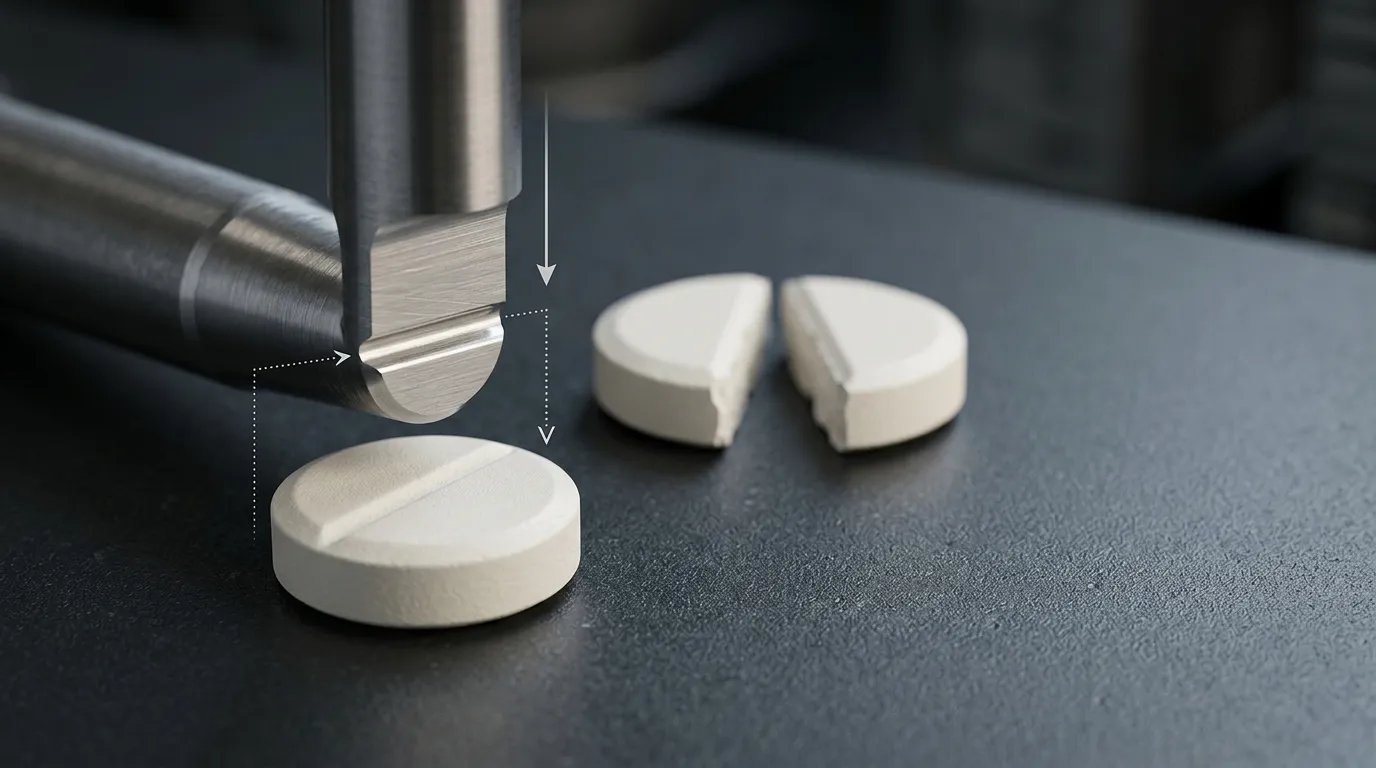
Tablet break line design is not a matter of making the deepest possible groove. A functional break line, also called a tablet score line, must guide the tablet along an intended fracture path while leaving enough strength for compression, Ejeção, Revestimento, Embalagem, and handling.
The geometry must also be practical for the punch tip that forms it. A sharper or more protruding feature may help initiate a break, but it can increase local stress, reduce clearance between upper and lower punches, or make the tooling more vulnerable to chipping.
A geometria da linha de quebra é uma decisão especializada dentro do amplo alcance de Tipos de ferramentas para press de tablets. The final design should be evaluated as a system involving the tablet shape, Espessura, Formulação, hardness range, punch configuration, Configuração da prensa, and product-validation method.
What Makes a Tablet Break Line Functional?
A functional score line is intended to help a tablet divide into defined portions. Its performance cannot be judged only by how visible, straight, or symmetrical the groove appears.
A useful break line should support several outcomes:
- The tablet can be held and divided using the intended method.
- Fracture occurs close to the planned path.
- The resulting portions are reasonably consistent.
- Material loss from crumbs and fragments remains controlled.
- The intact tablet remains strong enough for production and handling.
- Subdivision does not create unacceptable changes in product performance.
O Orientação da FDA sobre pontuação de comprimidos treats scoring as a product-performance issue rather than a cosmetic feature. Depending on the product and market, evaluation may include splitting behavior, mass loss, Friabilidade, Dissolução, Estabilidade, and performance across the proposed tablet-hardness range.
Pontuação funcional versus sulco decorativo
A tablet may contain a visible groove without being suitable for accurate subdivision. A decorative line may improve appearance or product recognition, but it should not be represented as a functional score unless the finished tablet has been tested for that purpose.
Visual inspection can confirm that the groove exists. It cannot prove that:
- The fragments have consistent mass.
- The active ingredient is evenly distributed.
- The tablet will divide similarly across the production hardness range.
- The split portions retain acceptable release characteristics.
- Patients or operators can reproduce the result using the intended method.
Tooling inspection and tablet-performance validation are therefore separate requirements.
Variáveis de Geometria de Linha de Quebra e Seus Trade-Offs
A score feature is defined by several connected dimensions. Changing one variable can affect the others, so break-line depth should never be specified in isolation.
| Variável de projeto | Efeito pretendido | Risco se levado longe demais | O que deve ser verificado |
|---|---|---|---|
| Profundidade ou penetração | Reduz a seção do comprimido que precisa se fraturar | Weak intact tablet, fragile center, tall punch feature | Tablet strength, split force, punch clearance |
| Largura do sulco | Cria espaço para a partitura e afeta seu perfil | Remoção excessiva de material ou má definição visual | Comportamento de fratura e fabricabilidade |
| Ângulo incluído | Concentra o caminho da fratura | Geometria de punção afiada e maior tensão local | Força do soco e consistência da subdivisão |
| Raio da raiz | Controla a nitidez na parte inferior da partitura | Too small may weaken the tooling; too large may reduce fracture guidance | Estresse da ferramenta e fragilidade do tablet |
| Duração da pontuação | Estende o caminho de fratura guiada | Lascamento das bordas ou interferência com outras características | Caminho de trinca e layout de face de tablete |
| Posição e orientação | Define geometria de segmentos pretendidos | Seções desiguais ou desalinhamento | Symmetry, Chaveamento, and drawing orientation |
The correct combination depends on the tablet rather than on a universal score-line standard.
Depth, Width, and Remaining Tablet Section
A deeper groove leaves less tablet material beneath the score. This can reduce the force needed to start a fracture, but it can also weaken the tablet before the user intends to split it.
Depth must be considered relative to:
- Overall tablet thickness.
- Cup depth and face curvature.
- The location of the score across the curved surface.
- Tablet hardness.
- Whether the opposite face also contains a score.
- The height and shape of the punch-tip feature.
Por exemplo, the same nominal score depth may leave a substantial residual section in a thick, shallow-profile tablet but a much thinner section in a smaller tablet with a deep cup.
Groove width also affects the feature profile. It should provide a manufacturable transition without removing more material than necessary or creating a punch feature that is too thin to withstand repeated loading.
Ângulo e raio raio
The included angle and root radius influence how strongly the score concentrates stress when the tablet is bent.
A sharp groove can encourage fracture to start at the intended line. The corresponding punch-tip feature, contudo, may contain a thin or sharp transition where mechanical stress becomes concentrated during each compression cycle.
A larger root radius generally creates a smoother tooling transition, but it may provide less concentrated fracture guidance in the tablet. This is why angle and radius should be reviewed together rather than treated as independent cosmetic dimensions.
Fontes técnicas de design de tablets, como a I Holland papel de desenho em tábua discuss score penetration, Raio, Ângulo, punch stress, and the need to balance tablet breakability with robust tooling. These relationships are useful design principles, but they do not establish a universal dimension for every formulation.
Duração, Posição, and Interaction With Face Features
The score should follow the intended segment boundary and remain compatible with the tablet’s shape and face profile.
Its endpoints require particular attention. A line that extends too close to a tablet edge may create a vulnerable edge condition, while a line that stops too early may not guide the complete fracture path.
Other face features also affect placement:
- Logos and characters can interrupt a symmetrical fracture path.
- Deep embossing can compete with the score for available face area.
- Curved surfaces can change the effective score penetration along its length.
- Off-center placement can create unequal tablet sections.
- Multiple intersecting scores increase both tablet and punch-tip complexity.
The score, identification marks, and overall cup profile should be reviewed as one punch-face layout.
Por que as propriedades dos tablets mudam o resultado
Identical punch geometry can produce different subdivision behavior in different formulations.
Tablet size and shape influence how the product can be held and where bending forces are applied. A large oblong tablet may provide more leverage than a small round tablet, even when the score geometry appears similar.
Thickness and cup profile determine how much material remains under the groove. Formulation properties then control how that material responds to stress.
Relevant formulation behavior includes:
- Fragilidade.
- Recuperação elástica.
- Deformação plástica.
- Compactability.
- Internal bonding strength.
- Distribution of the active ingredient.
Compression force also changes the result because it influences tablet density and hardness. A score that performs well at one development condition may become difficult to break at a higher hardness or excessively fragile at a lower one.
A revisão revisada por pares Tablet Scoring: Current Practice, Fundamentals, and Knowledge Gaps describes tablet subdivision as a multivariable problem involving patient use, Geometria de tablets, Formulação, manufacturing conditions, and the selected test method.
The design should therefore be evaluated across the intended production range, not only on a single batch produced under ideal development conditions.
Single-Sided or Double-Sided Scoring?
A tablet can be scored on one face or on both opposing faces. Neither configuration is automatically better.
| Fator de seleção | Pontuação de um só lado | Placar duplo e face |
| Configuração do perfurador | Recurso de pontuação no one punch face | Recursos coordenados nos socos superiores e inferiores |
| Alinhamento rotacional | Geralmente menos exigente | As características opostas devem permanecer alinhadas |
| Seção restante de tablets | Controlado de um lado | Reduzido de ambos os lados |
| Risco de desobstrução | Abaixo para o rosto adversário sem pontuação | Protuberâncias opostas podem reduzir a folga entre a ponta do punção |
| Complexidade de layout de faces | Deixa a face oposta disponível | Usa espaço em ambas as faces |
| Sensibilidade de configuração | Geralmente mais simples | Mais dependente da chave e dos comprimentos nominais |
| Necessidade de verificação | Produto específico | Produto- and setup-specific |
A double-sided score may guide fracture from both surfaces, but it introduces additional mechanical and setup requirements. The two features must be positioned correctly relative to each other, and their combined penetration must not leave an excessively weak central section.
The choice should be based on the tablet geometry, Formulação, intended segment pattern, available face area, Sistema de ferramentas, and validation results.
Alinhamento e Chave para Pontuações Opostas
Opposed score features must remain rotationally aligned during production. If one punch turns relative to the other, the score lines may no longer meet across the intended fracture plane.
Anti-turn keys and key guides can control punch orientation. Depending on the tooling arrangement, the lower punch may also require a keyed configuration.
The review should confirm:
- Which punch faces contain the score.
- The required angular orientation.
- The location of each key.
- Whether the press supports the intended keyed arrangement.
- How orientation will be checked during setup.
- Whether key or guide wear could allow movement over time.
This discussion is limited to score alignment. General upper- and lower-punch functions belong to the broader tooling system rather than this specific break-line decision.
Proteção da ponta do punção contra contato e falhas prematuras
The score feature machined into a punch face may be narrow, sharp, or raised relative to the surrounding cup. These conditions can increase local mechanical stress.
Repeated compression subjects the punch to cyclic loading. A geometry with a thin section or abrupt transition may become more vulnerable to fatigue, while an overload, contact event, unsuitable material condition, or handling impact can contribute to chipping or brittle fracture.
A Discussão sobre falhas em ferramentas sobre Tecnologia Farmacêutica identifies fatigue, brittle fracture, Design do perfurador, Condição do material, and compaction load as relevant contributors to punch-tip damage.
The main tooling risks associated with a break line include:
| Risco | Causa possível | Consequência possível | Ação de revisão |
| Concentração local de tensão | Sharp angle, small radius, thin feature | Característica de trinca por fadiga ou lascamento | Transições e carregamento de revisão |
| Contato com características opostas | Folga insuficiente para superiores/inferiores | Lascamento ou fratura imediata | Verifique os comprimentos nominais e a folga da ponta |
| Desalinhamento rotacional | Problema de chaveamento ou configuração | Uneven score, Interferência, poor fracture path | Verifique os controles de orientação |
| Excesso de protrusão de características | Geometria de pontuação profunda | Interferência de ejeção ou redução de espaço | Avalie, altura do recurso e remoção do tablet |
| Sobrecarga | Alta força de compressão ou condição anormal de pressão | Deformação plástica ou falha frágil | Confirmar alcance operacional |
| Projeto de tábuas marginais | Penetração excessiva ou seção central fraca | Fratura prematura do comprimido | Testes em condições de produção |
Tool material and heat treatment affect durability, but they cannot compensate for direct punch contact, an unsafe stress concentration, or an incorrect press setup.
SunshinePro's Página de ferramentas para press de tablets lists high-speed steel, Usinagem CNC, Tratamento térmico, Inspeção dimensional, and custom tooling from drawings or samples. These are relevant supplier capabilities, but they should not be interpreted as a guarantee of score performance or tool life for a specific product.
Folga de Punção de Cima para Inferior
Double-sided or highly protruding score features require careful clearance review.
The available gap depends on more than the visible tablet thickness. It can also be affected by:
- Feature height above each punch face.
- Upper and lower punch nominal lengths.
- Compression position.
- Press adjustment.
- Desgaste da ferramenta.
- Setup error.
- Deflection under load.
A practical review sequence is:
- Dimension the score features on both punch drawings.
- Confirm the nominal lengths of the upper and lower punches.
- Calculate the minimum expected separation at the operating position.
- Include a suitable safety margin for manufacturing and setup variation.
- Verify the arrangement during installation and trial compression.
- Inspect the punch tips after the trial for evidence of contact.
Press-specific values should come from the press manufacturer, approved tooling drawings, and project calculations rather than from a generic article.
Problemas de produção e manuseio relacionados à partitura
A scored tablet can survive compression but fail during a later production stage.
Durante a ejeção, the lower punch raises the tablet through the die. A weak score area may chip as the tablet moves, while a protruding punch feature may complicate release from the punch face.
Take-off introduces another contact event. If the tablet has already been weakened excessively, lateral movement can cause edge damage or premature fracture.
Coating and packaging can also expose a marginal design:
- Coating may bridge across the groove.
- Coating film may crack when the tablet is divided.
- Tablets may rub against each other during coating and handling.
- Packaging equipment may apply local loads.
- Transport vibration may break tablets that lack sufficient intact strength.
These problems do not prove that the score is always the root cause. The formulation, ejection force, tooling condition, Processo de revestimento, packaging design, and handling system may also contribute.
The purpose of the break-line review is to determine whether the score has created an avoidable weak section or tooling feature before wider process changes are made.
Diagnostice a falha antes de trocar a linha de freio
A score redesign should follow evidence, not assumptions.
| Problema observado | Possíveis causas | Evidências a serem coletadas |
| Tábua é difícil de dividir | Shallow score, high hardness, unsuitable formulation, poor grip, unsuitable test method | Hardness data, breaking method, segment results |
| Tablet se afasta da pontuação | Misplaced line, formulation fracture pattern, asymmetric geometry | Fracture location, cross-section, tablet dimensions |
| Fragmentos desiguais | Off-center score, rotational misalignment, inconsistent splitting method | Tool orientation, segment mass, user method |
| Chips de tablet durante a ejeção | Weak edge, excessive penetration, high ejection force, tooling condition | Ejection data, chip location, punch and die inspection |
| Tablet se separa em uma tampa | Aprisionamento de ar, formulation or compression issue, tooling configuration | Defect plane, press parameters, formulation review |
| Chips de destaque de pontuação de impacto | Direct contact, Concentração de tensão, sobrecarga, Danos no manuseio | Tip-gap check, fracture surface, setup records |
Capping should not be treated as another name for a score-related break. A score is intended to guide fracture through a defined plane, while capping usually involves separation of the top or bottom portion of the tablet from the main body.
Where the defect pattern indicates cap separation rather than failure along the intended score, the reader should move to the dedicated Soluções de ferramentas para recapacitação de tablets guidance instead of expanding the break-line article into a full capping investigation.
Como Validar um Design de Linha de Quebra Funcional
A functional break line requires verification at several levels. Dimensional inspection alone is not enough.
1. Inspect the Tooling
Confirm that the manufactured punches match the approved drawings.
Relevant checks may include:
- Score depth.
- Width.
- Ângulo incluído.
- Raio da raiz.
- Length and endpoint position.
- Orientação.
- Posição chave.
- Upper and lower punch nominal lengths.
- Condição da superfície.
- Opposed-feature clearance.
A SunshinePro descreve inspeção dimensional e relatórios de inspeção dentro de seus Práticas de controle de qualidade. These checks can verify whether the tool conforms to the specification, but they do not establish how a pharmaceutical formulation will behave.
2. Conduct Representative Press Trials
Trials should use the intended formulation and a relevant operating window.
The trial plan should consider:
- Low and high tablet-hardness conditions.
- Expected compression-force range.
- Production speed where it affects performance.
- Ejection and take-off behavior.
- Tool orientation.
- Evidence of upper/lower punch contact.
- Tablet chipping or premature fracture.
- Repeated-cycle effects on the punch feature.
A single successful compression event does not prove that the design is robust for production.
3. Evaluate the Whole Tablet
Before subdivision, confirm that the scored tablet remains suitable for handling.
Evaluation may include:
- Visual integrity.
- Breaking force or hardness.
- Friability.
- Resistance to coating and packaging damage.
- Stability during normal storage and transport.
- Consistency across batches and operating conditions.
The score should not make the intact tablet so weak that it breaks before the intended use.
4. Evaluate the Split Portions
Subdivision testing should represent the intended method, such as hand splitting or a defined mechanical device.
Depending on the product and regulatory strategy, Análise:
- Ease of splitting.
- Fracture location.
- Segment mass variation.
- Material loss.
- Content uniformity.
- Friability of the resulting portions.
- Dissolution or release behavior.
- Stability of split portions where required.
Equal mass does not automatically prove equal active content. If the formulation contains an uneven distribution of active ingredient, two fragments with similar weight may still differ in drug content.
The FDA guidance is relevant to products intended for the United States. Worldwide projects must confirm requirements in each applicable market, particularly for modified-release products or dosage forms where subdivision may alter release behavior.
A inspeção de ferramentas não é validação de produto
The responsibility boundary should remain clear:
| Atividade | O que isso confirma | O que isso não confirma |
| Aprovação do sorteio | Dimensões e configuração pretendidas | Desempenho final do tablet |
| Inspeção de ferramentas | Conformidade com o desenho | Subdivisão confiável |
| Julgamento à imprensa | Compressão e comportamento de manuseio sob condições de teste | Consistência comercial total |
| Testes farmacêuticos | Desempenho do produto e segmento | Vida útil prolongada da ferramenta sob todas as condições de prensa |
A tooling supplier can manufacture and inspect a punch feature. The pharmaceutical manufacturer or product owner must validate the final tablet.
Informações para Preparar Antes de Fazer Pedido Ferramentas de Tablet Pontuadas
A complete enquiry reduces the risk of designing the score without enough product or press information.
Dados de Tablet
Fornecer:
- Formato de tábua.
- Diameter or major and minor dimensions.
- Overall thickness.
- Perfil da taça.
- Target number of portions.
- Required segment symmetry.
- Coating status.
- Logos, characters, or other face features.
- Intended hand or mechanical splitting method.
Dados da Linha de Quebra
Define, where already established:
- Single- or double-sided configuration.
- Depth.
- Width.
- Ângulo incluído.
- Raio da raiz.
- Duração.
- Endpoint position.
- Orientação.
- Relationship to logos or embossing.
Where the dimensions remain under development, identify them as proposed rather than validated.
Formulação e Dados de Processo
Include relevant information such as:
- Development status of the formulation.
- Intended hardness range.
- Expected compression-force range.
- Known brittleness or elastic-recovery concerns.
- Ejection or take-off issues from prior trials.
- Revestimento, Embalagem, and handling requirements.
A tooling supplier does not need the full confidential formulation to understand that the tablet’s fracture behavior and hardness range affect the score design. The level of disclosure can be agreed within the project.
Dados de Prensa e Ferramentas
Confirme:
- Press model.
- Tooling standard.
- Punch type.
- Upper and lower punch nominal lengths.
- Keying requirements.
- Key orientation.
- Available lower-punch keying.
- Existing tooling drawings or samples.
- Inspection-document requirements.
A SunshinePro afirma que oferece produtos personalizados Ferramentas para prensa de tablets from drawings or samples and lists size customization, material-selection support, Usinagem CNC, Tratamento térmico, and dimensional inspection. Final material, Geometria, Escopo de inspeção, and project suitability should still be confirmed for the specific enquiry.
Princípios finais de revisão de projeto
Before approving a scored-tablet tooling drawing, confirm five points:
- The score geometry has been reviewed relative to the tablet thickness, Perfil da copa, Formulação, and hardness range.
- The selected single- or double-sided configuration matches the intended fracture path.
- Opposed features have adequate alignment and upper/lower punch clearance.
- Compressão, Ejeção, take-off, Revestimento, Embalagem, and handling risks have been considered.
- The validation plan separates tooling conformance from whole- and split-tablet performance.
There is no universal break-line geometry that guarantees accurate splitting and long tool life. The most reliable approach is to combine a complete tablet specification, a controlled punch-face design, suitable press setup, and product-specific validation.
For a custom tooling enquiry, prepare the tablet drawing, score dimensions, Detalhes da imprensa, keying requirements, and requested inspection records before entrando em contato com a SunshinePro.
Compartilhe:


Escrito por Sunshine
Em Sol, Somos um fabricante e fornecedor profissional de componentes de moldes de precisão, oferecendo uma ampla variedade de produtos para aplicações de estampagem e molde por injeção. Nosso foco principal inclui a formação de matrizes, pinos e mangas ejetor, e postes guia e buchas. Com usinagem CNC avançada, Controle rigoroso de qualidade, e fortes capacidades de produção, Garantimos confiabilidade, Peças de alta precisão, juntamente com componentes padrão em estoque para fornecimento global rápido e eficiente.
NOTÍCIAS
RECEBA O SERVIÇO
Com peças de qualidade para todos os orçamentos e equipe amigável treinada para tornar sua visita informativa e sem complicações.
