



Desalinhamento do pino de posicionamento do molde: Sintomas e Solução de Problemas
Mold positioning pin misalignment can cause binding during closure, Contato Desigual, parting-line mismatch, Flash, abnormal wear, or inconsistent part dimensions. The pin itself may be damaged, mas é apenas uma causa possível. A worn bushing, loose mounting bore, contaminated parting surface, damaged interlock, Crescimento térmico, poor mold installation, or machine-platen condition can create similar symptoms.
The correct approach is to identify when the problem occurs, inspect the entire mating system, measure the suspected geometry, and repair only the verified cause. For broader information about component fit, Desgaste, Materiais, e lubrificação, see SunshinePro’s guide to mold pins and bushings (inferido).
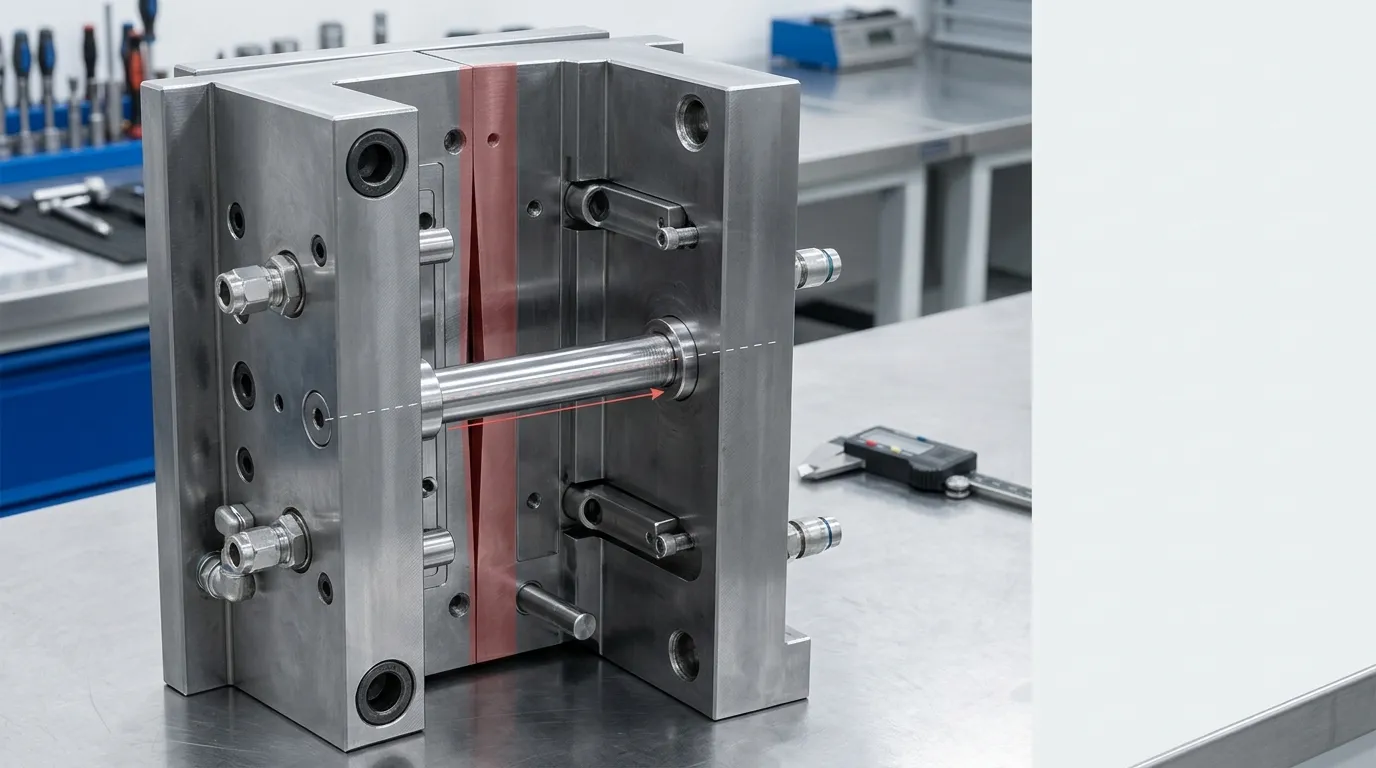
Primeiro confirme o que o "pino de posicionamento" faz nesse molde
“Positioning pin” is not used consistently across every mold design. Before troubleshooting, identify the component by function rather than relying only on its name.
| Componente | Papel principal | Implicação diagnóstica |
|---|---|---|
| Localização ou pino de cavilha | Estabelece posição repetível entre componentes ou placas | Check its geometry, Ajuste de montagem, Orientação, and mating hole or bushing |
| Pino guia, leader pin, ou pilar guia | Guia as metades do molde durante o engajamento | Verifique a retidão, Desgaste, bushing clearance, and side-loading marks |
| Bucha guia ou de localização | Recebe o pino e controla a interface de acasalamento | Check bore wear, ovality, Posição, Retenção, and entry damage |
| Trava lateral ou trava de afunilamento | Ajuda a estabelecer ou manter o registro final de mofo | Check contact pattern, Desgaste, Danos, e engajamento |
| Superfície de desligamento ou de acoplamento de precisão | Contribui para o alinhamento final e a vedação | Check for impact marks, Desajuste, local gaps, and edge damage |
A guide pin may control the initial closure path while another locating feature controls final core-to-cavity registration. Replacing the guide pin will not solve the problem if the final interlock, Buchas, mounting bore, or mold plate is out of position.
Guia separado da SunshinePro para mold guide pins covers broader guide-pin function, Desgaste, e seleção. Aqui, the focus is determining why an installed mold is no longer aligning correctly.
Sintomas que indicam um problema de registro de mofo
The timing and location of a symptom often provide more useful evidence than the symptom alone.
| Sintoma | Quando aparece | Subsistema possível | Primeira verificação de confirmação |
| Encadernação no mesmo ponto durante o fechamento | Fechamento a frio ou sem carga | Pino dobrado, skewed bushing, damaged interlock, Burr, or plate-position error | Pare no primeiro ponto de contato e inspecione para marcas de testemunha unilateral |
| Scraping, Vibração, or impact noise | Durante o engajamento de pinos ou travamentos | Carregamento lateral, insufficient clearance, Contaminação, or damaged entry geometry | Inspect the pin, bushing mouth, Intertravamentos, and nearby surfaces |
| Calor anormal próximo ao sistema de guias | Após ciclismo repetido | Atrito, Lubrificação ruim, tight fit, Carregamento lateral, or galling | Verifique a pontuação, Descoloração, condição do lubrificante, and uneven contact |
| Mofo não fecha de forma clara | Montagem ou fechamento controlado | Mounting error, obstruction, Distorção de placa, machine-side alignment, or damaged positioning components | Inspect mounting, Características de localização, parting surfaces, and plate relationships |
| Passo ou desajuste da linha de separação | Durante a produção | Registration loss, Movimento das placas, interlock wear, or machine-side loading | Compare a localização do descompasso com padrões de contato e desgaste |
| Flash localizado | Sob pressão de injeção | Misregistration, damaged shutoff, insufficient clamping, Contaminação, or process conditions | Verifique se o mofo está alinhado sem pressão e inspecione o corte afetado |
| Variação dimensional entre ciclos | Após aquecimento ou sob carga | Changing clearance, Crescimento térmico, Movimento das placas, or worn positioning features | Compare cold, warm, and production-condition measurements |
| Polimento de pinos ou buchas de um lado | Progressivo ao longo do tempo | Mispositioned bore, bent pin, plate error, or uneven machine loading | Meça o escorrimento do pino e inspecione a posição e perpendicularidade do furo |
DME’s technical guidance on mold interlocks identifies flash, dimensional problems, and component damage as possible consequences of improper mold alignment. It also notes that worn leader pins and bushings, thermal variation, mold weight, and equipment condition can affect registration. See DME’s Orientação técnica para alinhamento de moldes.
Flash alone does not prove positioning pin failure. Flash can also result from damaged shutoffs, trapped material, insufficient clamping, Pressão excessiva, or other tooling and process conditions. Treat it as evidence that requires further inspection.
Sintomas durante o fechamento do mofo
Closure-related symptoms usually point toward the engagement path.
Procure por:
- Resistance that begins at the same position during each closing attempt.
- A pin entering the bushing off-center.
- Fresh contact marks on only one side of the pin.
- Scraping at the bushing entrance.
- Impact marks on interlocks or shutoffs.
- A visible gap on one side of the parting line.
- A pin, Buchas, or retainer moving in its mounting feature.
A repeatable hard-contact point is more likely to involve geometry, obstruction, or mounting position than a process-setting problem.
Sintomas na Parte Moldada ou Superfície de Separação
Production evidence may include:
- A step across the parting line.
- Flash concentrated in one region.
- Uneven witness lines.
- Chipping or peening near a precision shutoff.
- Dimensional changes after the mold reaches operating temperature.
- Parts that shift in one direction under pressure but appear acceptable during an unloaded closure check.
These symptoms help locate the affected region, but measurements are still needed before deciding which component to repair.
Pare de ciclar o mofo quando o dano for provável
Do not continue closing the mold to “see if it clears” when there is evidence of hard interference or displaced components.
Stop and establish a safe inspection condition when you find:
- A visibly bent or loose pin.
- A cracked, chipado, or displaced bushing.
- Metal fragments or severe scoring.
- Fresh impact damage on a core, cavidade, Inserir, shutoff, or interlock.
- Sudden hard resistance during closure.
- A plate or component moving inside its mounting feature.
- An engagement path that cannot be confirmed safely.
Injection molding machines can expose technicians to crushing, stored hydraulic energy, electrical energy, hot surfaces, and moving components. Inspection and servicing should follow the machine manufacturer’s instructions, the facility’s hazardous-energy procedure, and applicable local regulations. Os EUA. Occupational Safety and Health Administration provides general guidance on Perigos em máquinas de moldagem por injeção horizontal e Controle de Energia Perigosa.
Solucionar o Desalinhamento em uma Ordem Fixa
A consistent sequence reduces unnecessary disassembly and prevents one symptom from being mistaken for proof of pin failure.
- Review when the problem started.
Determine whether the change was sudden or progressive. Check whether it began after maintenance, Substituição de componentes, mold transfer, machine setup, a cooling change, or warm-up. - Place the machine and mold in an approved safe inspection condition.
Isolate hazardous energy before entering the mold area or touching components that could move. - Clean exposed interfaces.
Remove trapped plastic, chips, Rávidas, contaminated lubricant, and other debris from the parting line, pin entries, Buchas, and interlocks. - Inspect the pin, Buchas, Montagem, e retenção.
Look for looseness, Pontuação, impact marks, Polimento desigual, Deslocamento, or damaged fasteners. - Observe the engagement pattern.
Under an approved controlled procedure, identify which component contacts first and whether the contact is centered or one-sided. - Measure the suspected geometry.
Check pin and bushing dimensions, Runout, condição do cano de montagem, component position, and plate relationships. - Separate mold-side causes from machine-side and thermal causes.
Compare cold and warm behavior, unloaded and production-loaded behavior, and results across machines when practical. - Correct the verified cause.
Limpo, adjust, Reparo, or replace only after the inspection evidence supports that action. - Validate the repair.
Confirm smooth engagement, stable registration, correct parting-line contact, and acceptable molded-part results.
Registre Quando o Problema Começou
The failure history can quickly narrow the investigation.
A sudden problem after maintenance may indicate:
- A reversed or incorrect replacement component.
- A bushing or pin installed at the wrong depth.
- A burr created during assembly.
- A loose retainer or fastener.
- A plate assembled out of position.
Progressive deterioration more often suggests:
- Increasing pin or bushing wear.
- Lubrication breakdown.
- Mounting-bore damage.
- Plate movement.
- Repeated side loading.
- Thermal or machine conditions that gradually accelerate wear.
A problem that appears only after moving the mold to another machine should trigger checks of mold installation, locating-ring engagement, platen condition, and clamping alignment before replacing mold components.
Comece com limpeza e inspeção não destrutiva
Begin with checks that do not alter the mold:
- Clean pin surfaces and bushing entrances.
- Remove plastic residue from the parting line.
- Inspect for burrs around bores and interlocks.
- Check retainers and fasteners for movement.
- Mark and photograph contact patterns.
- Compare the left and right sides of the mold.
- Check whether the pin enters the bushing concentrically.
Cleaning may restore movement when debris is the only obstruction. It does not prove that the pin, Buchas, or plate geometry remains within specification.
Inspecionar o Pino, Buchas, and Mounting Features as One System
A positioning pin does not work independently. Its performance depends on the mating bushing or hole, the mounting bore, the mold plate, and any final-positioning features.
Pistas de Falha no Lado do Pino
Evidence that directly implicates the pin includes:
- Measurable bending or runout.
- One-sided scoring along the engagement length.
- Impact damage at the leading end.
- Mushrooming or chipped edges.
- A loose shank or failed retaining feature.
- Incorrect installed height.
- Geometry that does not match the drawing.
- Contact concentrated in one region rather than distributed as intended.
One-sided polishing can indicate a bent pin, but it can also result from a mispositioned bushing or mounting bore. Confirm the pin’s straightness before assigning the cause.
Buchas- and Bore-Side Failure Clues
Inspect the mating side for:
- Uneven or oval bore wear.
- A loose bushing.
- Damage at the entry chamfer.
- Scoring concentrated on one side.
- A bushing installed out of position.
- Cracks or deformation around the mounting feature.
- A damaged press-fit bore.
- Burrs that prevent the bushing from seating correctly.
Replacing a worn pin while leaving an oval or loose bushing in place may restore movement temporarily without restoring repeatable registration. The mating pair and both mounting features should be evaluated together.
Meça a geometria antes de escolher um reparo
Visual inspection identifies where to investigate, but dimensional evidence should determine whether a component is acceptable.
Measure as applicable:
| Característica | Por que isso importa | Base de aceitação |
| Diâmetro do pino em várias posições | Reveals taper, localized wear, or material loss | Desenho aprovado de molde ou especificação de componentes |
| Furo do bucha em várias orientações | Identifica folga excessiva ou desgaste oval | Desenho, supplier specification, or applicable standard |
| Retidão dos pinos ou runout | Detecta flexão que causa contato lateral progressivo | Desenho ou procedimento de inspeção aprovado |
| Posição do pino e da bucha | Determina se seus eixos se alinham | Desenho de molde e estrutura de datum |
| Perpendicularidade à placa | Identifica instalação inclinada ou erro de furo | Desenho ou especificação de engenharia |
| Condição do diâmetro de montagem | Determina se o componente é suportado e mantido corretamente | Desenho e critérios de reparo aprovados |
| Relação de placas | Detects shift, Distorção, or movement between assemblies | Desenho de montagem e plano de inspeção de molde |
Do not apply one universal pin-to-bushing clearance or wear limit to every mold. The correct value depends on the component design, Tamanho, Função, supplier series, Temperatura de funcionamento, and required positioning accuracy.
For standardized components within their stated scope, ISO 8017 covers dimensions and tolerances for specified guide pillars and locating guide pillars. ISO 8018 covers specified headed guide and locating guide bushes. These standards do not replace the approved mold drawing, and they should not be applied to components outside their scope.
Record the measurement reference, Instrumento, Configuração, Revisão do desenho, and actual results. A list of numbers without the measurement method may not be sufficient for repair or replacement decisions.
Causas separadas do lado do molde, dos efeitos da máquina e da temperatura
The same mold symptom can originate outside the pin-and-bushing pair.
Ask:
- Did the problem begin after installing the mold on a different machine?
- Does the mold align when cold but bind after warm-up?
- Does it close smoothly without pressure but shift during production?
- Is one mold half operating at a different temperature?
- Are the locating ring and mounting surfaces seated correctly?
- Are the platens, Grampos, or tie system applying uneven load?
- Do interlocks show contact only after pressure is applied?
- Does the problem disappear when the mold is checked outside the original machine?
Desalinhamento entre Frio e Quente
A mold may close correctly at room temperature and begin binding after thermal stabilization. Unequal heating changes the dimensions of plates, bores, Pins, Buchas, and interlocks. The pin may appear to be the problem even though the underlying cause is differential thermal growth.
Compare:
- Cold engagement.
- Engagement during warm-up.
- Stable operating-temperature engagement.
- Temperatures on both mold halves.
- Cooling conditions near the affected region.
- Contact marks before and after warm-up.
Do not assume the pin changes independently of the surrounding plate. The entire alignment chain expands and moves together.
Desalinhamento sem carga versus sob pressão
Smooth unloaded closure does not guarantee stable registration during production.
If misalignment appears only under injection or clamping load, inspecionar:
- Side interlocks and taper locks.
- Plate support and fasteners.
- Shutoff contact.
- Mold mounting.
- Platen condition.
- Locating-ring engagement.
- Load-sensitive movement between plates.
Changing pressure, Velocidade, or clamping settings may reduce the visible defect, but it does not correct a mechanical positioning error.
Relacione a ação corretiva com a causa verificada
| Causa verificada | Ação apropriada | Verificação adicional |
| Trapped plastic, chips, or removable debris | Limpe as superfícies afetadas | Confirme que não há rebarba ou dano permanente |
| Lubrificante aprovado contaminado ou faltando | Limpe e restaure a condição de lubrificação especificada | Inspect for existing scoring, Desgaste, or galling |
| Bent, worn, or impact-damaged pin | Substitua por um componente que corresponda ao desenho aprovado | Inspecione a bucha e o diâmetro de montagem |
| Bucha gasta ou oval | Substitua ou repare conforme o design do molde | Confirme a condição do pino e a folga real de acasalamento |
| Pino ou bucha solta | Corrija a retenção ou a fixação por meio de um reparo aprovado | Verifique se o diâmetro ou a placa estão danificados |
| Furo de montagem danificado | Repare o diâmetro ou a placa afetada antes de instalar um novo componente | Restabelecer posição e perpendicularidade |
| Intertravamento ou desligamento desgastado | Repare ou substitua o recurso de posicionamento final afetado | Confirme que os componentes do guia não foram instalados lateralmente |
| Erro de instalação ou anel de localização | Montagem e centralização corretas do molde | Reverifique o fechamento e o contato da linha de separação |
| Carregamento lateral da máquina ou problema com placa | Siga o processo de inspeção e reparo do fabricante de máquinas | Confirme que o mofo não sofreu danos secundários |
| Distorção térmica | Corrija o desequilíbrio verificado de temperatura ou resfriamento | Validar o alinhamento em temperatura de operação estável |
Lubrication can reduce friction. It cannot straighten a bent pin, correct a misplaced bore, restore an oval bushing, or realign a distorted plate.
Do not install a new pin into a damaged bore simply because the replacement fits initially. If the mounting feature cannot hold the component at the required position and angle, the new part may fail quickly or reproduce the same alignment error.
Valide o alinhamento antes de devolver o molde à produção
After correction, validate the complete system rather than checking only whether the mold can close once.
Use the machine manufacturer’s approved procedure to confirm:
- Smooth and repeatable engagement.
- No abnormal impact, scraping, Vibração, or resistance.
- No new scoring or concentrated witness marks.
- Correct parting-line and shutoff contact.
- Stable pin and bushing temperatures.
- No movement at retainers or mounting features.
- Consistent behavior after the mold reaches operating temperature.
- Stable registration under approved production conditions.
- Acceptable molded-part dimensions.
- No abnormal flash or parting-line step.
Recheck critical dimensions when a pin, Buchas, Furo, Placa, or interlock has been repaired. Record what was changed, the measurements taken, and the validation result. One successful closing cycle is not sufficient evidence of long-term correction.
Prepare informações completas de substituição quando um componente estiver fora de especificação
Once inspection confirms that a positioning pin, guide component, or bushing requires replacement, provide the supplier with enough information to reproduce the intended geometry rather than the worn condition.
Prepare-se:
- The approved component drawing and revision.
- The component’s function: Localização, Guiamento, or final positioning.
- Pin and mating-bushing dimensions.
- Mounting and retention details.
- Required fit and tolerances.
- Material, Dureza, Tratamento térmico, and surface requirements stated on the drawing.
- Quantidade.
- The worn sample, when useful and available.
- Photographs or notes showing the failure pattern.
- Confirmation of whether the mating component or mounting bore will also be repaired.
- Documentação de inspeção obrigatória.
A SunshinePro afirma que oferece customização padrão e baseada em desenho Peças padrão para molde, including guide components and dowel pins. The company also lists locating-pin guide bushings and describes inspection processes for custom components.
After the failed component and its mating conditions have been measured, the next practical step is to Envie os requisitos de desenho e substituição para análise. The request should describe the verified failure and required geometry rather than asking a supplier to reproduce an unmeasured worn sample.
Compartilhe:


Escrito por Sunshine
Em Sol, Somos um fabricante e fornecedor profissional de componentes de moldes de precisão, oferecendo uma ampla variedade de produtos para aplicações de estampagem e molde por injeção. Nosso foco principal inclui a formação de matrizes, pinos e mangas ejetor, e postes guia e buchas. Com usinagem CNC avançada, Controle rigoroso de qualidade, e fortes capacidades de produção, Garantimos confiabilidade, Peças de alta precisão, juntamente com componentes padrão em estoque para fornecimento global rápido e eficiente.
NOTÍCIAS
RECEBA O SERVIÇO
Com peças de qualidade para todos os orçamentos e equipe amigável treinada para tornar sua visita informativa e sem complicações.
