



Injection Molding Guidelines: Projeto, Ferramentas, and Production Best Practices
Injection molding guidelines should be reviewed before tooling starts, not after steel is cut. The most important best practices include maintaining uniform wall thickness, adding proper draft angles, designing ribs and bosses carefully, setting realistic tolerances, and running a full DFM review early. Teams that validate manufacturability before tooling approval reduce revision costs, shorten lead times, and improve production consistency.
Injection molding problems usually start long before production begins. A part may look fine in CAD, then fail during sampling because of sink marks, poor ejection, unstable tolerances, or expensive tooling revisions. This guide focuses on the practical rules buyers and engineers should check before approving tooling, especially when schedules, production scale, and supplier coordination all matter.
What are the most important injection molding guidelines before tooling starts?
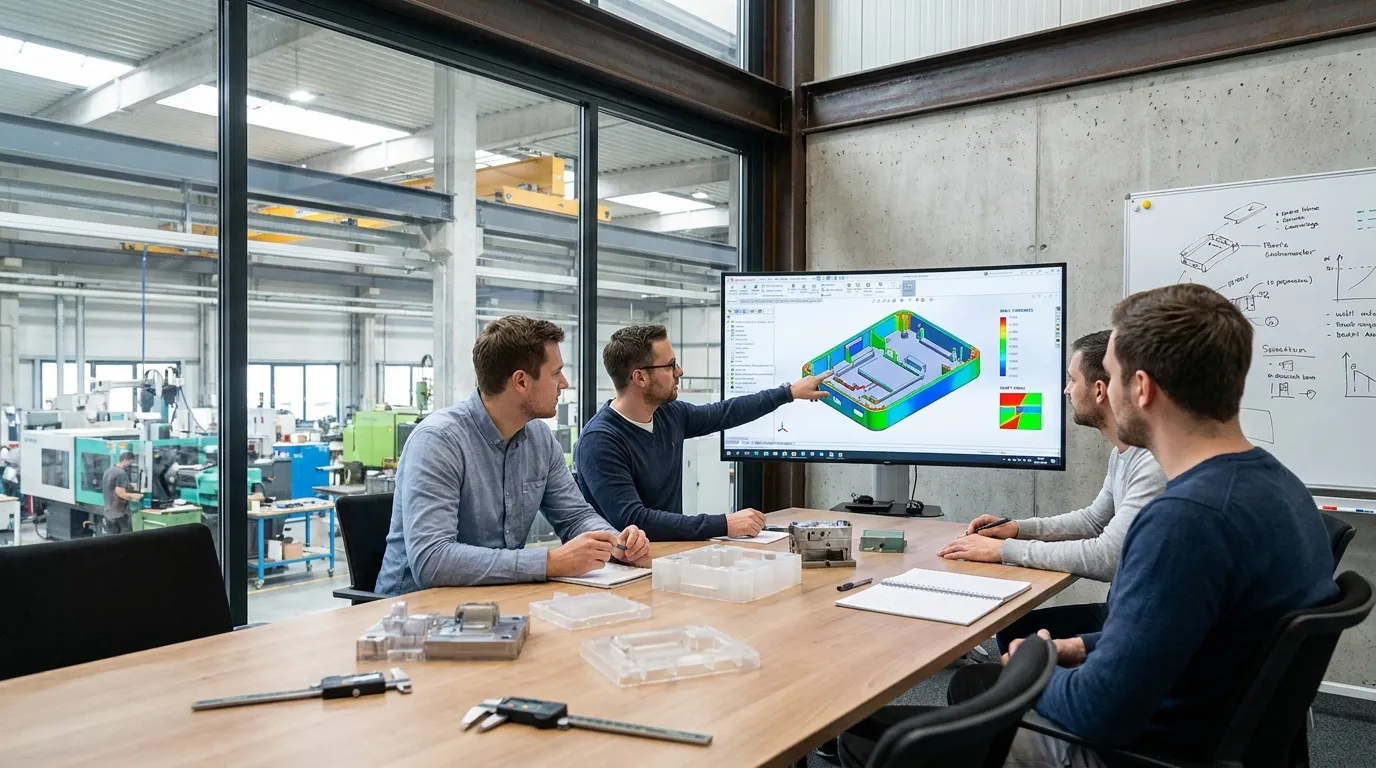
Injection molding guidelines should focus on moldability before steel cutting begins. Espessura uniforme da parede, Ângulos de tiragem adequados, Tolerâncias realistas, and early DFM review reduce tooling revisions, shorten lead times, and improve production consistency.
The most expensive injection molding mistakes usually happen during the design approval stage. Once tool steel is cut, even small geometry changes can delay production and increase cost. That’s why early manufacturability review matters more than rushing into tooling.
Start by reviewing wall thickness consistency, Ângulos de Draft, Retração do material, Posicionamento do portão, and assembly features. A good supplier should also provide a full Processo de revisão do DFM before tooling approval.
The cheapest tooling quote is not always the lowest production cost. Suppliers that skip detailed DFM analysis often create more expensive revisions later, especially when defects appear during T1 sampling.
For teams that need broader background on tooling systems and mold terminology, isso Guia completo de molde de injeção provides a full overview.
Lista de Verificação de Aprovação Pré-Ferramenta
| Área de Revisão | O que confirmar |
|---|---|
| Espessura da parede | Seções consistentes ao longo da peça |
| Ângulos de rascunho | Tiragem suficiente para uma ejeção limpa |
| Seleção de materiais | A resina corresponde às necessidades de resistência e encolhimento |
| Posicionamento dos portões | Enchimento equilibrado e controle estético |
| Tolerâncias | Apenas as dimensões críticas são apertadas |
| Design de nervuras e bosses | Sem recursos de suporte sobredimensionados |
| Análise do DFM | Fornecedores analisaram os riscos de moldabilidade |
| Plano de amostragem | T1 e cronograma de revisão acordados |
How do wall thickness and draft angles affect moldability?
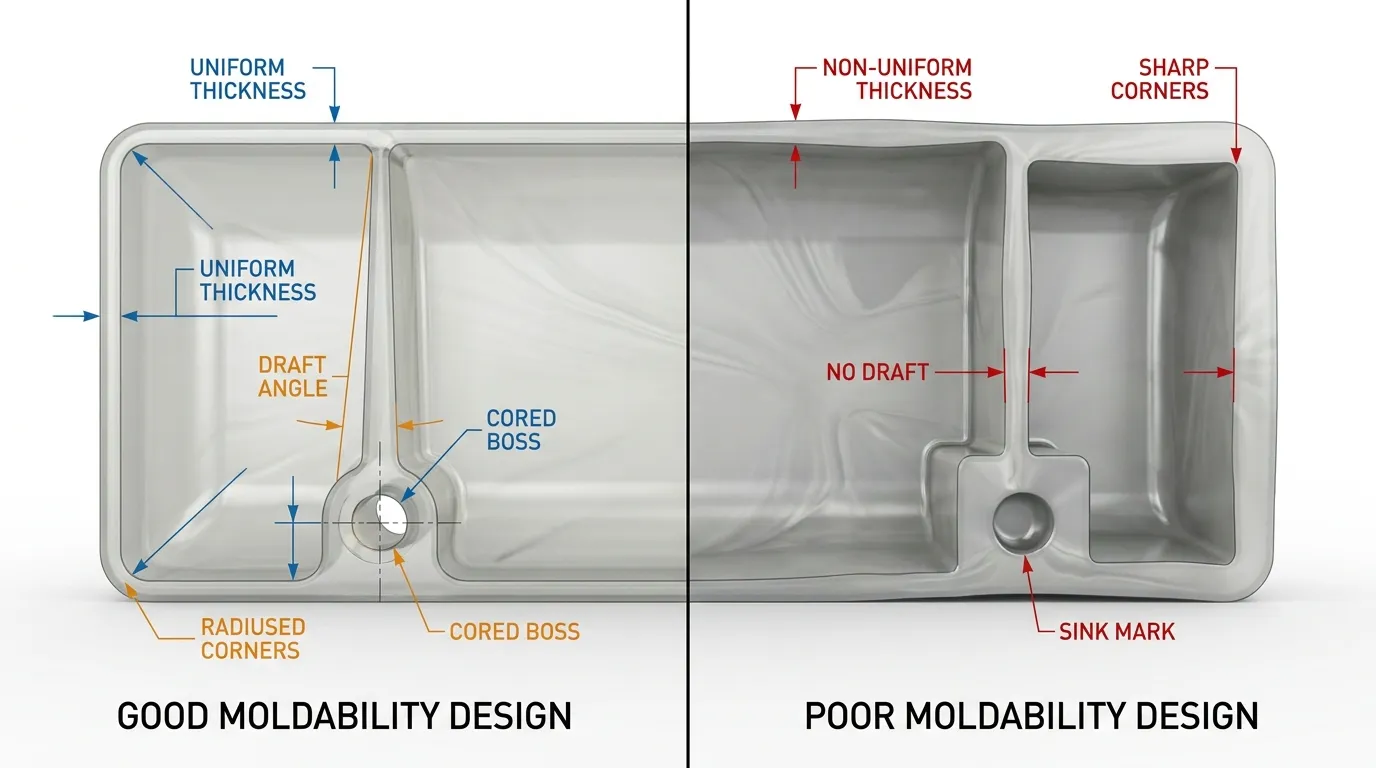
Wall thickness and draft angle directly affect filling, Resfriamento, e ejeção. Consistent wall sections reduce warpage, while sufficient draft angles help parts release cleanly and reduce cosmetic damage during production.
Wall thickness controls how plastic flows and cools inside the mold. Thick sections cool more slowly, which can create sink marks, voids, or uneven shrinkage. Thin sections may fail to fill properly if the material freezes too quickly.
Uma carcaça de eletrônicos de consumo é um exemplo comum. One side may look clean after molding, while another develops visible sink marks because internal ribs created thick cooling zones behind the cosmetic surface.
De acordo com o Guia de moldagem por injeção de cubos e o Guia de design de moldagem por injeção fictícia, maintaining uniform wall thickness helps reduce warpage and improves production stability.
Faixas recomendadas de espessura de parede
| Tipo de peça | Diretriz Geral |
|---|---|
| Pequenas peças de consumo | Thin, uniform walls |
| Alojamentos estruturais | Espessura moderada com suporte de nervuras |
| Grandes painéis cosméticos | Espessura equilibrada para reduzir a empenagem |
| Peças industriais de alta resistência | Reinforcement through geometry, not excessive wall thickness |
Diretrizes de ângulo de rascunho para peças texturizadas e não texturizadas
Draft angles help parts eject cleanly from the mold. Most molded parts need at least 1 to 2 degrees of draft per side. Textured surfaces often require more because the texture increases friction during ejection.
An automotive trim supplier may increase draft angles after testing textured surfaces. Without extra draft, cosmetic drag marks can appear during ejection, especially on deep features or glossy parts.
If you're refining geometry for manufacturability, this guide on Geometria das peças plásticas covers additional design considerations.
What are the best practices for ribs, Chefes, and corners?
Ribs and bosses should strengthen parts without creating thick sections that cool unevenly. Gradual transitions, reinforced bosses, and proper rib thickness help prevent sink marks and stress concentration.
Ribs are often better than thick walls when additional stiffness is needed. Thick plastic sections cool unevenly and create visible defects. Properly sized ribs strengthen the part while maintaining more consistent cooling behavior.
Bosses also need careful support. Unsupported bosses may crack during assembly or distort during molding. A startup hardware company may delay tooling approval after a DFM review identifies unsupported screw bosses near a thin wall section.
Checklist de Design de Nervuras e Bosses
- Mantenha a espessura das nervuras menor que a da parede adjacente
- Adicione filetes nas bases das nervuras para reduzir a concentração de estresse
- Reforçar chefes altos com costelas de suporte
- Evite cantos fechados que interrompam o fluxo de materiais
- Use transições graduais de raio entre as seções da parede
Corners matter more than many teams expect. Sharp internal corners increase stress and interrupt flow. Rounded transitions help material move more evenly through the cavity and reduce cracking risk later.
For more detailed feature planning, this resource on Design de características de molde explains how mold structures interact with part geometry.
How should material selection influence part design?
Material selection affects shrinkage, Tolerâncias, Comportamento de resfriamento, and mold design requirements. Teams should match resin properties to both product performance and manufacturability goals before tooling approval.
Material choice affects much more than strength. Different resins shrink differently during cooling, respond differently to heat, and require different processing conditions. Those variables directly influence tooling design and production consistency.
A material with higher shrinkage may require additional compensation during mold design. Another resin may need tighter process control to maintain cosmetic quality or dimensional stability.
Tabela de Decisão de Seleção de Materiais
| Prioridade de Projeto | Consideração Material |
|---|---|
| Acabamento cosmético | Qualidade da superfície e comportamento do fluxo |
| Resistência ao calor | Estabilidade térmica durante o uso |
| Resistência estrutural | Resistência ao impacto e rigidez |
| Tolerâncias apertadas | Comportamento previsível de retração |
| Uso externo | Resistência UV e ambiental |
Tight tolerances should not be treated as default engineering practice. Many injection molded parts perform well with standard production tolerances and lower tooling complexity. Over-specifying precision often increases cost without improving functional performance.
Este guia sobre Considerações sobre o Processamento de Materiais explains how resin behavior affects production conditions and mold setup.
What tolerance guidelines prevent unnecessary tooling cost?
Tight tolerances increase tooling complexity, Requisitos de inspeção, and process variability. Most injection molded parts should use standard production tolerances unless the application requires critical precision features.
Every tolerance should have a reason behind it. Tight dimensions increase machining precision, Complexidade do molde, Monitoramento de processos, e requisitos de inspeção. They may also reduce production yield during high-volume manufacturing.
Many buyers unknowingly create unnecessary tooling costs by applying precision tolerances across an entire part instead of limiting them to functional areas.
Tabela de Comparação de Tolerâncias
| Estratégia de Tolerância | Impacto na Produção |
|---|---|
| Tolerância padrão de produção | Menor custo de ferramentagem e amostragem mais rápida |
| Tolerância estética rigorosa | Mais polimento e inspeção |
| Tolerância de montagem apertada | Maior precisão nas ferramentas é necessária |
| Tolerância apertada em toda a parte | Aumento da variabilidade da produção |
A connector housing may only need critical tolerances around mating features. The outer housing surfaces often do not require the same precision. Restricting tight tolerances to functional areas helps maintain reasonable tooling cost and production efficiency.
If your team is balancing cost against manufacturability, this article on Planejamento de tolerância de fabricação provides additional DFM guidance.
What should a proper injection molding DFM review include?
A proper DFM review checks whether the part can fill, Fresco, eject, and maintain tolerances consistently during production. It should identify geometry risks before mold steel is cut.
A strong DFM review is one of the best ways to prevent tooling revisions. It helps suppliers identify molding risks before machining begins, when changes are still manageable and affordable.
De acordo com o Protolabs projetam para kit de ferramentas de moldabilidade, DFM analysis should evaluate geometry, Comportamento material, Posicionamento do portão, Eficiência de resfriamento, and ejection performance.
Áreas Principais de Revisão do DFM
- Colocação de comportas e fluxo de materiais
- Consistência de resfriamento em toda a cavidade
- Validação do ângulo de ejeção e de rascunho
- Marca de afundamento e risco de empenamento
- Análise da geometria de nervuras e chefes
- Posicionamento da linha de separação
- Viabilidade da tolerância
A common production delay happens when teams approve tooling before reviewing gate placement carefully. A later gate relocation may require re-machining steel and extending the sampling timeline by several weeks.
Speed-focused tooling schedules can also create unstable production launches if revision planning is compressed too aggressively. Fast timelines work best when designs are already mature and fully reviewed.
Perguntas que os compradores devem fazer durante a aprovação do DFM
- Which areas are highest risk for sink or warpage?
- Are any features difficult to eject?
- Which dimensions are difficult to maintain consistently?
- Will cosmetic surfaces require additional draft?
- What revisions become expensive after steel cutting?
For a deeper review workflow, this guide on Análise de DFM por moldagem por injeção expands on manufacturability evaluation methods.
Which supplier questions prevent production delays?
Buyers should evaluate how suppliers handle DFM feedback, Revisões de amostragem, Manutenção de Mofo, and production ramp-up. These operational details often affect timelines more than quoted tooling cost alone.
A supplier may offer competitive tooling pricing but still struggle during production ramp-up. Questions about workflow, Comunicação, and revision handling often reveal more about long-term reliability than the initial quote.
Ask suppliers how they manage T1 sampling, Correções de ferramentas, preventive maintenance, and process validation. Mold maintenance planning matters because worn tooling can affect consistency over long production runs.
Lista de Verificação de Avaliação de Fornecedores
| Pergunta | Por que isso importa |
|---|---|
| How are DFM revisions handled? | Previne confusão de aprovação |
| What is the T1 sampling timeline? | Define expectativas realistas de cronograma |
| What press sizes are available? | Confirma compatibilidade de produção |
| How are tooling repairs managed? | Reduz o risco de tempo de inatividade |
| What quality checks are standard? | Melhora a consistência |
A supplier with a slightly longer lead time may still be the safer option if their DFM communication is stronger and their sampling process is more organized.
Esta visão geral de Estágios do fluxo de trabalho de produção helps buyers understand how supplier coordination affects production readiness.
What production and sourcing risks should teams plan for?
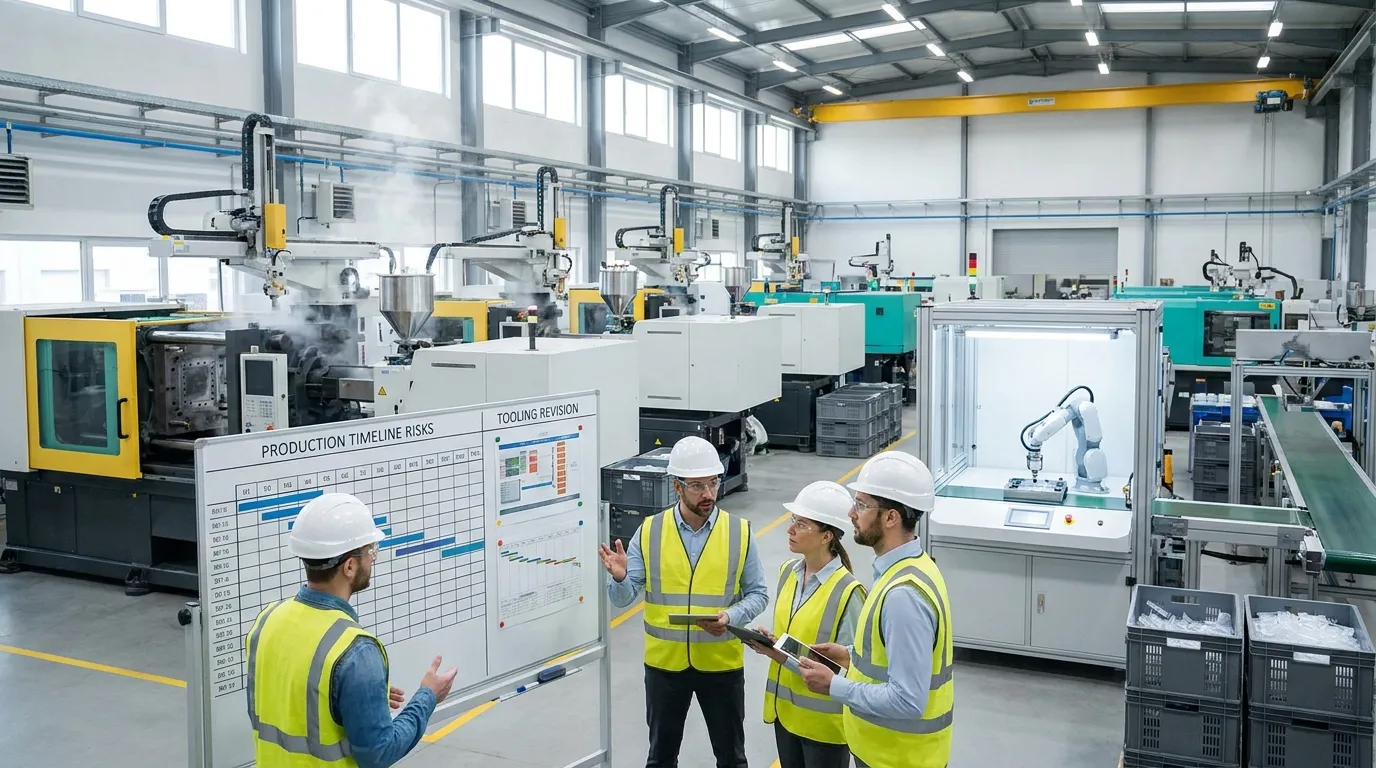
Injection molding timelines often slip because of tooling revisions, Aprovações Atrasadas, Inspeções Alfandegárias, or unstable production ramp-up after sampling. Early planning reduces both cost risk and launch delays.
Most project delays happen after teams assume tooling is already “finished.” In reality, Amostragem, Revisões, Navegação, and production transfer can still create schedule instability long after steel cutting begins.
A post-steel design revision is one of the most expensive timeline disruptions. Even changing gate placement or adjusting a cosmetic feature may require reworking mold steel and restarting validation.
Por que mudanças pós-aço no projeto criam atrasos caros
A medical enclosure project may pass initial CAD approval, then fail cosmetic review after T1 sampling. The revised gate location improves surface quality but adds several weeks to the tooling schedule because the cavity needs machining updates.
Those delays become more serious when overseas tooling shipments, customs clearance, or tariff-related inspections are involved. Relatórios do setor de Aprios e atualizações sobre o transporte discutidas por Moldagem BAP show how lead times can extend when production transfer and logistics planning are weak.
Tabela de Risco de Atraso em Moldagem por Injeção
| Fonte de Risco | Causa Típica | Impacto na Linha do Tempo | Etapa de Prevenção |
|---|---|---|---|
| Revisão das ferramentas | Mudança tardia da geometria | Atraso de várias semanas | Finalizar o DFM cedo |
| Inspeção alfandegária | Papelada incompleta | Atraso no envio | Verifique a documentação |
| Plano de amostragem ruim | Processo de aprovação pouco claro | Ciclos de amostragem repetidos | Defina as expectativas T1 |
| Mudança material | Problema de disponibilidade de resina | Revalidação necessária | Seleção precoce do material da eclusa |
| Transferência de produção | Configuração inconsistente do processo | Instabilidade no início | Padronizar os controles de processo |
An overseas tooling shipment may also face customs delays if sample declarations or commercial documentation are incomplete. Those risks are often ignored during early sourcing discussions, even though they directly affect launch schedules.
For teams managing supplier timelines, this guide to the Cronograma da Ferramenta para a Produção explains how production stages connect from tooling approval through manufacturing ramp-up.
Acertando o Próximo Passo
Good injection molding guidelines are less about memorizing technical rules and more about making better production decisions before tooling starts. Teams that validate wall thickness, Draft, Tolerâncias, Materiais, and DFM feedback early usually avoid the most expensive revisions later.
Antes de aprovar ferramentas, Revise a peça tanto do ponto de vista da engenharia quanto da produção. Ask suppliers difficult questions, challenge unnecessary tolerances, and confirm how revisions will be handled if sampling uncovers problems. Small decisions during design review often determine whether production stays stable or becomes expensive to fix later.
Perguntas Frequentes
What is the ideal wall thickness for injection molding?
The ideal wall thickness depends on the resin and part geometry, but consistency matters more than absolute thickness. Uniform walls reduce warpage, Marcas de afundamento, and cooling imbalance during production.
How much draft angle is recommended for injection molded parts?
Most injection molded parts need at least 1 to 2 degrees of draft per side for smooth ejection. Textured surfaces and deeper features usually require additional draft to prevent drag marks and cosmetic damage.
Why is DFM important in injection molding?
DFM helps manufacturers identify filling, Resfriamento, Ejeção, and tolerance risks before tooling begins. Early DFM review reduces revision costs and prevents avoidable production delays during sampling and ramp-up.
Quanto tempo leva para construir um molde de injeção?
Production mold lead times commonly range from several weeks to several months depending on geometry, Cavidades, finish requirements, e revisões de ferramentas. Design changes after steel cutting usually extend schedules further.
O que causa marcas de afundamento na moldagem por injeção?
Sink marks usually occur when thick sections cool unevenly or ribs and bosses are oversized. Consistent wall thickness and gradual transitions help reduce the risk during molding.
What questions should buyers ask an injection molding supplier?
Buyers should ask about DFM review process, sampling workflow, press capability, Manuseio de revisões, and mold maintenance planning. These factors strongly influence production stability and lead time reliability.
Compartilhe:


Escrito por Sunshine
Em Sol, Somos um fabricante e fornecedor profissional de componentes de moldes de precisão, oferecendo uma ampla variedade de produtos para aplicações de estampagem e molde por injeção. Nosso foco principal inclui a formação de matrizes, pinos e mangas ejetor, e postes guia e buchas. Com usinagem CNC avançada, Controle rigoroso de qualidade, e fortes capacidades de produção, Garantimos confiabilidade, Peças de alta precisão, juntamente com componentes padrão em estoque para fornecimento global rápido e eficiente.
NOTÍCIAS
RECEBA O SERVIÇO
Com peças de qualidade para todos os orçamentos e equipe amigável treinada para tornar sua visita informativa e sem complicações.
