



Pinos de Punção de Aço de Aço de Ferramenta de Carboneto vs Ferramentas: Vida útil da ferramenta, Risco, e Custo
Carbide does not automatically make a better punch pin, and tool steel is not always the cheaper long-term choice. Carbide is usually the stronger candidate when gradual abrasive wear, Deriva dimensional, and frequent sharpening limit production. Tool steel is often safer when the punch faces impact, Dobra, Carregamento lateral, uncertain alignment, or frequent design changes.
The right choice depends on how the current punch fails and how much that failure costs. Material selection is only one part of the wider die decision covered in this Guia de matrizes de punção (inferido). Aqui, the focus is narrower: selecting between cemented-carbide and tool-steel punch pins based on tool life, Risco de quebra, Manutenção, and cost per accepted part.
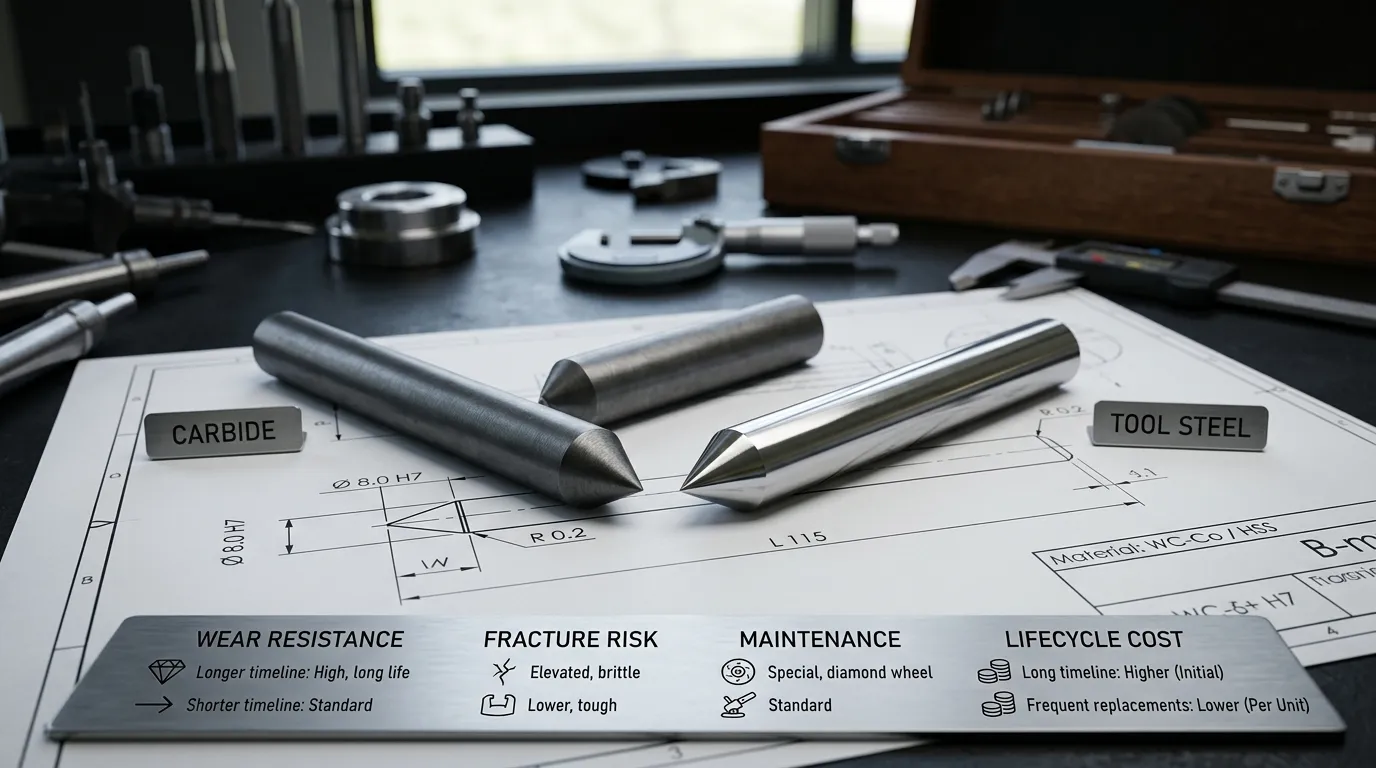
Carbureto vs pinos de aço para ferramentas em um olhar
| Fator de comparação | Pino de perfuração de carboneto cimentado | Pino de perfuração de aço para ferramenta |
|---|---|---|
| Resistência ao desgaste | Geralmente mais alto, especially in abrasive and stable applications | Depende muito do grau de aço e do tratamento térmico |
| Retenção de bordas | Pode manter as dimensões e a condição de corte por mais tempo quando o desgaste controla a falha | Pode exigir afiação mais frequente em condições de desgaste severo |
| Lascamento e tolerância à fratura | Mais sensível ao impacto, Carregamento lateral, and stress concentration | Generally more forgiving under shock, Dobra, and unstable conditions |
| Requisitos de alinhamento | Requires accurate guidance, Apoio, and uniform clearance | Geralmente tolera melhor pequenas variações operacionais |
| Adequação geométrica | Risk increases with slender sections, Comprimento sem suporte, and abrupt transitions | Frequentemente preferido para geometrias difíceis ou propensas a deflexão |
| Remoimento | Possible, but normally requires suitable diamond-grinding equipment and experience | Geralmente, é mais fácil para uma sala de ferramentas convencional remoer ou modificar |
| Custo inicial | Geralmente mais alto | Geralmente mais baixo, though premium HSS and PM grades can narrow the difference |
| Melhor uso adequado | Estábulo, repetitive, wear-dominated production | Impact-prone, changeable, short-run, or fracture-sensitive production |
| Teste econômico | A redução das interrupções no serviço deve justificar o custo mais alto de compra e manutenção | Aquisição menor e manutenção mais fácil devem compensar intervalos de serviço mais curtos |
These are directional differences, not guaranteed outcomes. Grau de Carboneto, Grau de aço, Geometria do punção, Material da peça, A Condição, Autorização, Lubrificação, and maintenance practices can change the result.
O que "carburo" e "aço para ferramentas" significam nessa comparação
The comparison is between punch pins made from cemented tungsten carbide and punches made from hardened tool steel. A steel punch with a thin surface coating is not the same as a solid or predominantly carbide punch.
The term “tool steel” also covers several material families. A conventional D2- or SKD11-type punch does not offer the same performance balance as high-speed steel or a powder-metallurgy tool steel.
Cemented Carbide Is a Grade Family, Not One Fixed Material
Cemented carbide is a composite material. Hard tungsten-carbide particles provide much of its hardness and wear resistance, while a metallic binder holds those particles together and contributes toughness.
De acordo com Explicação técnica do CERATIZIT sobre o carboneto cimentado, binder content and carbide grain size are two major variables controlling material properties. This means that specifying only “tungsten carbide” is incomplete.
A grade selected for maximum wear resistance may not provide the best resistance to chipping. A tougher carbide grade may survive impact or interrupted loading better, but it may not retain its edge as long in a purely abrasive application.
A responsible carbide specification should therefore consider:
- Conteúdo de fichário
- Classe de grão-tamanho do carboneto
- Resistência ao desgaste necessária
- Carga esperada de choque e flexão
- Seção transversal do punção e comprimento não suportado
- Material da peça e condição da superfície
Tool Steel Includes Conventional, HSS, and PM Options
Tool steel should not be treated as one low-cost, low-performance category.
Conventional cold-work grades such as D2 or SKD11 are widely associated with good abrasive wear resistance and compressive strength. They can work well where loads are controlled and the geometry is sufficiently supported. Their suitability becomes less certain when severe chipping or shock resistance is required.
Aço de alta velocidade, including M2- or SKH51-type grades, is also part of the tool-steel family. It generally offers a different balance of wear resistance, Resistência, and regrindability from conventional cold-work steel.
Powder-metallurgy tool steels can provide another intermediate option. Their finer and more uniform structure may improve the balance between wear resistance and toughness compared with conventional grades. O Discussão das Diretrizes AHSS sobre ferramentas e desgaste dos matrizes notes that tool selection must account for wear, shock resistance, rigidez, Resistência, and the actual forming or cutting conditions.
Heat treatment remains critical for every steel option. The grade name alone does not establish final punch performance.
Which Material Delivers Longer Punch-Pin Life?
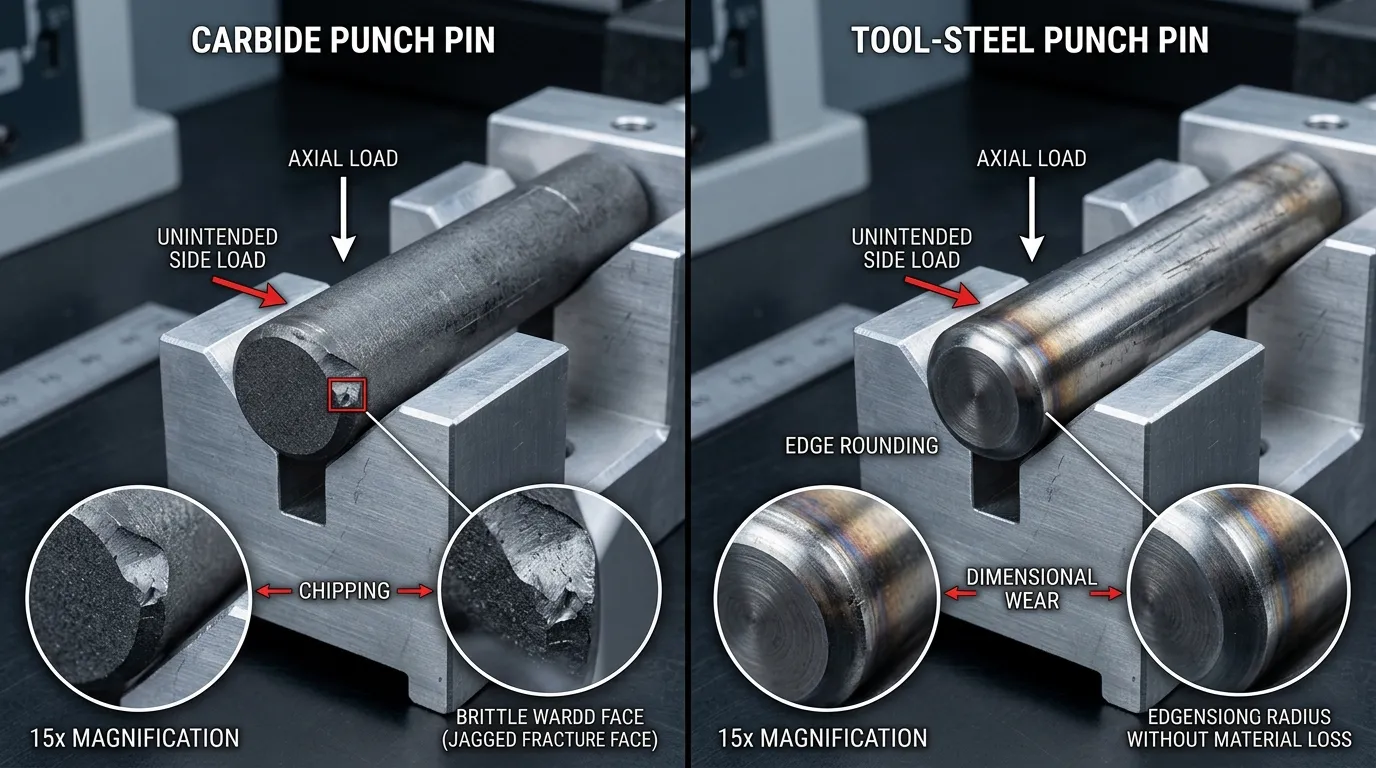
Carbide can deliver a much longer service interval when abrasive wear is the main reason the punch leaves production. It may not last longer when the real problem is chipping, rachaduras, Dobra, Desalinhamento, or unstable stripping.
Tool life should therefore be connected to a defined failure mode rather than a generic number of strokes.
A Carbeto tem o caso mais forte quando o desgaste controla a falha
Carbide is a strong candidate when the punch gradually loses its cutting profile instead of breaking suddenly.
Typical wear-dominated symptoms include:
- Arredondamento progressivo de bordas
- Aumento da altura da meira
- Tamanho gradual do buraco ou desvio das características
- Afiamento frequente programado
- Desgaste superficial sem grande lascamento nas bordas
- Falha consistente após intervalos de produção semelhantes
These conditions allow carbide’s wear resistance to create measurable value. The benefit may appear as longer intervals between service, more stable dimensions, fewer tool changes, or lower inspection and adjustment demand.
The application must still be mechanically stable. High wear resistance cannot compensate for uneven clearance, Orientação ruim, or a punch that bends during entry.
O aço para ferramentas pode durar mais quando a fratura controla a falha
A tool-steel punch may be more reliable when sudden damage ends the tool’s service life.
Warning signs include:
- Bordas de corte lascadas
- Rachaduras próximas a uma mudança de diâmetro
- Fratura completa por punção
- Flexão ou deflexão repetida
- Desgaste desigual de um lado
- Dano durante a retirada da lâmina
- Falhas que ocorrem em intervalos inconsistentes
In these conditions, additional hardness may not solve the problem. The punch may need greater toughness, Suporte aprimorado, corrected alignment, a different transition radius, or a revised stripper arrangement.
Material-related fracture is only one part of the diagnosis. O guia dedicado a Quebra de punção em matrizes de estampagem covers the wider causes and corrective actions.
Defina a Vida Útil da Ferramenta Antes de Comparar Materiais
“Longer life” has little meaning unless the endpoint is defined.
Possíveis pontos finais incluem:
- Rebarba máxima aceitável
- Diâmetro do furo ou tolerância de perfil
- Limite de defeitos de superfície
- Primeiro chip de borda visível
- Quebra catastrófica
- Intervalo de afiação programado
- Número de peças aceitas antes do serviço
Accepted parts are usually a better comparison measure than raw press strokes. A punch may complete many strokes while producing parts that no longer meet the drawing or burr requirement.
The same endpoint must be used for both materials. Comparing a steel punch until sharpening with a carbide punch until complete fracture produces a misleading result.
Por que o carboneto pode durar mais — ou quebrar mais cedo
Carbide performs best when the die system keeps the punch under controlled, predominantly axial loading. Its wear advantage becomes less useful when the punch is exposed to bending, Contato Desigual, or sudden impact.
Alinhamento, Liberação, and Guide Condition
A punch should enter the die opening concentrically. Worn guide posts, loose bushings, Movimento das placas, holder runout, or uneven clearance can move the load toward one side of the cutting edge.
That local load increases stress even when the average punching force appears acceptable. A steel punch may deflect or wear under these conditions. A carbide punch may chip or fracture with less visible warning.
SunshinePro's Guia de componentes do die explica como socar, Marcos orientadores, Buchas, Componentes de desgaste, and stripper systems interact. These components should be inspected before a steel punch is replaced with carbide.
Clearance also matters. Insufficient, excessive, or uneven punch-to-die clearance can change cutting force, Formação de rebarbas, material flow, e carregamento de borda. Carbide should not be used to hide a clearance problem.
Punch Geometry, Desmontagem, and Workpiece Conditions
Geometry strongly affects risk. A small-diameter punch with a long unsupported section is more sensitive to bending than a short, well-supported punch of the same material.
Risk can also increase with:
- Mudanças abruptas no diâmetro
- Transições internas acentuadas
- Suporte insuficiente para cabeça ou ombro
- Geometria irregular de borda de corte
- Alta força de desmembramento
- Levantamento de material durante a retirada do punho
- Puxar slug
- Contato descentrado com a escota
The workpiece changes the loading environment as well. Força, Espessura, Revestimento, Rugosidade superficial, and abrasive particles can affect cutting force and wear. The AHSS Guidelines identifies tool material, Pressão de contato, sheet strength, Condição da superfície, Revestimento, Lubrificação, Temperatura, and sliding behavior as interacting wear variables.
This is why a material that performs well in one die may fail quickly in another, even when the punch dimensions look similar.
Como Comparar o Custo por Peça Aceita
Carbide normally costs more to purchase, but initial price alone does not show which material is more economical.
A useful comparison includes every cost directly influenced by the punch:
- Compra inicial do perfurador
- Remoagem ou afiação
- Coating or recoating, Quando aplicável
- Ferramentas de reposição
- Mão de obra de remoção e instalação
- Tempo de ajuste e ajuste
- Tempo de inatividade para a pressão
- Sucata produzida antes que um punção desgastada ou danificada seja detectada
- Inspeção adicional
- Manutenção de emergência
- Produção aceita
A basic calculation is:
Custo por peça aceita = Custo total relacionado ao punção ÷ Número de peças aceitas produzidas
Por exemplo, two punches may have very different purchase prices. The more expensive punch can still cost less per part if it reduces planned service, emergency stoppages, sucata, and adjustment time. The cheaper punch can remain the better choice when production demand is limited, maintenance is simple, or carbide fracture risk is high.
The calculation should use actual plant data where possible. Avoid assuming that carbide will last five, ten, or twenty times longer. Such multipliers cannot be transferred reliably between different workpiece materials, punch geometries, Prensas, clearances, and failure criteria.
A risk-adjusted comparison should model at least two carbide outcomes:
- Expected case: Carbide reaches the planned wear-based service interval.
- Adverse case: Carbide chips or breaks early because of side loading, Impacto, or an unsuitable grade.
This prevents a favourable wear estimate from hiding the financial effect of one catastrophic failure.
When to Choose Carbide, Aço para ferramentas, or a Middle Option
| Condição de produção | Candidato inicial mais forte | Principal motivo |
| Stable die, desgaste abrasivo, afiação frequente | Carbeto | A resistência ao desgaste pode estender os intervalos de serviço |
| Repeated chipping, Dobra, or impact | Aço para ferramentas mais resistente | A resistência à fratura importa mais do que a dureza máxima |
| Produção curta ou modificação do design da peça | Aço para ferramentas | Compromisso inicial menor e modificação mais fácil |
| Corridas longas e repetitivas com tempo de inatividade caro | Carbeto, after system checks | A redução da intervenção pode justificar o custo mais alto |
| Conventional steel wears too quickly, but carbide risk is high | Aço para ferramentas HSS ou PM | Equilíbrio intermediário entre desgaste e tenacidade |
| Diferentes estações apresentam diferentes modos de falha | Estratégia híbrida de materiais | Cada estação pode usar o material adequado à sua carga |
Escolha Carbeto Quando o Desgaste e o Tempo de Indisponibilidade Dominam
Carbide is a strong candidate when:
- The existing punch wears gradually rather than breaking.
- Guidance and clearance are stable.
- Punch geometry is well supported.
- The workpiece creates significant abrasive wear.
- Repeated sharpening interrupts valuable production time.
- Dimensional consistency between service intervals is important.
- A suitable carbide grade can be selected.
- Qualified carbide grinding and handling are available.
High production volume strengthens the economic case, but volume alone is not enough. A high-volume die with poor alignment can consume carbide punches faster than a well-selected steel alternative.
Escolha aço para ferramentas quando a tenacidade e a flexibilidade predominam
Tool steel is often the safer choice when:
- The punch experiences impact or side loading.
- Geometry is slender or difficult to support.
- Alignment cannot be controlled closely.
- The die is used for prototypes, short runs, or changing designs.
- The punch may need local modification.
- In-house regrinding is important.
- A sudden carbide fracture could damage other die components.
- Current failures are cracks or chips rather than gradual wear.
The exact grade still matters. Conventional cold-work steel, HSS, and PM tool steel should not be grouped under one performance assumption.
Consider HSS, PM Tool Steel, or a Hybrid Die Strategy
The decision does not always need to be binary.
HSS may provide more wear resistance than a conventional tool steel while retaining useful toughness and easier regrinding than carbide. PM tool steel may offer another balance where both wear and chipping are concerns.
A hybrid die can also use different materials in different stations. Carbide may be justified at stable, high-wear piercing stations, while a tougher steel remains preferable where punches are slender, heavily stripped, or exposed to off-axis load.
Testing one high-wear station before converting a complete punch set can reduce technical and financial risk.
Verifique o sistema de dados antes de atualizar para Carbide
Before replacing a steel punch with carbide, verify the following:
- Identify the present failure mode. Determine whether the punch wears, deforms, chips, rachaduras, bends, or breaks.
- Inspect the guide system. Check guide posts, Buchas, Placas, and holders for movement or uneven wear.
- Verify alignment and runout. Confirm that the punch enters the die opening concentrically.
- Check clearance around the full cutting perimeter. Do not rely on one measurement.
- Review punch support. Examine unsupported length, head support, diameter changes, and transition radii.
- Evaluate stripping conditions. Look for excessive stripping force, material lifting, or slug pulling.
- Confirm workpiece details. Record material grade, strength condition, Espessura, Revestimento, e lubrificação.
- Review the maintenance process. Confirm that appropriate carbide grinding, Inspeção, and handling are available.
- Set a success criterion. Define the required burr, dimensional limit, service interval, and accepted-part target.
If these checks reveal a mechanical problem, correct it before changing material. A carbide upgrade should address a wear problem, not conceal a die-system fault.
O que Enviar a um Fornecedor para uma Recomendação de Material Responsável
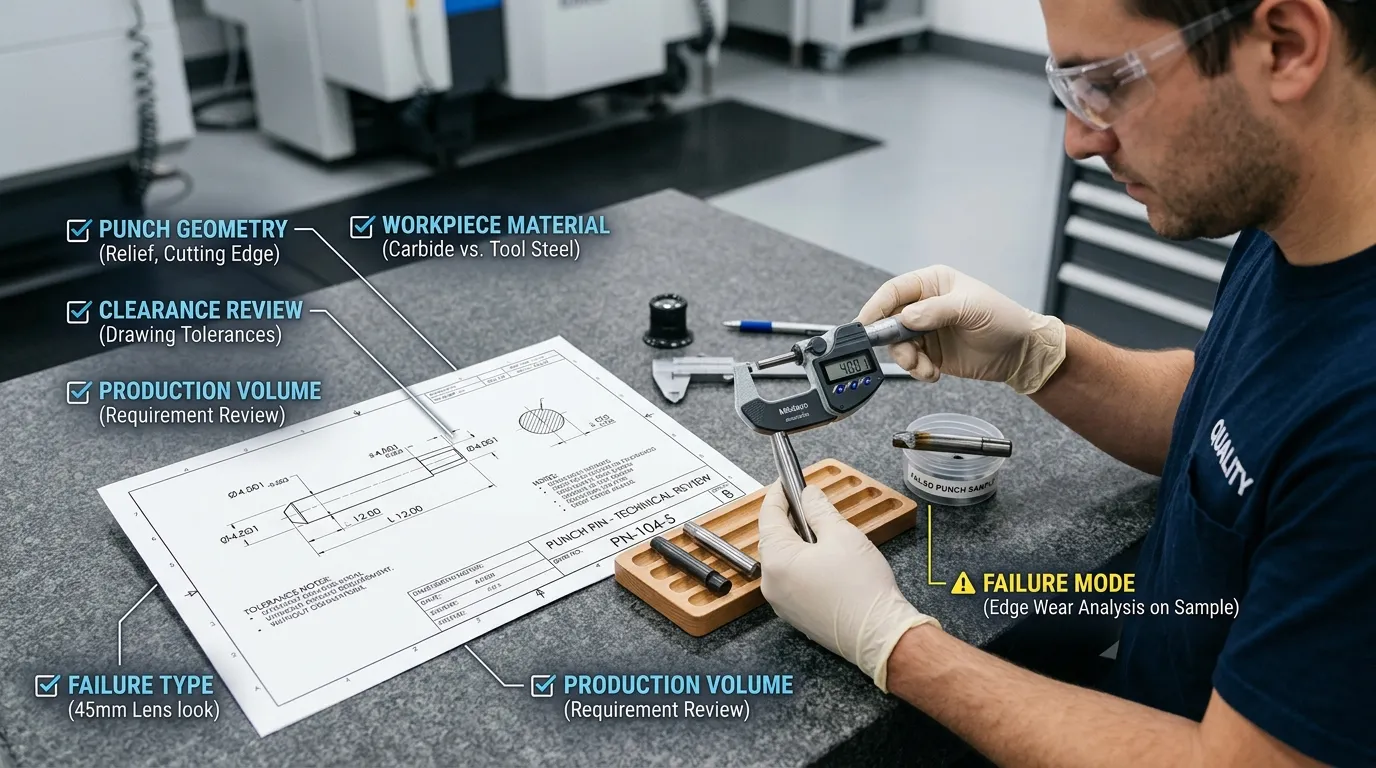
A supplier cannot make a defensible carbide-versus-tool-steel recommendation from the punch diameter alone.
Fornecer:
- Desenho dimensionado de punção ou amostra física
- Punch diameter, Comprimento, Estilo de cabeça, and transition geometry
- Tolerâncias e requisitos de superfície exigidos
- Material e grau da peça
- Espessura da peça e condição de resistência
- Revestimento ou revestimento superficial
- Tipo de prensa e velocidade de operação, Quando relevante
- Folga para o punção
- Condições de lubrificação
- Arranjo de stripper
- Volume anual ou em lote esperado
- Material do punção atual e tratamento térmico
- Intervalo de serviço atual
- Histórico de remoagem
- Fotografias de socos gastos ou quebrados
- Descrição do modo de falha
- Limites aceitáveis de rebarba e dimensão
- Impacto do tempo de inatividade ou da mudança
SunshinePro lists carbide punches, die punch pins, and high-speed steel punches within its Gama de matrizes e pinos de perfuração. Its carbide punch information also lists grinding, EDM, Usinagem de precisão, Dimensões personalizadas, e opções de revestimento selecionadas. The exact material grade, Geometria, Tolerância, Revestimento, and process route still need confirmation against the drawing and application.
Final Decision Rule: Match the Material to the Failure Mode
Choose carbide when controlled alignment and stable geometry allow wear resistance to reduce service interruptions and cost per accepted part. Choose tool steel when toughness, repairability, Geometria, or fracture control matters more than maximum wear resistance. Consider HSS or PM tool steel when the application falls between those positions.
The most reliable decision starts with the failed punch, the die condition, and the production data—not with hardness alone. To evaluate a custom requirement, Envie o desenho do punção, Detalhes da peça, Condições de operação, and failure history through SunshinePro’s Página de contato.
Compartilhe:


Escrito por Sunshine
Em Sol, Somos um fabricante e fornecedor profissional de componentes de moldes de precisão, oferecendo uma ampla variedade de produtos para aplicações de estampagem e molde por injeção. Nosso foco principal inclui a formação de matrizes, pinos e mangas ejetor, e postes guia e buchas. Com usinagem CNC avançada, Controle rigoroso de qualidade, e fortes capacidades de produção, Garantimos confiabilidade, Peças de alta precisão, juntamente com componentes padrão em estoque para fornecimento global rápido e eficiente.
NOTÍCIAS
RECEBA O SERVIÇO
Com peças de qualidade para todos os orçamentos e equipe amigável treinada para tornar sua visita informativa e sem complicações.
