



Pinos de Encaixe por Pressão vs Pinos de Encaixe Deslizante: Retenção e Disponibilidade
A press-fit punch pin uses controlled interference between the punch shank and its mounting bore. This can provide firm engagement and a compact mounting arrangement, but removal normally requires more force, Acesso, or disassembly. A slip-fit punch uses controlled clearance, making installation and replacement easier, but it needs a separate feature to retain, Localizar, and orient the punch correctly.
Neither option is universally better. The correct choice depends on stripping force, Carregamento lateral, positional requirements, punch-change frequency, Acesso de manutenção, and the design of the complete retainer system. Para informações mais amplas sobre socos, Pins, Buchas, and related tooling parts, ver o Guia de componentes do die (inferido).
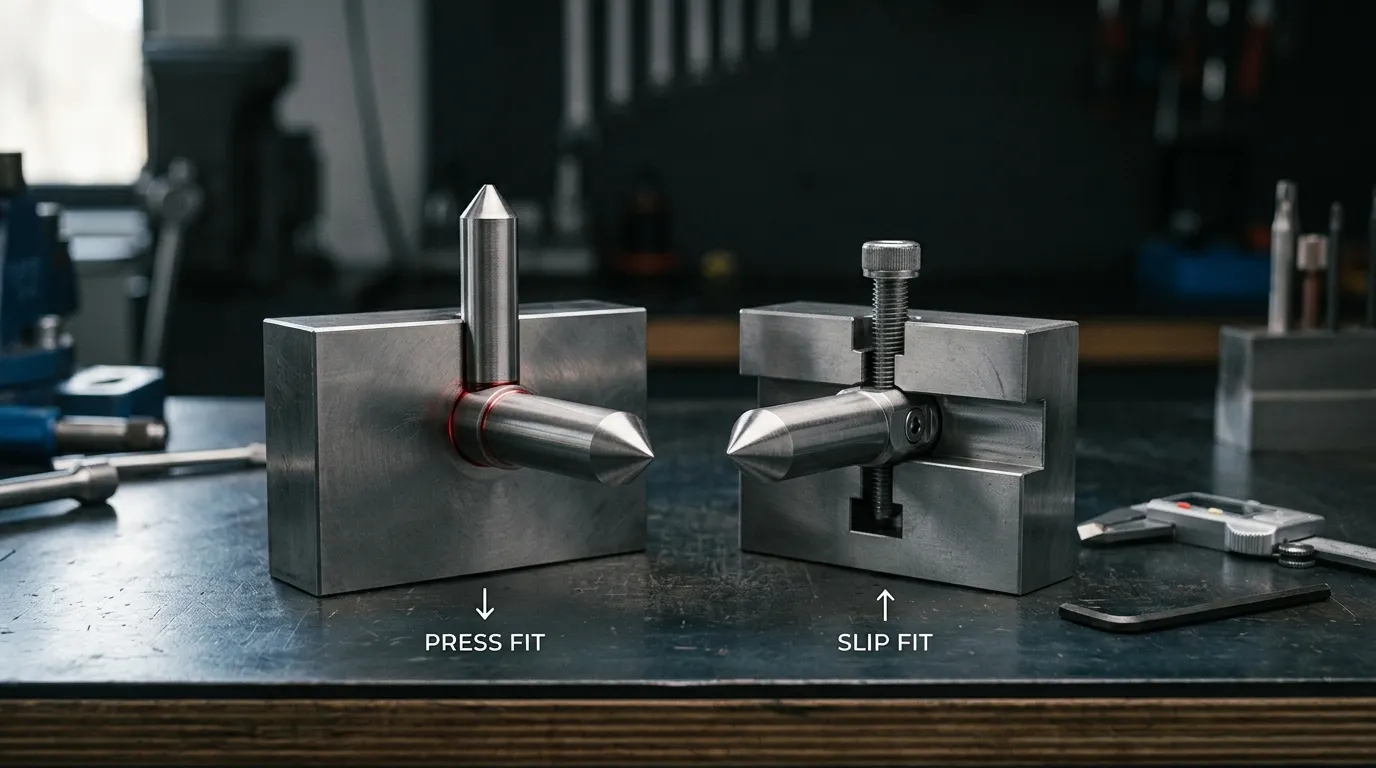
O que Significa Encaixe por Pressão e Ajuste por Deslizamento em um Conjunto de Punção
The fit being compared is the dimensional relationship between the punch shank and the bore in the punch plate or retainer. It is not the cutting clearance between the punch tip and die opening.
A terminologia geral vem de sistemas de limites e ajustes, como ISO 286-1, but the standard does not prescribe one universal fit for punch pins. The appropriate dimensions must be chosen for the actual punch diameter, Materiais, plate construction, Carregamento, Método de montagem, e estratégia de manutenção.
Ajuste de Pressão: Interference Between the Punch Shank and Bore
With a press fit, the punch shank is intentionally larger than the effective mounting bore within specified limits. Installation therefore requires controlled force or another approved assembly method.
The interference can help resist relative movement between the punch and plate. It may also contribute to positional stability. No entanto, the interference should not automatically be treated as the complete retention system. A headed punch, Flange, Placa de suporte, ombro, or another feature may still carry part of the axial load or prevent withdrawal.
Too much interference can increase assembly force and create a risk of scoring, Deformação, ou mudança dimensional. Too little may not produce the intended engagement.
Ajuste por escorregamento: Controlled Clearance With Separate Retention
A slip fit provides intentional positive clearance between the punch shank and its mounting bore. The punch can normally be inserted or removed without pressing it through the plate.
This does not mean the punch should move freely during stamping. A properly designed slip-fit arrangement uses another feature to provide positive axial retention and, where necessary, angular orientation. Depending on the tooling system, that feature may be:
- Uma cabeça de punção ou flange
- Um parafuso ou pino de ajuste
- Um porta-chaves ou moldado
- Um retentor dedicado
- Um mecanismo de trava por bola
- Um recurso separado de anti-rotação
Ball lock is one example of a removable punch-retention system. It is not a synonym for every slip-fit punch.
Ajuste, Retenção, Localização, and Guidance Are Separate Functions
Several functions must be considered independently:
| Função | O que ele controla |
|---|---|
| Ajuste | Folga ou interferência entre a haste do punção e o cano |
| Retenção | Resistance to axial withdrawal, including stripping force |
| Localização | Posição do eixo do punção no conjunto do chip |
| Orientação | Posição angular de punções moldadas ou não arredondadas |
| Orientação | Controle do punção próximo ao seu caminho de trabalho |
| Apoio de apoio | Transferência da carga compressiva de perfuração para a estrutura do chip |
One component may perform more than one function. Por exemplo, a punch plate may both locate and hold a press-fit punch. In another design, a retainer may hold the punch while a stripper plate guides it closer to the working end. MISUMI’s technical reference on Métodos de montagem de punção e matriz shows both press-fit mounting and clearance-fit arrangements with separate guidance or retention features.
Pinos de Encaixe por Pressão vs Encaixe Deslizante em Resumo
| Fator de Comparação | Ajuste de Pressão | Ajuste por escorregamento |
| Relação do perno ao cano | Interferência controlada | Liberação controlada |
| Instalação | Requer pressão controlada ou outro método assistido por força | Geralmente inserido sem pressão |
| Remoção | May require pressing, rear access, or partial disassembly | Normalmente é mais fácil se o recurso de lançamento for acessível |
| Retenção axial | Fit may contribute, often combined with a head or backing feature | Exige retenção positiva separada da autorização |
| Controle posicional | Pode proporcionar engajamento firme quando a geometria do diâmetro está correta | Depends more visibly on retainer accuracy, guiding features, and tolerance stack |
| Frequência de substituição | É mais adequado onde a substituição é relativamente rara | Frequentemente preferido onde os socos são trocados regularmente |
| Risco durante o serviço repetido | A condição do cano ou do haste pode mudar após remoções repetidas | Retainer, locking feature, and guiding surfaces must be checked for wear |
| Orientação do punção moldada | May rely on press-fit geometry plus a head, flat, or key | Geralmente precisa de um recurso definido de anti-rotação ou orientação |
| Cenário mais adequado | Montagem estável com acesso controlado ao conjunto | Sistema funcional com retenção positiva e orientação confiável |
The most important distinction is not simply “tight” versus “loose.” It is whether the complete assembly provides enough retention, Localização, Orientação, and service access for the intended application.
Como o encaixe por pressão afeta a retenção e manutenção do punção
A press fit creates contact around the punch shank and mating bore. In a well-designed assembly, this can help prevent relative movement and keep the punch firmly engaged with the mounting plate.
The working load still has to pass through the complete die structure. A punch head, ombro, Placa de suporte, or retainer surface may support the punch under compressive load. Stripping force acts in the opposite direction when the stock is removed from the punch, so the design must also prevent axial withdrawal.
Dayton Progress distinguishes one of its headed press-fit systems from quick-change ball-lock tooling, noting that the press-fit arrangement requires more retainer disassembly during replacement. That is useful as a system example, but it should not be treated as a rule for every press-fit punch design.
Onde o encaixe por pressão é mais útil
Press fit may be suitable when:
- The punch is not expected to be changed frequently.
- The punch plate and bore can be manufactured and inspected consistently.
- Controlled installation and removal access are available.
- A compact mounting arrangement is preferred.
- The punch head, backing surface, and guidance system already provide the required load support.
- The mating bore is intended to remain stable through the planned service life.
The decision should still be based on the complete assembly. Production volume alone is not enough to determine the fit.
Limitações de Serviço e Substituição
A press-fit punch may require access behind the plate, a controlled press-out operation, or removal of other retainer components. Before fitting a replacement, the maintenance team should inspect both the punch shank and the mounting bore.
Important checks include:
- Diâmetro do diâmetro e arredondamento do diâmetro
- Pontuação, Rávidas, Deformação, ou captador de material
- Perpendicularidade do diâmetro e posição
- Condição de perfuração-haste
- Assentos na cabeça ou ombro
- Contato da placa de apoio
- Orientação dos punços moldados
A replacement punch should not automatically be installed into a previously serviced bore without verification. If the bore has enlarged, become out of round, or suffered surface damage, the original fit may no longer be achieved.
Como o ajuste por encaixe afeta a retenção e manutenção do punção
Slip fit makes removal easier by providing controlled clearance at the punch shank. That service advantage shifts more responsibility to the retainer, orientation feature, e sistema de guiamento.
The design must answer three questions clearly:
- What prevents the punch from pulling out?
- What controls its radial and angular position?
- What guides the punch close to the cutting area?
If those functions are defined properly, a slip-fit punch does not need to operate as a loose component.
Opções de Retenção Positiva para um Punch Slip-Fit
| Recurso de Retenção | Função principal | Consideração de Serviço |
| Cabeça ou flange | Previne a retirada axial contra uma superfície de suporte | Pode exigir acesso pela parte traseira do conjunto |
| Parafuso ou pino de ajuste | Fixa mecanicamente o punção ou suporte | A condição do fixador e o método de travamento devem ser verificados |
| Porta-chaves ou moldado | Retém ou orienta o punção | O ajuste e o desgaste da chave afetam a repetibilidade |
| Retentor dedicado | Localiza e segura o punção como um conjunto separado | A montagem do retentor e a localização do cavilho passam a fazer parte da cadeia de tolerância |
| Trava de bola | Proporciona retenção positiva com um mecanismo de liberação | Ball, Assento, Groove, Orientação, and release access require inspection |
Ball-lock systems are widely used for removable tooling, but their dimensional details are product-specific. Values from one manufacturer’s catalogue should not be applied automatically to another retainer system.
Accuracy Depends on Location, Orientação, and Tolerance Stack
The presence of clearance does not by itself determine punch-point accuracy. The final position may depend on:
- Posição do furo de contenção
- Perpendicularidade do diâmetro
- Localização do cavilho ou parafuso de fixação
- Folga de corte de punção
- Recursos anti-rotação
- Planicidade da placa de suporte
- Comprimento do punção
- Folga do guia de descapagem
- Local de abertura do die
A stripper-guided arrangement can control the punch closer to the working end, reducing reliance on the punch-plate fit alone. O Referência de montagem MISUMI illustrates this type of relationship.
Slip-fit and ball-lock systems can still accumulate positional variation across several interfaces. Dayton Lamina’s technical discussion of Ferramentas de trava esfera demonstrates why retainer clearances, mounting accuracy, and component geometry must be evaluated as a system rather than individually.
Choose the Fit by Load, Accuracy, and Changeover Needs
The choice should be made from application requirements, not from a general assumption that one fit is stronger or more precise.
| Pergunta de Seleção | O ajuste de pressão pode ser preferido quando | O ajuste por encaixe pode ser preferido quando |
| How often is the punch replaced? | A substituição é rara | A substituição é rotineira ou sensível ao tempo |
| Is positive retention available? | The complete press-fit, cabeça, and backing arrangement already provides suitable retention | Um retentor dedicado, cabeça, Chave, bolt, or ball lock is available |
| How is the punch guided? | A placa de perfuração ou outro recurso oferece controle adequado | Guidance is provided separately, such as near the punch tip |
| Is maintenance access restricted? | A pressão controlada ou desmontagem continua prática | A remoção direta por meio de um mecanismo de liberação é mais prática |
| Is the punch shaped or non-round? | A orientação pode ser controlada de forma confiável dentro do projeto de montagem | A key, flat, Detentor, or oriented retainer provides repeatable angular location |
| Are interchangeable spares required? | O cano e as hastes de substituição podem manter a interferência pretendida | Recursos padronizados de liberação e retenção suportam substituições repetíveis |
| Is side loading expected? | A estrutura completa de ajuste e orientação pode resistir à carga | A orientação próxima separada pode controlar o punção próximo à área de trabalho |
| Is the existing bore already worn? | Somente após a inspeção se confirma que a interferência necessária ainda pode ser alcançada | A redesigned retainer may be considered, but conversion requires engineering review |
Favoreça o encaixe de pressa quando a retenção é estável e as mudanças são infrequentes
Press fit is more attractive when the punch is expected to remain installed for long periods, controlled assembly equipment is available, and the mating bore can maintain its specified geometry. It also suits designs where a compact arrangement is more valuable than rapid replacement.
The head, Suporte, punch length, and guidance method still need separate verification.
Favorecer o ajuste por deslizamento na substituição e o acesso orientam o design
Slip fit is more attractive when punches are changed regularly, spare interchangeability matters, or pressing the component from the plate would interrupt maintenance.
This option depends on a reliable positive-retention feature. The retainer must also control position and orientation well enough for the required die accuracy.
Use um sistema completo de retenção para casos exigentes
Alta força de desmembramento, shaped punches, Carregamento lateral, restricted access, or tight positional requirements may call for a purpose-designed retention and guidance system. In such cases, the press or slip relationship is only one feature within the design.
The final arrangement should be reviewed at assembly level rather than selected from a generic fit chart.
O que especificar no desenho do punção e da placa
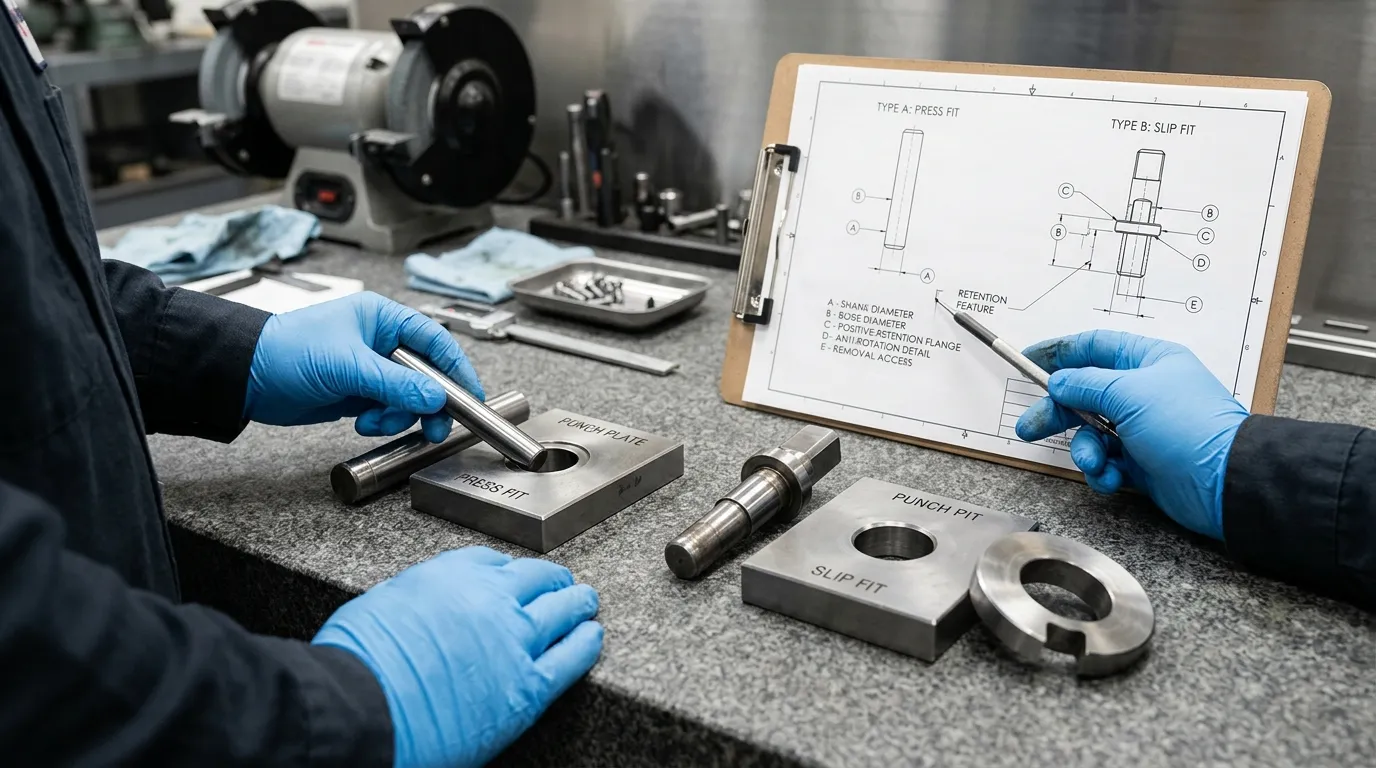
After choosing the fit concept, the drawing must define it clearly. Terms such as “tight fit” or “easy fit” are not precise enough for manufacturing or inspection.
Include the following information where relevant:
- Diâmetro nominal e tolerância do cabo de punção
- Diâmetro nominal e tolerância do diâmetro nominal do diâmetro e tolerância do diâmetro de acoplamento
- Autorização ou interferência funcional necessária
- Padrão de ajuste e unidades aplicáveis
- Material de placa de punção ou contenção
- Espessura da placa e comprimento de engajamento
- Cabeça de punção, ombro, Groove, Chave, or locking feature
- Detalhes anti-rotação para punções moldadas
- Requisitos de posição do diâmetro e perpendicularidade
- Dados relevantes
- Requisitos de placa de apoio ou assentos
- Ferramenta de liberação ou acesso para remoção
- Expectativas de substituição e intercambiabilidade
- Requisitos de inspeção ou bitola
SunshinePro states that custom non-standard mould and die accessories can be produced from customer drawings or samples. The fit should still be defined by the customer’s die design or confirmed through an engineering review rather than inferred by the supplier from an ambiguous note.
Riscos de Instalação e Inspeção para Cada Ajuste
Correct dimensions on a drawing do not guarantee a successful assembly if the components are dirty, Danificado, misaligned, or inspected incorrectly.
Riscos de Ajuste Pressado a Verificar
Before installation or replacement, inspect for:
- Rebarbas ou contaminação no haste e no furo
- Entrada incorreta ou bordas de diâmetro danificadas
- Dimensões de haste ou de diâmetro fora dos limites
- Escoamento ou captação de material de remoção anterior
- Ampliação do diâmetro ou perda de arredondamento
- Assentamento incompleto contra a cabeça ou superfície de apoio
- Orientação incorreta
- Desalinhamento durante a pressão
Do not use installation force alone as proof that the correct fit has been achieved. Excessive force may indicate a dimensional, geometric, Superfície, or alignment problem.
Riscos de Ajuste Escorregadiço a Verificar
For a slip-fit assembly, inspecionar:
- Liberação contra os limites de desenho
- Desgaste no furo do retentor
- Condition of the head, Chave, bolt, ball, Groove, or holder
- Controle anti-rotação
- Precisão do cavilho e do aparelho de contenção
- Contato da placa de apoio
- Acesso ao lançamento
- Sinais de movimento não intencional
- Erro posicional acumulado entre o sistema de retenção e guia
Mounting problems can contribute to poor alignment or unfavourable punch loading, but they are not the only causes of failure. Material choice, Tratamento térmico, Folga de corte, side force, and punch geometry also matter. Those wider failure mechanisms are covered in Quebra de punção em matrizes de estampagem.
Erros Comuns ao Escolher o Encaixe do Pino de Punção
- Treating slip fit as uncontrolled looseness. A designed clearance can operate accurately when the retainer and guidance system control the punch.
- Assuming interference is the complete retention method. The head, backing surface, Força de desmantelamento, and removal direction still matter.
- Selecting from a generic fit chart only. ISO fit classes provide a dimensional framework, not an automatic punch-design answer.
- Ignoring punch guidance. A firm shank fit cannot compensate for every issue caused by punch length, Carregamento lateral, or poor working-end guidance.
- Ignorando a orientação. Shaped punches need a reliable anti-rotation feature.
- Failing to plan removal access. A mechanically sound fit may still create an impractical maintenance process.
- Reusing a worn bore without inspection. The replacement punch may not achieve the intended fit or position.
- Applying one ball-lock specification to every supplier. Retainer geometries and clearances are system-specific.
- Confusing mounting fit with cutting clearance. The shank-to-bore relationship is separate from the clearance between the punch tip and die opening. The broader Guia de matrizes de punção covers the wider die-system context.
- Converting press fit to slip fit without redesigning retention. Increasing bore clearance changes how the punch is held, located, and guided.
O que Confirmar com um Fornecedor de Punch-PIN
Before ordering a replacement or custom punch pin, provide enough information for the supplier to understand the complete mounting arrangement:
- Desenho de punção ou amostra física
- Detalhes da placa de punção ou contenção de encaixe
- Required press fit, slip fit, or explicit dimensional limits
- Método de retenção e anti-rotação
- Cabeça de punção, ombro, Groove, or locking geometry
- Required position, Perpendicularidade, and orientation
- Expectativas de substituição e intercambiabilidade
- Inspection requirements
- Aplicação relevante e condições de serviço
Listas SunshinePro Cunhos e pinos de perfuração among its product categories and accepts enquiries for standard or tailored component requirements. For a custom or replacement project, submit the punch drawing or sample together with the mating-bore, Retenção, Orientação, and service requirements through the Página de contato.
Compartilhe:


Escrito por Sunshine
Em Sol, Somos um fabricante e fornecedor profissional de componentes de moldes de precisão, oferecendo uma ampla variedade de produtos para aplicações de estampagem e molde por injeção. Nosso foco principal inclui a formação de matrizes, pinos e mangas ejetor, e postes guia e buchas. Com usinagem CNC avançada, Controle rigoroso de qualidade, e fortes capacidades de produção, Garantimos confiabilidade, Peças de alta precisão, juntamente com componentes padrão em estoque para fornecimento global rápido e eficiente.
NOTÍCIAS
RECEBA O SERVIÇO
Com peças de qualidade para todos os orçamentos e equipe amigável treinada para tornar sua visita informativa e sem complicações.
