



Componentes de Precisão para Moldes: Quando a precisão e a resistência ao desgaste são importantes
Precision components for molds are high-tolerance parts that improve alignment, repeatability, and wear resistance in injection mold systems. Components such as guide posts, pinos ejetores, and bushings need tight dimensional control to reduce flash, uneven wear, and part variation. The right material, revestimento, and inspection process can extend mold life and maintain stable production quality across long manufacturing runs.
A mold can look well-built on paper and still fail in production because of small component inaccuracies. Desalinhamento, surface wear, and tolerance drift often start with the parts that guide, Posição, and eject material inside the mold. For manufacturers running high-volume production, precision components are not just about tighter machining. They affect maintenance costs, scrap rates, and long-term mold stability.
What are precision components in mold manufacturing?
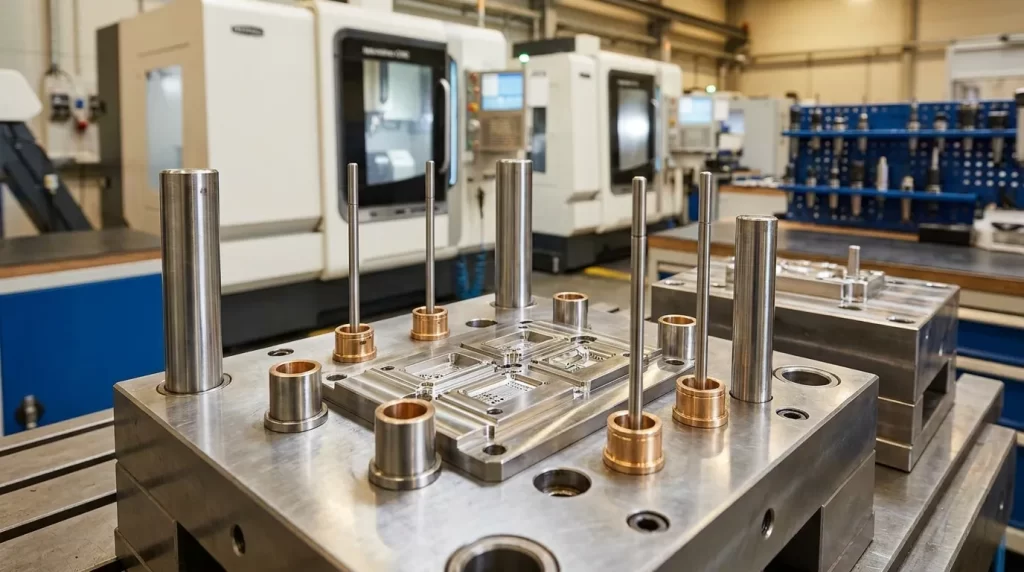
Precision components in molds are high-tolerance parts designed to maintain alignment, repeatability, and dimensional accuracy during repeated production cycles. They reduce variation, minimize wear-related defects, and improve mold lifespan.
Na fabricação de moldes, precision components refer to parts that must maintain exact positioning under repeated mechanical stress. These components include guide posts, Buchas, pinos ejetores, Mangas, and cavity inserts. Even a small dimensional shift can create flash, Fixação, or inconsistent plastic parts.
The need for precision becomes more obvious in high-cycle molds. A mold producing thousands of parts each day cannot rely on loose-fitting components. Wear increases quickly when alignment drifts, especially in molds processing abrasive resins or thin-wall parts.
Manufacturers often use hardened tool steels, Esmerilamento de precisão, Usinagem EDM, and advanced inspection systems to maintain dimensional consistency. A broader overview of mold systems and component categories is available in this Guia completo de componentes do molde.
For buyers comparing suppliers, the key issue is not just machining capability. It is whether the supplier can maintain repeatability over long production runs using properly engineered Componentes de molde de precisão.
Which mold components require the highest precision?
Sistemas de guias, ejector components, and cavity alignment parts usually require the highest precision because even small dimensional variation can create flash, Desajuste, Desgaste prematuro, or unstable part quality.
Not every mold component needs micron-level tolerances. Some areas are far more sensitive to dimensional variation than others. Guide systems and moving parts usually experience the highest stress and alignment pressure during production.
Sistemas de guias
Guide posts and bushings control mold alignment during opening and closing. If these parts wear unevenly, cavity surfaces may no longer match correctly. That often causes flash on finished parts or visible mismatch lines.
Automotive trim molds are a common example. A guide-post tolerance difference as small as ±0.01 mm can affect visible surface quality on exterior plastic parts.
Sistemas ejetores
Ejector pins and sleeves require smooth movement and consistent positioning. Excess friction or slight misalignment increases wear and can damage molded parts during ejection.
In high-volume electronics production, ejector pins often fail early because of short cycle times and repeated friction contact. Poor alignment accelerates galling and surface scoring.
| Componente de Mofo | Por que a precisão importa | Risco de Falha Comum |
|---|---|---|
| Postes-guia | Mantém o alinhamento do molde | Flash e desajuste |
| Buchas | Controle a estabilidade do movimento | Desgaste desigual |
| Pinos ejetores | Suporta liberação limpa da peça | Cravando pinos |
| Inserções de núcleo | Mantém a precisão dimensional | Inconsistência de partes |
| Mangas | Reduz o movimento de atrito | Pontuação de superfície |
Fornecedores dos fabricantes Peças de alinhamento de molde should focus on repeatability and wear performance instead of chasing the tightest possible tolerance everywhere.
What tolerance range is considered high precision for mold components?
High-precision mold components commonly operate within ±0.01 mm tolerance or tighter depending on mold complexity, Tipo de resina, and production volume requirements.
Tolerance requirements depend on the mold application. Thin-wall packaging molds and medical molds usually require tighter dimensional control than general consumer products. De acordo com Attur International, precision machining applications often operate within ±0.01 mm tolerance ranges.
That does not mean every component should be machined to the tightest possible limit. Ultra-tight tolerances are not automatically better. If the mold application does not require them, they can increase cost without improving production stability.
| Tipo de Aplicação | Requisito típico de tolerância |
|---|---|
| Componentes gerais do molde | ±0.02 mm |
| Peças de alinhamento de precisão | ±0.01 mm |
| Moldura de parede fina | ±0.005 mm |
| Medicina ou micromoldagem | Below ±0.005 mm |
Tolerance planning should match actual production conditions. High-volume molds processing abrasive materials usually benefit more from stable wear resistance than from unnecessary ultra-fine tolerances.
Why does wear resistance matter in injection molds?
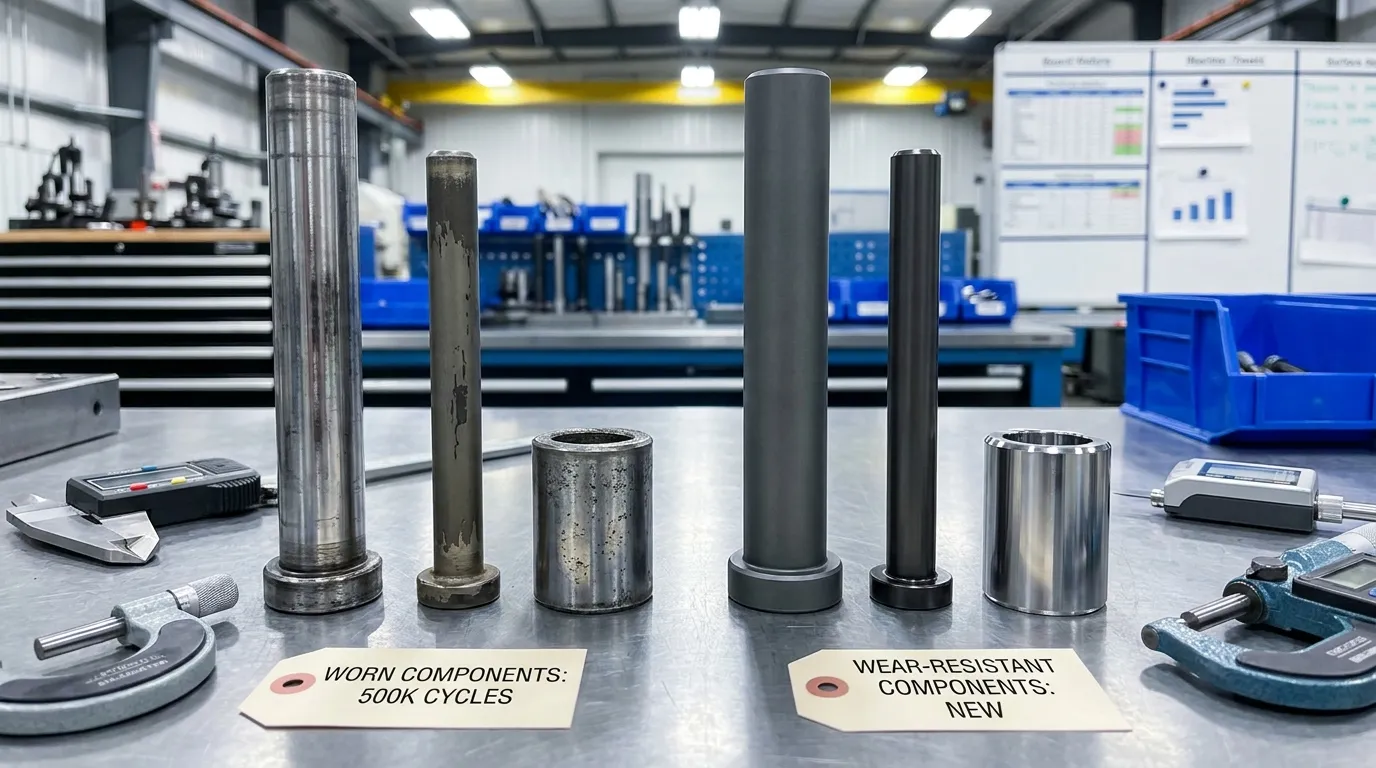
Wear resistance directly affects mold lifespan, Estabilidade do ciclo, and part consistency. Poor wear performance increases maintenance frequency, Deriva dimensional, and the risk of flash or sticking during production.
Mold components experience repeated friction, Pressão, and heat during production. Com o tempo, these forces remove material from contact surfaces and reduce alignment accuracy. Once wear begins, dimensional variation spreads quickly through the entire mold system.
Abrasive plastics make the problem worse. Glass-filled resins and engineering plastics create higher friction loads that accelerate surface damage. Components that start with weak hardness or poor surface treatment often fail much earlier than expected.
Pontos de desgaste comuns
The most common wear locations include:
- Postes guia e buchas
- Pinos ejetores
- Núcleos deslizantes
- Superfícies de desligamento
- Mangas e insertos móveis
Coatings help, but they cannot compensate for poor alignment or weak base material selection. A nitrided surface on a poorly fitted guide system will still wear unevenly under repeated load.
Lista de Verificação de Falhas de Desgaste por Mofo
| Sinal de Aviso | Causa Provável | Ação Recomendada |
|---|---|---|
| Flash em peças moldadas | Desgaste do alinhamento | Sistema de guias de inspeção |
| Cravando pinos | Gallagem superficial | Substituir ou cobrir os pinos ejetores |
| Desgaste desigual da cavidade | Dureza fraca | Qualidade de material de atualização |
| Pontuação de superfície | Dano por atrito | Melhorar a lubrificação |
| Manutenção frequente | Fraca resistência ao desgaste | Estratégia de revestimento para revisão |
Para fabricantes comparando Peças resistentes ao desgaste para moldes, the better long-term choice is often the component that reduces downtime rather than the one with the lowest purchase price.
Which materials and coatings improve mold component lifespan?
High-grade tool steels combined with surface treatments like nitriding or PVD coatings improve hardness, Reduzir o atrito, and extend the operating life of precision mold components under repeated production stress.
Material selection affects both wear resistance and dimensional stability. Hardened tool steels are common because they maintain strength under repeated mechanical load. Surface treatments improve resistance to friction and abrasion without changing the entire component structure.
Nitriding is widely used because it hardens the outer surface while maintaining core toughness. PVD coatings reduce friction and improve release performance on moving parts.
| Material ou revestimento | Principal benefício | Uso típico |
|---|---|---|
| Aço para ferramentas | Alta dureza | Componentes principais |
| Nitruração | Resistência ao desgaste superficial | Sistemas de guias |
| Revestimento PVD | Menor atrito | Pinos ejetores |
| Tratamento térmico | Estabilidade dimensional | Partes estruturais |
A supplier comparison often shows the real value of coatings. One production facility using coated bushings reduced maintenance intervals compared with untreated steel bushings operating under the same cycle conditions.
Custom precision components are valuable for high-cycle or complex molds, but standard parts are often the smarter choice for easier maintenance and replacement. Buyers evaluating Componentes duráveis de molde should balance lifespan, replacement speed, and total operating cost.
How are precision mold components inspected and verified?
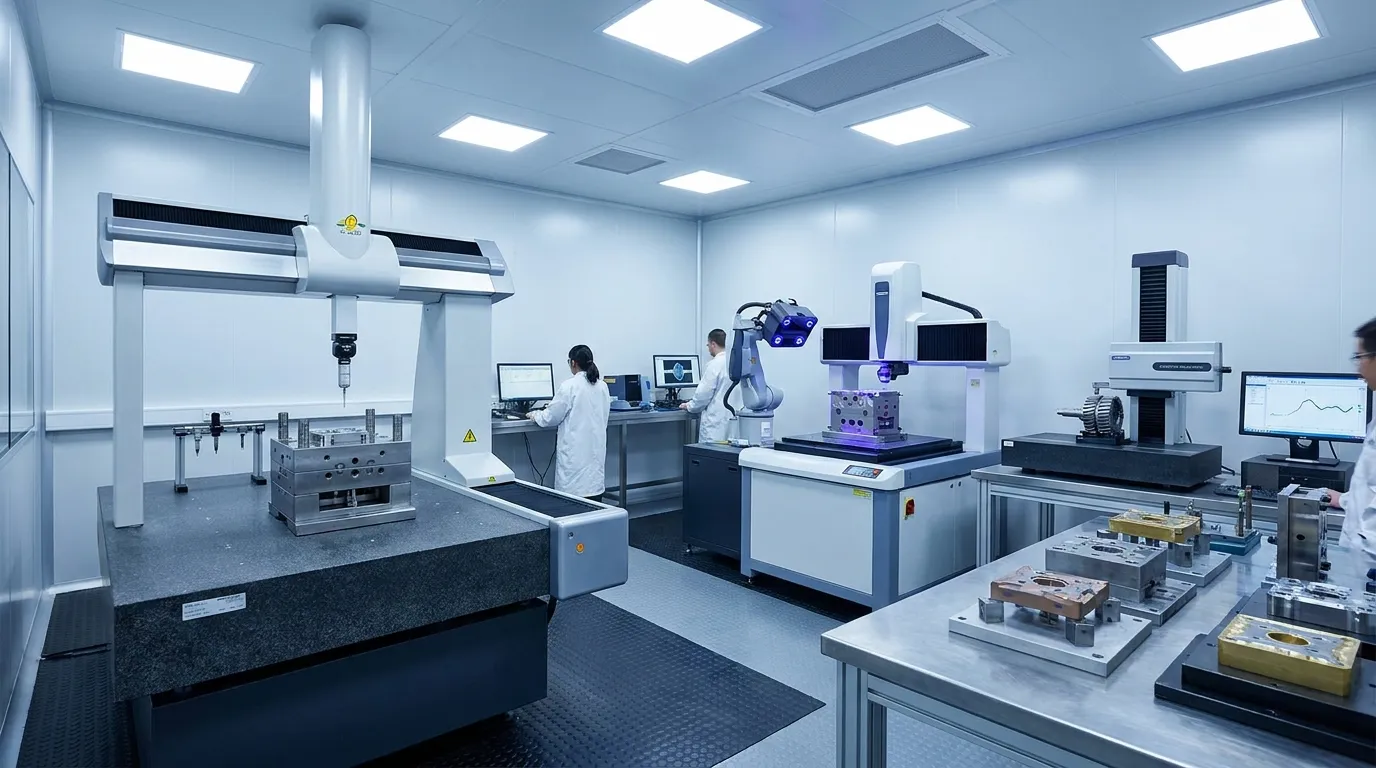
Manufacturers verify precision mold components using contour measurement systems, optical inspection, and dimensional metrology tools to confirm tolerance accuracy and surface conformity before production use.
Inspection matters because even small dimensional variation can affect mold performance. Most suppliers use multiple verification methods depending on component complexity and tolerance requirements.
De acordo com MinebeaMitsumi, precision manufacturing depends heavily on dimensional consistency and stable machining accuracy.
Processo típico de inspeção
- Medição dimensional inicial usando calibres ou micrômetros
- Verificação de precisão com sistemas de medição de curvas de nível (CMM) ou de contorno
- Inspeção superficial para marcas de desgaste ou defeitos de acabamento
- Validação final de repetibilidade antes do envio
Optical inspection systems are common for smaller components with complex geometry. Contour measuring equipment helps verify profiles and edge accuracy on inserts and precision-fit parts.
Inspection also helps identify process drift before it becomes a production issue. In thin-wall molding, a ±0.01 mm alignment variation can create inconsistent cavity fill and visible defects across thousands of parts.
Are custom precision components always better than standard parts?
Custom precision components are not always the best choice. They work well for demanding molds with tight tolerances or unusual geometry, but standard components are often easier to replace and maintain during regular production.
The decision depends on production volume, Complexidade, e estratégia de manutenção. A custom component may improve cycle stability in a high-volume automotive mold, but it can also increase lead time and replacement cost.
Tabela de Decisão de Componentes Padrão vs Precisão
| Situação | Escolha Melhor | Por quê |
|---|---|---|
| Produção em grande volume | Peças de precisão personalizadas | Melhor estabilidade a longo prazo |
| Produtos simples de consumo | Peças padrão | Substituição mais rápida |
| Moldagem por tolerância apertada | Peças personalizadas | Alinhamento aprimorado |
| Ambientes de manutenção frequentes | Peças padrão | Obtenção mais fácil |
| Geometria complexa de molde | Peças personalizadas | Melhor ajuste e desempenho |
A buyer producing low-volume consumer products may gain little value from expensive custom alignment systems. Por outro lado,, medical or electronics molds often justify higher precision because downtime and defect rates carry much higher production costs.
The smarter approach is matching component strategy to production conditions instead of assuming tighter tolerance always improves results.
How do sourcing and customs delays affect precision component supply?
Precision mold components often have longer sourcing timelines because they require specialized machining, Inspeção, and export documentation. Customs delays can add another layer of risk when replacement parts are needed quickly.
Shipment documentation matters more in 2026 because import systems are stricter in several regions. The EU’s Import Control System 2 (ICS2) requires more detailed shipment information for imported goods.
A common problem is vague shipment labeling. One supplier described mold components simply as “machine parts,” which delayed customs clearance because the classification lacked enough detail.
Lista de Verificação de Envio de Componentes de Precisão
- Confirme a precisão do código HS antes do envio
- Use descrições detalhadas das peças
- Verifique a documentação material
- Inclua especificações dimensionais quando necessário
- Confirme os requisitos de conformidade com o destino
- Revise a papelada de importação antes do envio
De acordo com Orientação da DHL sobre atrasos na alfândega e recente Boletins comerciais da CBP, incomplete documentation remains a major cause of shipping disruption.
O que fazer a seguir
Choosing the right precision components comes down to production stability, Resistência ao desgaste, and realistic tolerance requirements. The best option is not always the tightest or most expensive part. It is the component that maintains accuracy over time without creating unnecessary maintenance cost or sourcing delays.
If you are reviewing mold performance problems, start with alignment systems, ejector components, and wear surfaces first. Those areas usually reveal the earliest signs of dimensional drift. For a broader understanding of mold systems and applications, isso Guia de molde de injeção plástica provides additional context on how molds are designed and used across production environments.
Perguntas Frequentes
What are precision components used for in molds?
Precision components maintain alignment, Precisão dimensional, and repeatability inside mold systems. They help reduce defects, improve consistency, and extend mold lifespan during repeated production cycles.
What tolerance is considered high precision in mold manufacturing?
High precision in mold manufacturing commonly means tolerances around ±0.01 mm or tighter depending on the application. Critical mold areas may require even smaller variation for stable production.
Which mold components wear out the fastest?
Pinos ejetores, guide systems, and high-friction contact surfaces usually experience the fastest wear. Lubrificação ruim, misalignment, and abrasive materials accelerate failure.
Are coated mold components worth the cost?
Coated components often last longer and reduce friction in high-cycle production environments. The added cost is usually justified when downtime or replacement frequency becomes expensive.
How are precision mold parts inspected?
Manufacturers use contour measuring systems, optical inspection equipment, and dimensional metrology tools to verify tolerances and surface quality. Inspection confirms repeatability before production use.
Can standard mold components replace custom precision parts?
Standard components work well for many general applications, but custom parts are often necessary for tight tolerances, unusual geometries, or high-volume production stability.
Compartilhar:


Escrito por Sunshine
Em Sol, Somos um fabricante e fornecedor profissional de componentes de moldes de precisão, oferecendo uma ampla variedade de produtos para aplicações de estampagem e molde por injeção. Nosso foco principal inclui a formação de matrizes, pinos e mangas ejetor, e postes guia e buchas. Com usinagem CNC avançada, Controle rigoroso de qualidade, e fortes capacidades de produção, Garantimos confiabilidade, Peças de alta precisão, juntamente com componentes padrão em estoque para fornecimento global rápido e eficiente.
NOTÍCIAS
RECEBA O SERVIÇO
Com peças de qualidade para todos os orçamentos e equipe amigável treinada para tornar sua visita informativa e sem complicações.
