



Projeto de pino de perfuração para padrões repetidos de pequenos furos
Perforation punch pin design is not simply a matter of choosing a small diameter and a hard material. A reliable design must coordinate the hole pattern, sheet material, Geometria do punção, support system, combined cutting force, A Liberação, slug path, and maintenance method.
The challenge becomes greater as hole diameter decreases or more holes are punched during each stroke. A long, unsupported tip may deflect. A dense cluster can exceed press capacity or distort the sheet. Small slugs may clog the die or return to the work surface. The punch therefore has to be designed as part of the complete cutting system.
For broader information about punches, stripper systems, Elementos guia, and other tooling parts, ver o Guia de componentes do die (inferido). This guide focuses specifically on punch pins used for repeated small-hole patterns.
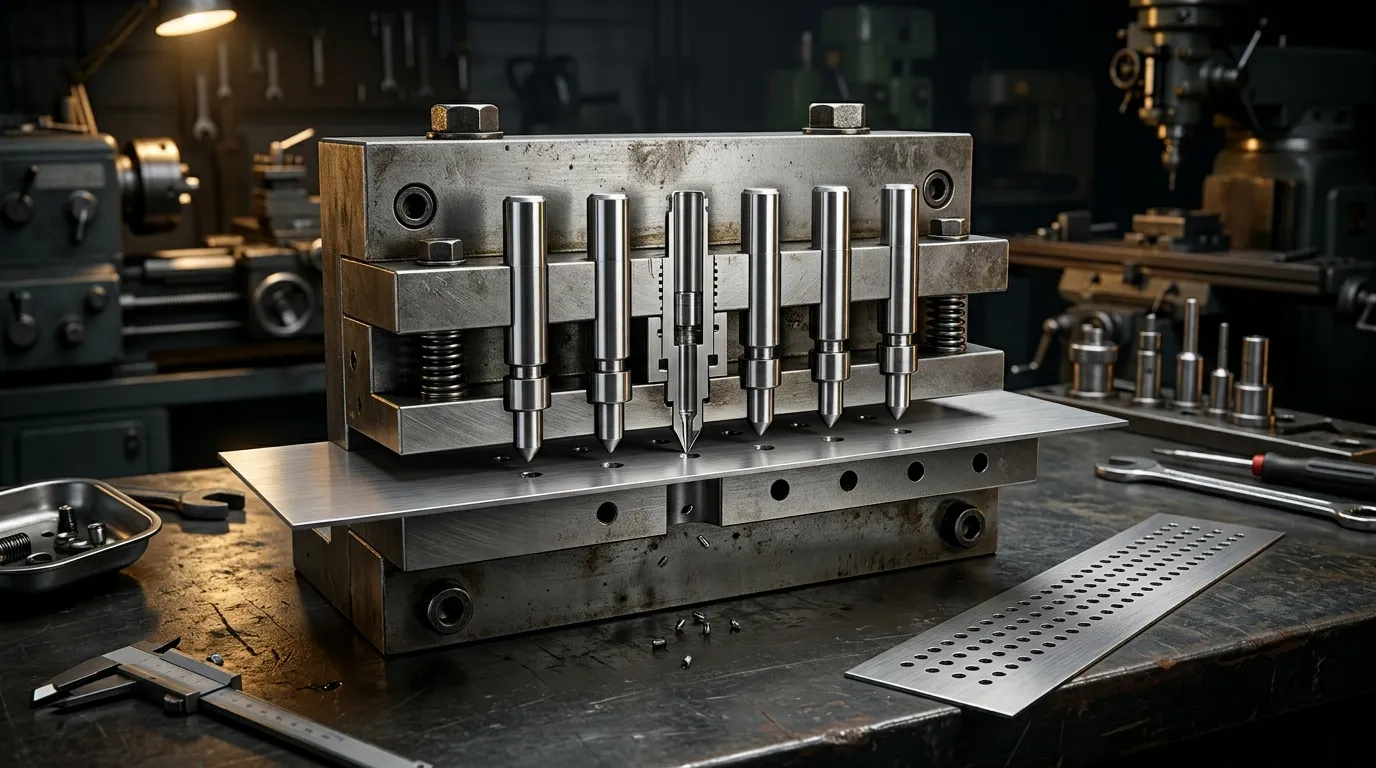
What Must Be Designed Together in a Perforation Punching System?
A perforation punch pin forms one part of a load path that extends through the tool:
- The cutting tip enters the sheet.
- The punch shank transfers the cutting load upward.
- The punch plate locates and retains the pin.
- The backing plate supports the punch against axial reaction.
- The stripper controls the sheet and may guide the punch near its tip.
- The die opening provides the opposing cutting edge.
- The slug passes through the die relief and exits the tool.
A weakness in any one part can affect the entire operation. A strong punch material will not prevent failure if the working tip is too long, the stripper allows lateral movement, or the die opening is misaligned. A correctly sized pin can still produce unstable results if several tips create excessive combined force or if the slug path becomes blocked.
This is why perforation tooling should not be treated as an isolated component-selection exercise. General die construction and die-type decisions are covered more broadly in the Guia de matrizes de punção. Aqui, the design starts with the repeated hole pattern and works inward toward the punch pin.
Defina o padrão do furo e os requisitos da folha antes de projetar o pino
The working diameter is only one input. Before selecting a pin architecture or material, define the conditions that control the cutting operation.
The design package should include:
- Material e condição da chapa
- Espessura nominal da folha e tolerância à espessura
- Hole diameter, Formato, and dimensional tolerance
- Inclinação do buraco em cada direção
- Material restante entre os furos adjacentes
- Pattern arrangement, including aligned or staggered rows
- Área aberta obrigatória
- Direção da mesca e altura permitida da mesceira
- Requisitos de planitude da folha
- Volume de produção esperado
- Capacidade disponível para a imprensa e a estação
- Requisitos de lubrificação e limpeza
- Método planejado de afiação e substituição
These inputs are connected. Changing the sheet thickness affects cutting force, slug geometry, practical hole size, and die clearance. Reducing hole pitch leaves less material between adjacent openings and may weaken both the sheet and the die. Increasing the number of tips raises the combined cut perimeter and total force.
Hole Size, Material, and Thickness Set the First Feasibility Check
A small hole is more difficult to punch when its diameter approaches or falls below the sheet thickness. The exact practical limit depends on the work material, punch material, guidance, Alinhamento, tool construction, and required hole quality.
A hard or high-strength sheet generally creates greater cutting load than a softer material of the same thickness. A small punch cross-section must carry that load without bending, Lascamento, or breaking. Guided tooling may support a more demanding diameter-to-thickness relationship than a long, non-guided punch, but guidance does not eliminate the need for sufficient punch strength.
Referências técnicas como a orientação da MISUMI sobre Perfuração de pequenos diâmetros emphasize short working sections, stepped support, and controlled slug removal. Supplier ratios can be useful for an early feasibility check, but they should not be treated as universal design limits.
Pitch, Remaining Web, and Flatness Define the Pattern-Level Risk
Hole pitch is the centre-to-centre distance between adjacent perforations. The remaining web, sometimes called the bridge, is the material left between their edges.
A pattern may contain individually feasible holes but still be difficult to manufacture if the web becomes too narrow. Dense perforations can:
- Reduzir a rigidez local da chapa
- Enfraqueça o material do dado entre as aberturas
- Aumentar o risco de interação de furos
- Alongamento ou ondulação da folha
- Crie enlatamento de óleo em um painel maior
- Concentre a carga de corte em uma região da ferramenta
Aligned rows and staggered rows do not distribute load in the same way. A staggered pattern may improve open-area distribution or reduce direct alignment of weak sections, but it does not automatically solve distortion. The finished panel’s flatness requirement must be considered with the complete punching sequence.
Escolha a arquitetura de pino perfurador que suporta a ponta pequena de trabalho
A perforation pin normally contains several functional regions:
- A ponta de trabalho que cria o furo
- Uma transição ou ombro atrás da ponta
- Uma haste maior que transfere e suporta a carga
- Um recurso de retenção que localiza o punção na placa de perfuração
- Uma margem de ajuste ou remoagem quando necessário
The small working portion should be only as long as the operation needs. Extra unsupported length increases sensitivity to lateral movement and bending. The required length must still allow suitable penetration, stripper guidance, withdrawal, and future sharpening.
Reto, Stepped, and Multi-Step Pins Serve Different Section Sizes
| Arquitetura dos pinos | Lógica típica de projeto | Principal vantagem | Limitação principal |
|---|---|---|---|
| Pino reto | A seção de trabalho e a haste têm a mesma ou similar seção transversal | Geometria simples e fabricação | Uma seção muito pequena de comprimento total pode não ter rigidez |
| Pino degrau | A ponta de trabalho pequena é sustentada por uma haste maior | Melhor suporte atrás da seção de corte | A posição e a transição dos ombros exigem um design cuidadoso |
| Pino multi-passo | Várias transições conectam uma ponta pequena a um corpo muito maior | Mudança mais gradual entre seções amplamente diferentes | Geometria e inspeção mais complexas |
Discussão de MISUMI sobre Design de perfuração distinguishes straight, escalonados, and multi-step punches according to the strength and size of the functional section.
A stepped punch is often considered when the required hole is too small for a long straight pin to remain sufficiently rigid. The larger shank provides support, while the smaller section performs the cut. The transition should transfer load without creating an unnecessarily sharp stress concentration.
Comprimento de Trabalho e Geometria de Transição Controlam Deflexão e Tensão
Two punches with the same tip diameter can behave very differently if one has a much longer unsupported working section.
As the slender section becomes longer, the pin becomes more vulnerable to:
- Deflexão lateral
- Desalinhamento com a abertura do dado
- Desgaste lateral irregular
- Lascamento na aresta de corte
- Quebra por fadiga
- Flexão durante o desmontamento
The transition behind the working tip also matters. An abrupt reduction in section can create a highly stressed area. A better-supported transition distributes the load into the larger shank while preserving the required access to the sheet and stripper.
There is no single universal working-length ratio for every material and application. The final geometry must account for penetration, Espessura da folha, stripper position, guidance length, regrinding allowance, and the actual load on the tip.
Guia, Reter, and Back the Punch Through the Full Stroke
Small punches require both axial and lateral support.
The punch plate retains and locates the shank. The backing plate supports the punch against cutting reaction. The stripper controls the sheet during withdrawal and may guide the punch close to the cutting region. These elements must remain aligned with the die opening.
Even a correctly dimensioned pin can fail if the support system allows side loading.
Guia do decapante limita o punção que se desvia próximo à ponta de corte
A stripper-guided punch passes through a controlled opening in the stripper plate before entering the sheet. This close support reduces the distance over which the small tip can move laterally.
Nota técnica de MISUMI sobre Orientação para stripper perfuradores de furo explains that small punches are especially vulnerable to lateral movement. The stripper can reduce that movement, but only when the stripper itself moves accurately.
If the stripper tilts, shifts, or has excessive clearance, it may transfer error to the punch rather than correcting it. The stripper opening, punch shank, and die opening must therefore be treated as one alignment system.
A placa de perfuração e a placa de suporte completam o caminho da carga axial
The punch plate positions the pin, but it may not provide sufficient resistance to concentrated axial load by itself. A small punch head or shank can create high local pressure behind the pin.
A backing plate spreads this reaction into a stronger supporting area. Without adequate backing, the punch may indent or sink into the holder, changing its working height and alignment.
Orientação da MISUMI sobre Design da placa de apoio highlights this issue for punches with small supporting cross-sections.
The load path should remain flat, rigid, and correctly located. A hard punch placed against a weak or poorly supported holder can still lose position under repeated loading.
Ajuste a contagem de pinos e a disposição do padrão à força de punção disponível
A cluster punch produces several holes in one stroke. This can reduce the number of press cycles required, but the press must cut the combined perimeter of all engaged tips.
The total load is not determined by hole count alone. It depends on:
- Perímetro total engajado no corte
- Espessura da folha
- Resistência ao cisalhamento do material de trabalho
- Número de pontas cortando simultaneamente
- Nitidez do punção
- A limpeza
- Condições de desmantelamento
- Eficiência de ferramentas e prensas
Adding more tips may increase output per stroke, but it also raises cutting load, slug volume, maintenance exposure, and the possibility of sheet distortion.
Estimate Force from Total Cut Perimeter, Not Hole Count Alone
A conceptual punching-force relationship is:
Força de perfuração ≈ perímetro total de corte × espessura da chapa × resistência ao cisalhamento do material
For a cluster, the total cut perimeter is the sum of the perimeters of all tips engaged during the same part of the stroke.
This means ten small round holes do not create the same load as ten slots with a much greater combined perimeter. Two patterns with similar open area may also require different force because their edge lengths differ.
Mate Precision's Orientação para perfuração de cluster uses total cutting perimeter as a central force-planning factor and recommends checking cluster load against the machine and station limits.
The calculation should be treated as an engineering estimate. The actual tool must also account for stripping force, load balance, press condition, and the manufacturer’s tooling limits.
Escalonamento e distribuição de carga podem reduzir problemas em nível de padrão
If every adjacent tip enters the material at the same time, cutting load may be concentrated within a small area. This can increase peak force and stretch the sheet around the pattern.
Possible design responses include:
- Dividindo o padrão em mais de uma estação
- Usando menos pontas ativas
- Organizando as linhas para que o engajamento seja distribuído
- Alternar comprimentos de ponta onde o sistema de ferramentas permite
- Balanceando o padrão ao redor do centro de ferramentas
- Alterando a sequência de perfuração
These methods can reduce local concentration, but they may also add tool complexity or change the loading sequence. They must preserve the finished hole locations and part geometry.
Informações da Wilson Tool sobre perfuração com ferramentas cluster also identifies sheet stretch and oil-canning as practical concerns in dense perforation work.
Coordenar a Liberação do Die com a Evacuação de Slugs
The punch and die opening form one cutting pair. Clearance between them influences cutting load, fracture behaviour, Formação de rebarbas, Desgaste de ferramentas, and slug release.
Repeated small-hole patterns make waste handling especially important. A cluster with 20 tips creates 20 slugs during each complete punching cycle. Even when each slug is small, the cumulative waste flow can become substantial.
The die must provide:
- Folga de corte adequada
- Adequado ao país
- Relevo abaixo da aresta de corte
- Uma rota de saída contínua
- Acesso para inspeção e limpeza
- Proteção contra recirculação de slugs
Clearance Must Be Verified for the Material, Espessura, and Required Edge
Clearance is normally considered per side between the punch and die cutting edges. The appropriate value depends on the sheet material, espessura, required edge condition, punch condition, and tooling method.
Clearance that is too small may increase force and wear. Clearance that is too large may increase burrs, edge rollover, ou variação dimensional. As the punch and die wear, effective clearance changes even if the original dimensions remain correct.
For this article, the important point is that the pin diameter cannot be finalized independently from the die opening. Exact clearance values require material- and application-specific calculation and validation.
Cada furo adicional adiciona mais uma bala que deve sair de forma confiável
Small slugs can:
- Acumular em passagens de dados restritas
- Ponte sobre trechos estreitos em relevo
- Compactar até se formar um bloqueio
- Siga a face do soco
- Retorno à superfície de trabalho
- Danifique a escota durante um curso posterior
The die relief should allow slugs to move away without trapping one another. Tool access should permit cleaning before debris raises the cutting load or damages the punch.
Slug pulling requires particular attention. A slug that follows the punch upward may be pressed back into the sheet or trapped between the tool and workpiece. Geometria, Autorização, Lubrificação, Condição da superfície, and waste-path design can all influence this behaviour.
Selecione o material do pino e o tratamento da superfície pelo modo de falha esperado
The hardest available punch material is not automatically the best choice. Material selection should respond to the dominant failure risk.
Common risks include:
- Desgaste abrasivo
- Desgaste adesivo ou galha
- Lascamento de borda
- Quebra por fadiga
- Deformação plástica
- Impacto do desalinhamento
- Corrosão ou danos superficiais
A material that resists wear well may be less tolerant of shock or side loading. A tougher material may survive misalignment better but require more frequent sharpening.
Aço para ferramentas, HSS, and Carbide Balance Wear and Toughness Differently
| Família material | Características úteis | Principal preocupação de projeto |
| Aço para ferramentas | Broad balance of toughness, Resistência ao desgaste, Tratamento térmico, and regrindability | O desempenho depende fortemente do grau e do tratamento térmico |
| Aço de alta velocidade ou metalurgia em pó | Pode proporcionar maior resistência ao desgaste enquanto mantém uma tenacidade útil | Custos e dificuldade de usinagem podem aumentar |
| Carbeto | Alta resistência ao desgaste e resistência à compressão | More sensitive to impact, Lascamento, and alignment errors |
Carbide may be suitable for stable, abrasivo, high-volume applications, but it is not a universal solution for every small hole. A slender carbide tip exposed to side load or impact may chip where a tougher steel punch would survive.
The selection should consider the sheet material, working-tip diameter, Comprimento sem suporte, guidance, Lubrificação, press condition, and previous failure history.
SunshinePro's pino perfurador personalizado página lista SKH51, SKH9, DC53, ASP-grade materials, and carbide among its stated material options. Final suitability still has to be confirmed against the actual drawing and application.
Acabamento de Superfície, Revestimento, and Lubrication Address Surface Interaction
Surface finish influences friction, Captador de material, Lançamento, and the condition of the substrate beneath a coating. A smoother working surface may help reduce adhesion in suitable applications, but finish alone cannot correct an unsupported tip or misaligned die.
Coatings such as TiN, TiCN, and DLC may be considered for selected wear or friction conditions. Their value depends on:
- Substrato de punção
- Material da peça
- Preparação de superfície
- Geometria das arestas
- Lubrificação
- Temperatura
- Impacto e carga lateral
- Adesão do revestimento
A coating should not be used as a structural repair. It cannot compensate for excessive working length, poor stripper guidance, weak backing, or incorrect clearance.
Lubrication is also part of the system. It can reduce friction, Desgaste adesivo, and stripping resistance, but the lubricant must be compatible with the work material, downstream process, and cleanliness requirements.
Design the Tool for Replacement, Afiamento, and Inspection
Perforation tooling should be serviceable before the first production run begins. A design that performs well initially but cannot be repaired economically may create unnecessary downtime later.
The maintenance plan should address:
- Substituição individual de pinos
- Disponibilidade de pontas sobressalentes
- Tolerância de afiação
- Ajuste de comprimento após o reesmero
- Acesso aos pinos retidos
- Identificação da ponta
- Pontos de inspeção
- Limites de substituição
Ferramentas fixas com múltiplas pontas e pontas substituíveis criam diferentes modelos de manutenção
A fixed multi-tip punch may be compact and mechanically simple. If one tip is damaged, no entanto, the repair may affect the complete tool.
Replaceable-tip systems allow individual punches to be changed without discarding the whole cluster body. Wilson Tool describes replaceable configurations among its perforation-tool options.
Replaceable tips are not suitable for every pattern. Very close spacing may leave insufficient room for individual retention features. The design must also provide access for removal, accurate location after replacement, and a practical spare-parts system.
The best configuration depends on pattern density, Frequência de manutenção, tool size, and the cost of replacing one damaged position compared with servicing the complete assembly.
A remoagem muda mais do que a aresta de corte
Sharpening removes material from the cutting face. This changes the punch length and may alter penetration, Ajuste, stripper relationship, or the available guided length.
After regrinding, inspecionar:
- Diâmetro ou perfil da ponta
- Condição de ponta
- Comprimento de trabalho restante
- Retidão
- Concentricidade entre a ponta e o haste
- Condição de transição
- Danos superficiais
- Recurso de retenção
- Comprimento total ou posição de ajuste
A pin should not remain in service merely because its edge can still be sharpened. If the remaining geometry no longer provides sufficient support or alignment, replacement may be safer than another regrind.
Diagnosticar problemas de padrão revisando a variável de design por trás deles
Production symptoms rarely identify one guaranteed root cause. They do indicate which design relationships should be checked first.
| Sintoma de produção | Possíveis causas de projeto | Itens a analisar |
| Desvio do punção ou variação na posição dos furos | Long unsupported tip, weak stripper guidance, Desalinhamento | Duração de trabalho, stripper clearance, plate alignment, Cêntrica |
| Quebra repetida de punção | Excessive force, Carregamento lateral, Concentração de tensão, Resistência insuficiente | Tip length, Transição, Material, Autorização, press alignment |
| Lascamento de borda | Brittle material, Impacto, poor edge condition, Contato Desigual | Grau de material, Tratamento térmico, punch face, Alinhamento |
| Crescimento rápido da rebarba | Punch or die wear, changing effective clearance | Cutting edges, A Abertura, sharpening interval |
| Captador de galha ou material | Material adesivo para trabalho, poor finish, unsuitable lubrication | Acabamento superficial, Revestimento, lubrificante, Autorização |
| Puxar slug | Aderência, Autorização inadequada, poor release conditions | Face do soco, A Abertura, lubrificante, slug path |
| O bloqueio | Alívio restrito ou acúmulo excessivo de slug | O país, Relevo, exit path, cleaning access |
| Furos irregulares em um agrupamento | Unbalanced load, different tip lengths, Deflexão de placas | Tip projection, backing support, tool rigidity |
| Ondulação em folha ou enlatamento de óleo | Dense pattern, concentrated engagement, insufficient web | Pitch, pattern sequence, active tip count |
| Carga excessiva de prensa | Too much simultaneous cut perimeter, dull edges, Falta de limpeza | Pin count, cutting perimeter, Material, condição de aresta |
For a broader review of fractured or chipped punches, Veja Quebra de punção em matrizes de estampagem. The focus here should remain on the design variables created by small diameters and repeated patterns.
Prepare um Pacote de Desenho e RFQ Pronto para o Fornecedor
A supplier cannot evaluate a perforation application from the punch diameter alone. The same nominal pin may behave very differently in thin aluminium, high-strength steel, Folha revestida, or a dense multi-tip cluster.
Um pacote útil de RFQ deve incluir:
- Material e condição da peça
- Espessura nominal e tolerância
- Hole shape, Dimensões, e tolerâncias
- Desenho completo do padrão
- Pitch e rede restante
- Direção necessária da rebarba
- Requisito de planitude ou distorção
- Intenção de ponta única ou ferramenta cluster
- Diâmetro e comprimento da ponta de trabalho
- Dimensões do cabo
- Geometria de passos e transições
- Método de retenção
- Die-opening and clearance information, if already defined
- Tipo de prensa e capacidade relevante
- Volume de produção
- Condições de lubrificação
- Histórico atual de falhas em projetos de substituição
- Material solicitado e tratamento térmico
- Requisitos de acabamento superficial ou revestimento
- Características de inspeção exigidas
- Remoagem e estratégia de pinos sobressalentes
- Critérios de revisão e aceitação do desenho
Include the Pattern, Imprensa, and Failure History—not Only the Pin Diameter
For a replacement project, provide the complete pattern and production context wherever possible. Useful supporting information may include:
- Fotos do soco gasto ou quebrado
- Imagens da folha danificada
- Localização das falhas dentro do padrão
- Histórico de afiação atual
- Progressão de rebarbas
- Evidência de obstrução de projéteis
- Mudanças no carregamento de prensa
- Dimensões existentes do punção e matriz
This information helps distinguish a material problem from a geometry, Alinhamento, Autorização, or waste-flow problem.
Confirme o Escopo de Fabricação e os Critérios de Aceitação antes da Produção
The RFQ should state whether the supplier is being asked to:
- Fabricar um alfinete em um desenho aprovado
- Revise a fabricabilidade da geometria do pino
- Recomende um material ou revestimento
- Produzir pinos de reposição a partir de uma amostra
- Documentação de inspeção de fornecimento
- Participar de projetos mais amplos de dados ou aplicações
These are different scopes of responsibility.
A SunshinePro afirma que produz pinos de perfuração personalizados from customer drawings and lists CNC machining, EDM, Esmerilamento de precisão, Tratamento térmico, and optional coatings on the product page. Project-specific material, Tolerância, Fim, coating suitability, and inspection requirements should still be confirmed against the drawing.
For a technical review or quotation, provide the pattern drawing, sheet material and thickness, Geometria do punção, press information, and any current failure details through the Página de contato SunshinePro.
Compartilhe:


Escrito por Sunshine
Em Sol, Somos um fabricante e fornecedor profissional de componentes de moldes de precisão, oferecendo uma ampla variedade de produtos para aplicações de estampagem e molde por injeção. Nosso foco principal inclui a formação de matrizes, pinos e mangas ejetor, e postes guia e buchas. Com usinagem CNC avançada, Controle rigoroso de qualidade, e fortes capacidades de produção, Garantimos confiabilidade, Peças de alta precisão, juntamente com componentes padrão em estoque para fornecimento global rápido e eficiente.
NOTÍCIAS
RECEBA O SERVIÇO
Com peças de qualidade para todos os orçamentos e equipe amigável treinada para tornar sua visita informativa e sem complicações.
