



Guia de Molde de Injeção: Componentes, Tipos, e Como Funciona
Injection mold systems are precision tools used to shape molten plastic into repeatable parts during injection molding production. A typical injection mold includes the cavity, Núcleo, runner system, Canais de resfriamento, and ejector components. Mold type, Seleção de materiais, and cooling design directly affect part quality, Velocidade de produção, tooling cost, e vida útil do molde.
An injection mold determines how a plastic part looks, fits, and performs. Even small tooling decisions can affect cycle time, Taxas de defeitos, and long-term production cost. This guide explains how injection molds work, what components matter most, and how manufacturers choose the right mold setup for different production goals.
What is an injection mold?
An injection mold is a precision tooling system used to shape molten plastic into repeatable parts during injection molding. The mold controls the part’s final shape, Dimensões, Acabamento superficial, e consistência da produção.
An injection mold is the custom-built tool installed inside an injection molding machine. Molten plastic flows into the mold cavity under pressure, cools into shape, and then ejects as a finished part. The same mold can produce thousands or even millions of identical components when maintained correctly.
The mold itself contains several engineered systems that control material flow, Resfriamento, Alinhamento, e lançamento parcial. That’s why tooling quality has such a strong impact on production efficiency and defect prevention.
If you’re new to the manufacturing process, isso Guia de moldagem por injeção plástica explains the broader molding workflow and machine operation in more detail.
For a technical overview of molding fundamentals, o Visão geral da moldagem por injeção da TWI Global provides a useful industry reference.
How does an injection mold work during production?
Injection molds work by receiving molten plastic under pressure, cooling the material inside a precision cavity, and ejecting the finished part after solidification. The process repeats rapidly for high-volume production.
The process starts with plastic pellets melting inside the injection molding machine barrel. The machine pushes the molten plastic into the mold cavity through a runner and gate system. Once the cavity fills, the mold holds pressure while the material cools and hardens.
Cooling time matters more than many buyers expect. A poorly designed cooling layout can slow production dramatically and increase warping or shrinkage issues. In high-volume manufacturing, even a few seconds added to cycle time can affect overall production cost.
Fase de injeção
Durante a injeção, the mold must stay tightly clamped to handle pressure. The cavity and core shape the plastic into its final geometry. Gates control how material enters the part, while runners distribute material through the mold.
A consumer electronics housing with thin walls, por exemplo, often requires balanced flow paths to prevent cosmetic marks and incomplete filling.
Fase de resfriamento e ejeção
Após o resfriamento, ejector pins push the part out of the mold. The mold then closes again, and the cycle repeats. Efficient cooling design helps reduce downtime and improve production speed.
Isso Guia de moldabilidade do Protolabs explains how moldability and cooling design affect manufacturing performance.
For a broader explanation of production flow, see this Guia do processo de moldagem por injeção.
What are the main components of an injection mold?
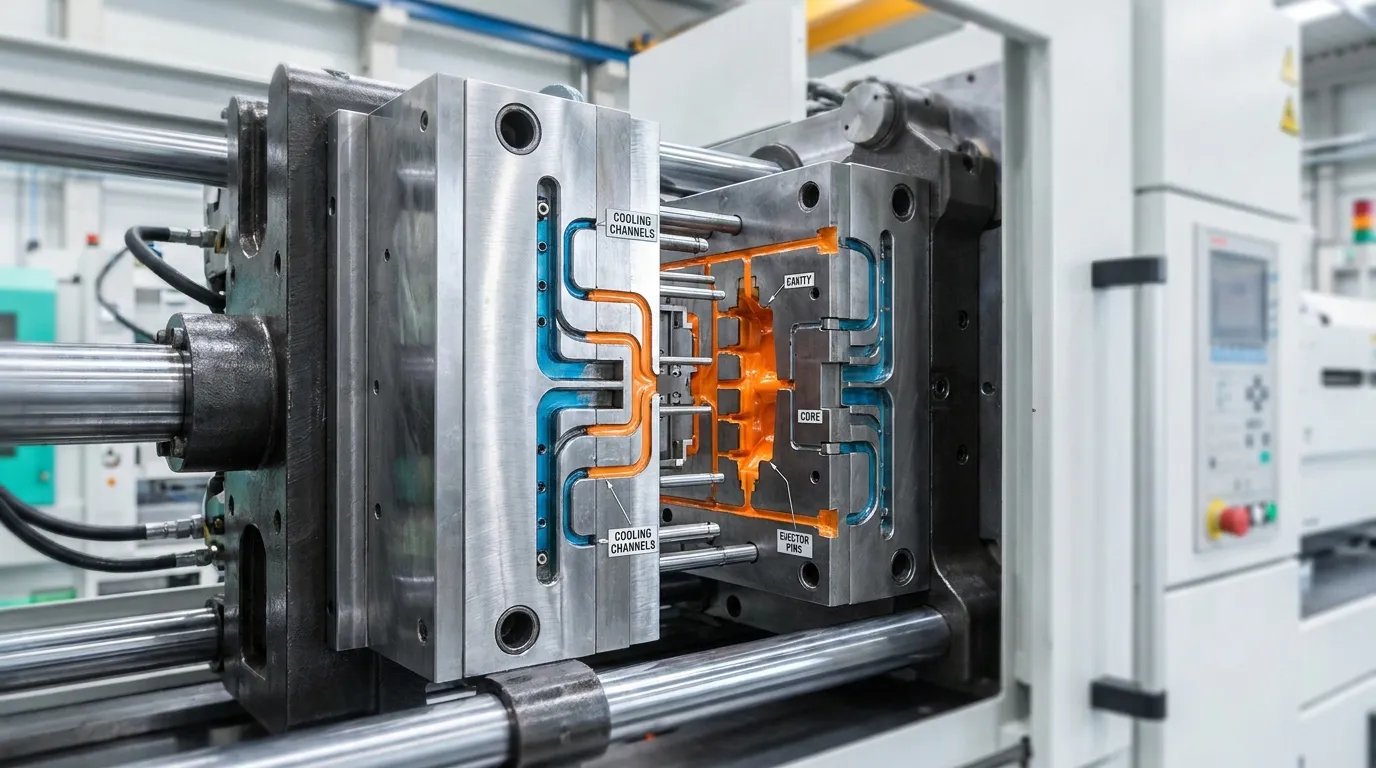
Injection mold components work together to control plastic flow, Resfriamento, Alinhamento, and part ejection. Core systems include the cavity, runner system, Ejetores, Canais de resfriamento, and guide mechanisms.
Every injection mold includes several mechanical systems that must work together with tight precision. If one area fails, the entire molding process can suffer from defects, Tempo de inatividade, or inconsistent dimensions.
| Componente | Função | Por que isso importa |
|---|---|---|
| Cavidade | Forma a forma externa da peça | Controle dimensões e acabamento superficial |
| Núcleo | Cria recursos internos | Afeta o ajuste e a geometria estrutural |
| Sistema de corredores | Direciona o fluxo de plástico fundido | Impactos do balanço de preenchimento |
| Portão | Ponto de entrada na cavidade | Influências das linhas de solda e marcas |
| Canais de resfriamento | Remove o calor do molde | Reduz o tempo de ciclo |
| Pinos ejetores | Empurrar as peças finalizadas para fora | Previne travamento e danos |
| Pinos guia | Alinhar metades do molde | Mantém a precisão durante a fixação |
Cooling channels often receive less attention than cavities or gates, but they directly affect production efficiency. A redesigned cooling layout can shorten cycle time significantly during high-volume production runs.
Por exemplo, a medical component with tight tolerances may require advanced cooling paths and hardened steel inserts to maintain dimensional stability across long production runs.
Isso Visão geral dos componentes do molde provides a deeper look at individual tooling systems and their engineering roles.
For additional mold construction details, o Referência de Construção de Moldes de Injeção offers a useful technical resource.
What are the different types of injection molds?
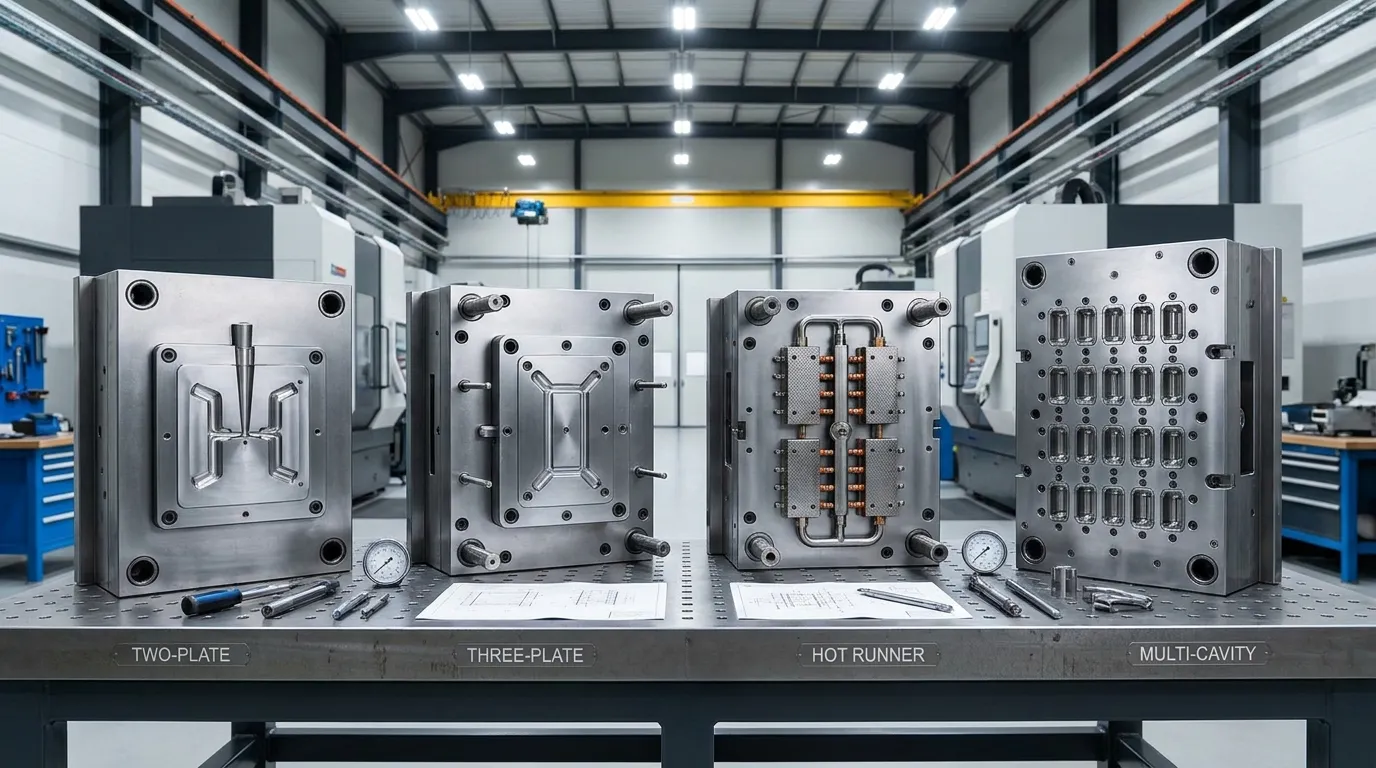
Different injection mold types are designed for different production needs. Simpler molds reduce tooling cost, while advanced systems like hot runner molds improve cycle efficiency and reduce material waste.
Manufacturers select mold types based on production volume, part complexity, gating requirements, and budget. Some molds focus on lower tooling cost, while others prioritize faster production and reduced scrap.
Moldes de duas placas vs moldes de três placas
A two-plate mold uses a single parting line and simpler runner system. It works well for many standard plastic parts and usually costs less to manufacture.
A three-plate mold adds an extra plate that allows more flexible gate placement. This helps with complex geometries and automatic runner separation, but it also increases tooling complexity and maintenance requirements.
| Tipo de molde | Melhores Para | Principal Vantagem | Principal Desvantagem |
|---|---|---|---|
| Molde de duas placas | Peças de produção padrão | Menor custo de ferramenta | Colocação limitada de portões |
| Molde de três placas | Layouts complexos de portões | Melhor flexibilidade de portão | Manutenção mais alta |
| Mofo de corredor quente | Produção em grande volume | Menos desperdício de material | Custo inicial mais alto |
| Molde de múltiplas cavidades | Grandes séries de produção | Maior produção por ciclo | Mais complexidade de balanceamento |
Hot runner molds are not always the best choice. They improve material efficiency, but simpler cold runner systems are often safer for lower production volumes or products with frequent material changes.
A low-volume prototype project, for instance, may benefit more from a simpler tooling design with lower upfront investment.
Isso Guia de Aplicações de Mofo na Indústria explains how different mold setups fit various industries and product categories.
Which materials are used to make injection molds?
Steel molds are preferred for long production runs and tight tolerances, while aluminum molds reduce tooling cost and speed up prototyping. Material selection depends on production volume, part complexity, and expected mold lifespan.
Tool steel is the most common mold material for long-term production. Hardened steel handles high injection pressure, Materiais abrasivos, and repeated cycles better than softer metals. It’s commonly used for automotive, Medicina, and industrial production programs.
Aluminum molds are lighter and easier to machine. That makes them useful for prototyping, Ferramentas para pontes, and shorter production runs where speed matters more than maximum lifespan.
| Material | Melhor Uso | Força | Limitação |
|---|---|---|---|
| Aço temperado | Longas séries de produção | Alta durabilidade | Custo mais alto |
| Aço pré-temperado | Ferramentas de médio volume | Usinagem mais fácil | Vida útil mais curta |
| Alumínio | Protótipos e corridas de baixo volume | Prazo de entrega mais rápido | Menor resistência ao desgaste |
Aluminum molds reduce lead time and tooling cost, but steel molds are usually the better long-term investment for high-volume production. A medical connector produced in large quantities may justify hardened steel tooling because dimensional consistency matters over millions of cycles.
How long does injection mold production take?
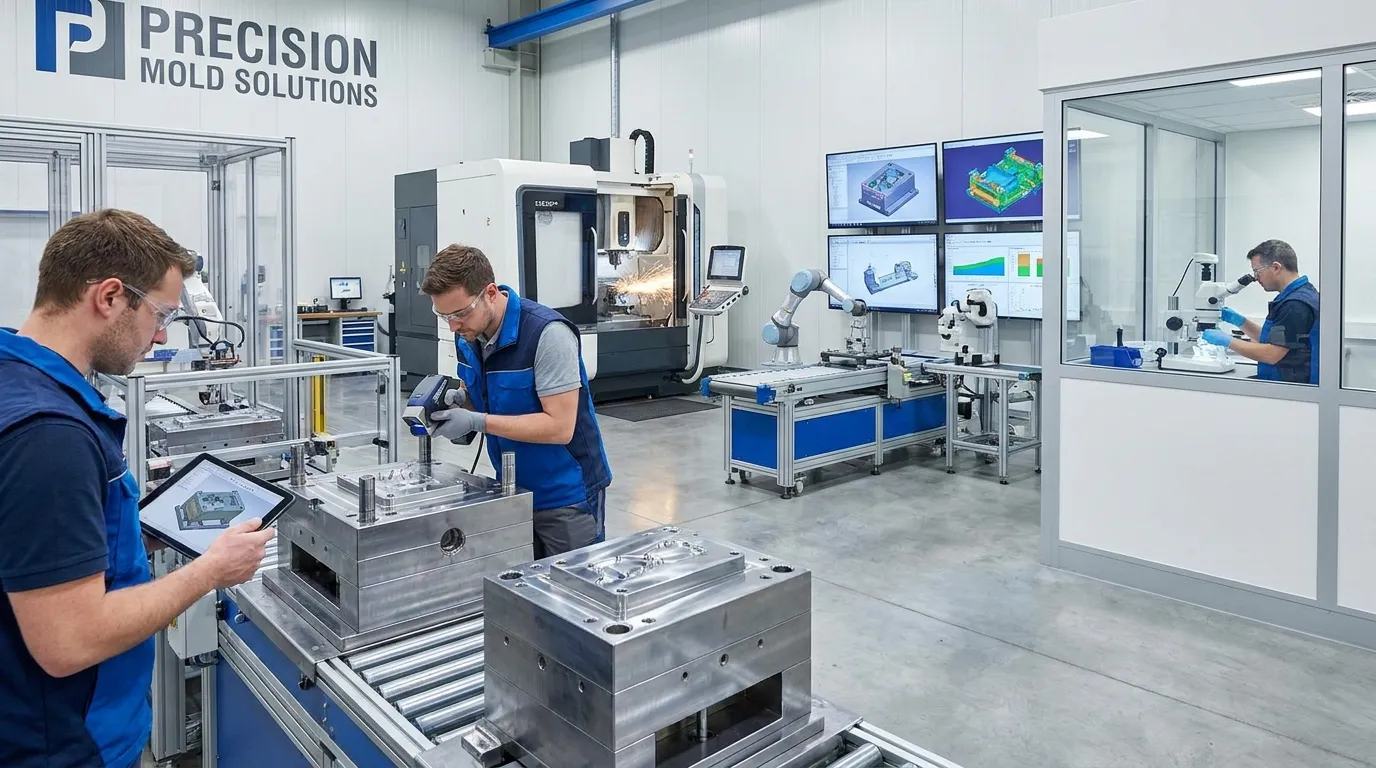
Injection mold lead times commonly range from several weeks to several months depending on mold complexity, Contagem de cáries, Revisões de ferramentas, e requisitos de validação.
Lead time depends on more than machining speed. Mold design reviews, material sourcing, Amostragem, and validation testing all affect delivery schedules. Complex multi-cavity molds naturally take longer because they require tighter balancing and additional machining steps.
A simple prototype mold may move from design approval to sampling quickly. A multi-cavity production tool for consumer electronics can take much longer due to cosmetic requirements and repeated validation testing.
Fatores que atrasam a entrega do mofo
- Revisões de projeto após o corte de aço
- Atrasos na obtenção de aço para ferramentas especiais
- Solicitações adicionais de amostragem
- Correções de fluxo ou resfriamento do molde
- Atrasos no envio internacional e na alfândega
Faster tooling timelines are not always a positive sign. Aggressive schedules can reduce testing time and increase production issues later.
| Fase de Produção | Foco Típico |
|---|---|
| Aprovação de projeto | Revisão e validação de peças do DFM |
| Usinagem CNC | Fabricação de base e cavidade de molde |
| Assembleia | Instalação de componentes e sistemas |
| Amostragem | Produção de peças de teste iniciais |
| Validação | Verificações dimensionais e cosméticas |
Isso Guia de tempo de entrega do EvokPoly explains how tooling complexity affects scheduling. O Artigo sobre tendências de manufatura fictícias also highlights how automation and digital validation are changing mold production workflows.
What problems can affect injection molds?
Injection molds can develop production problems from wear, cooling imbalance, alignment issues, or poor maintenance. Many defects start small and become expensive only after production volumes increase.
Flash happens when molten plastic escapes along the mold parting line. Short shots occur when the cavity does not fill completely. Uneven cooling can also create warping, Marcas de afundamento, or dimensional instability.
Fundamentos de manutenção de mofo
Regular maintenance helps prevent unexpected downtime and part inconsistency. Most production teams monitor wear surfaces, Canais de resfriamento, Sistemas ejetores, and alignment components during scheduled inspections.
A high-volume packaging mold, por exemplo, may require more frequent cleaning because resin buildup can affect gate performance and filling consistency.
Lista de verificação comum de problemas de mofo
- Flash ao redor da borda da peça
- Planos curtos ou preenchimento incompleto
- Desequilíbrio de resfriamento
- Pinos ejetores gastos
- Deriva de alinhamento do molde
- Bloqueio do portão
- Arranhões ou marcas superficiais
Isso Guia de Componentes de Molde de Precisão explains how individual tooling systems influence mold precision and maintenance planning.
How do manufacturers choose the right injection mold design?
Choosing the right mold design depends on production volume, Seleção de materiais, part geometry, and long-term cost goals. The best tooling setup is usually the one that balances reliability, cycle efficiency, and maintenance needs.
A low-volume consumer product may use aluminum tooling to reduce launch cost and shorten development time. A medical device component with strict tolerances often requires hardened steel tooling and tighter validation procedures.
Tabela de comparação de tipos de moldes de injeção
| Necessidade de Produção | Configuração recomendada de molde | Por que combina |
|---|---|---|
| Peças protótipo | Molde de alumínio | Resposta mais rápida |
| Produção de médios | Molde de aço de duas placas | Custo e durabilidade equilibrados |
| Embalagens de alto volume | Molde de canal quente multi-cavidades | Eficiência de ciclo mais rápida |
| Peças médicas de tolerância apertada | Molde de aço temperado | Melhor estabilidade dimensional |
| Alojamento de eletrônica estética | Sistema de condutores balanceados de múltiplas cavidades | Maior consistência visual |
Part geometry also changes tooling strategy. Thin-wall electronics housings often require balanced runner layouts and advanced cooling control. Costelas profundas, Undercuts, or textured surfaces may increase tooling complexity and maintenance requirements.
Manufacturers also evaluate long-term operating cost. A cheaper mold can become expensive later if cycle times stay slow or maintenance needs increase.
Isso Guia de aplicações de moldes por injeção shows how tooling decisions vary across industries and product categories.
O que fazer a seguir
An injection mold affects far more than part shape. It influences production speed, maintenance needs, Taxas de defeitos, e custo de fabricação de longo prazo. That’s why mold design decisions should match the product’s production goals instead of focusing only on upfront tooling price.
If you're comparing mold options, start by defining production volume, Requisitos de materiais, and quality expectations first. Then review cooling strategy, cavity layout, and mold material selection with your supplier. A well-designed injection mold usually saves far more money during production than it costs during tooling development.
Perguntas Frequentes
What is an injection mold used for?
An injection mold is used to manufacture repeatable plastic parts by shaping molten material inside a precision cavity. It’s widely used for automotive, Eletrônica, Medicina, and consumer products that require consistent dimensions and high production volume.
What are the main parts of an injection mold?
The main parts include the cavity, Núcleo, runner system, gate, Canais de resfriamento, Sistema ejetor, and guide components. Each system controls how plastic flows, Cool, aligns, e lançamentos durante a produção.
What is the difference between a two-plate and three-plate mold?
A two-plate mold uses one parting line and a simpler runner system, while a three-plate mold adds a separate runner plate for flexible gate placement. Three-plate molds improve gating control but increase tooling complexity and maintenance.
How long does it take to build an injection mold?
Injection mold production can take several weeks to several months depending on complexity, Contagem de cáries, testing requirements, and design revisions. Large production tools usually require longer validation and sampling stages.
Why are injection molds expensive?
Injection molds require precision machining, engineered cooling systems, hardened materials, and detailed testing. Higher cavity counts, tight tolerances, and complex part geometries increase tooling cost significantly.
How many parts can one injection mold produce?
Mold lifespan depends on tooling material, maintenance quality, e condições de produção. Hardened steel molds can often produce hundreds of thousands or even millions of cycles when maintained properly.
Compartilhar:


Escrito por Sunshine
Em Sol, Somos um fabricante e fornecedor profissional de componentes de moldes de precisão, oferecendo uma ampla variedade de produtos para aplicações de estampagem e molde por injeção. Nosso foco principal inclui a formação de matrizes, pinos e mangas ejetor, e postes guia e buchas. Com usinagem CNC avançada, Controle rigoroso de qualidade, e fortes capacidades de produção, Garantimos confiabilidade, Peças de alta precisão, juntamente com componentes padrão em estoque para fornecimento global rápido e eficiente.
NOTÍCIAS
RECEBA O SERVIÇO
Com peças de qualidade para todos os orçamentos e equipe amigável treinada para tornar sua visita informativa e sem complicações.
