



Moldagem por Injeção Automotiva: Requisitos de Ferramentas para Peças Plásticas Duráveis
Automotive injection molding requires tooling that can maintain dimensional stability, cosmetic consistency, and repeatable part quality through long production runs. Automotive molds face thermal cycling, vibration-related stress, Materiais abrasivos, and tight tolerance requirements. Ferramentas de aço temperado, balanced cooling channels, proper venting, and preventive maintenance help manufacturers produce durable automotive plastic parts with stable surface finishes and longer mold life.
Automotive suppliers cannot treat vehicle parts like standard consumer plastics. A dashboard panel, grille, or under-hood housing may go through years of heat, vibration, Exposição à luz UV, e tensões mecânicas. Tooling decisions directly affect whether those parts stay dimensionally stable and visually consistent after hundreds of thousands of cycles.
What makes automotive injection molding different from standard plastic molding?
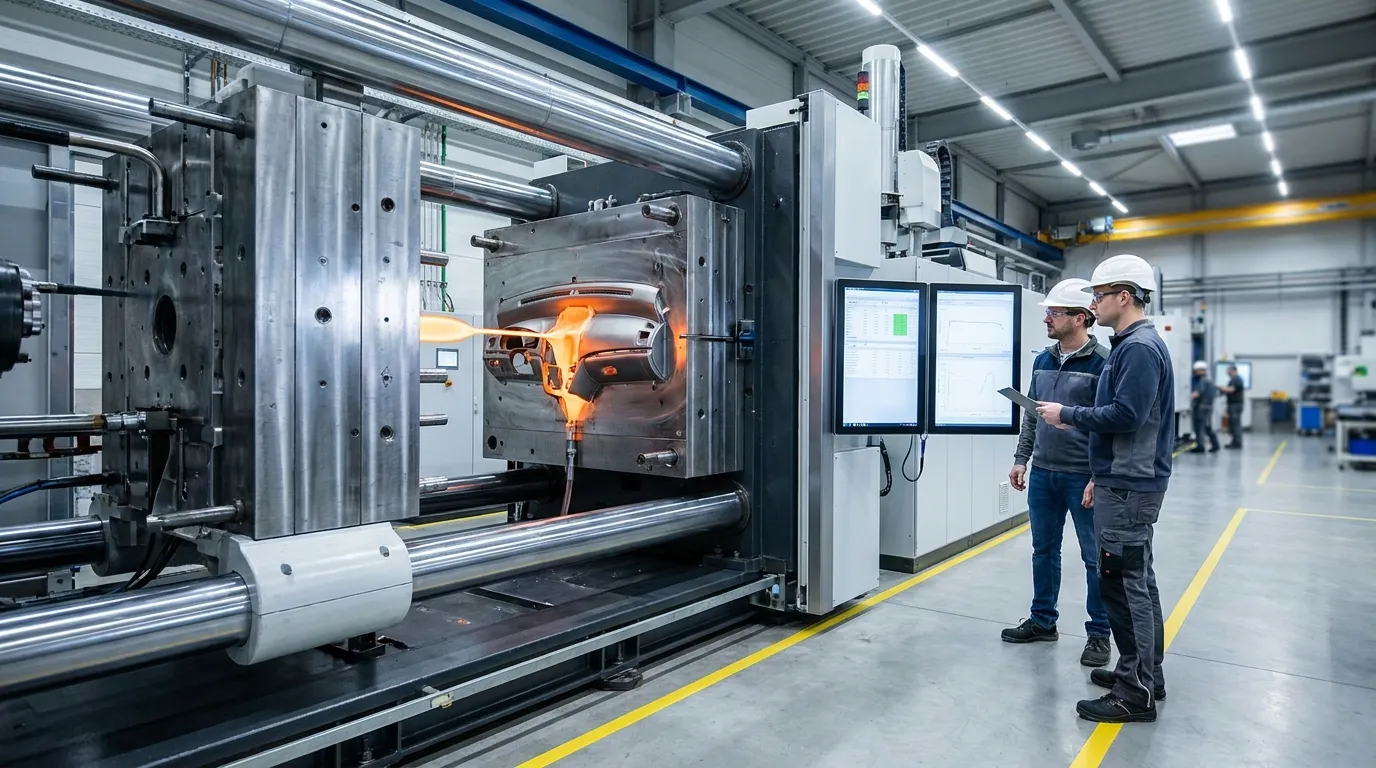
Automotive injection molding requires stronger tooling because vehicle parts must survive heat, vibration, Exposição à luz UV, and long production runs without losing dimensional accuracy or cosmetic quality. Standard consumer-product molds usually face lower stress and shorter production demands.
Automotive parts often stay in service for years under changing temperatures and constant vibration. Interior trim pieces must fit tightly without rattling. Exterior components need stable surface finishes even after long UV exposure. Under-hood parts may experience repeated thermal cycling that pushes both the resin and the mold harder than standard commercial applications.
Production volume also changes the tooling strategy. Automotive programs commonly run for hundreds of thousands or even millions of cycles. Softer tooling materials may wear too quickly under those conditions, especially when using glass-filled engineering plastics.
| Moldagem Plástica Padrão | Moldagem por Injeção Automotiva |
|---|---|
| Menores volumes de produção | Séries de produção em grande volume |
| Padrões cosméticos básicos | Consistência estrita do acabamento superficial |
| Exposição térmica limitada | Ciclos térmicos repetidos |
| Demandas de menor dimensão | Tolerâncias de montagem apertadas |
| Vida útil menor do produto | Expectativas de durabilidade a longo prazo |
This is why many automotive suppliers invest heavily in hardened tooling, Controle de processos, and preventive maintenance. De acordo com Intertek, automotive plastic components often require extensive validation and testing to maintain quality standards across production.
If you need a broader overview of mold construction, o Fundamentos do design de moldes page explains the core structure behind injection mold systems.
Which automotive parts place the highest demands on injection molds?
Automotive parts exposed to heat, vibration, UV light, or cosmetic inspection place the greatest demands on injection molds. Painéis de controle, Churrasqueiras, Alojamentos de lâmpada, and under-hood components require stable tooling that can maintain tight tolerances across long production runs.
Not every automotive component stresses a mold equally. Large cosmetic panels often create the biggest challenges because they combine appearance requirements with dimensional accuracy. Even a small amount of warpage can create fitment problems during assembly.
Lamp housings are another demanding application. Poor cavity polishing or inconsistent cooling can create gloss variation that becomes visible immediately under light reflection. Exterior grilles and trim pieces also need stable surface texture retention throughout the mold lifecycle.
| Peça Automotiva | Desafio Principal de Ferramentas |
|---|---|
| Painéis do painel | Controle de warpage |
| Alojamentos de lâmpada | Consistência do brilho |
| Grades externas | Qualidade da superfície relacionada à UV |
| Alojamentos sob o capô | Resistência térmica |
| Painéis internos de acabamento | Ajuste dimensional apertado |
| Componentes HVAC | Repetibilidade a longo prazo |
A dashboard molding project is a good example. Uneven cooling channels can create shrinkage differences across the part surface. The result may look flat at first, then distort slightly after installation. That small dimensional shift often causes alignment issues during vehicle assembly.
Manufacturers working across different industries often apply similar precision principles. O Aplicações em moldes de injeção resource shows how tooling requirements change between product categories.
Why do mold steel selection and hardness matter in automotive production?
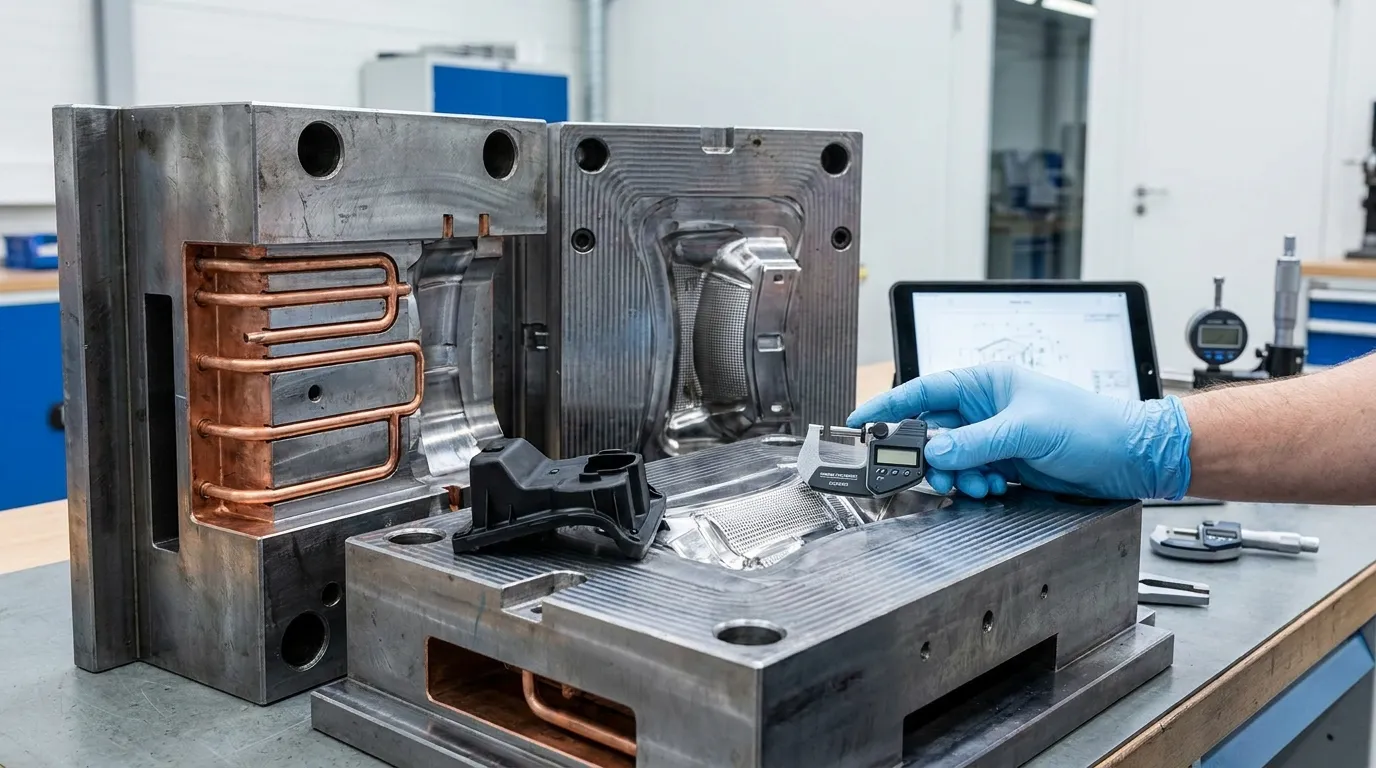
Mold steel selection affects wear resistance, cavity stability, surface finish retention, e consistência de produção a longo prazo. Automotive programs with high volumes or abrasive resins usually require hardened steel tooling instead of softer aluminum molds.
Tooling material directly affects how long a mold can maintain quality standards. Automotive molds frequently run abrasive materials such as glass-filled nylon, which can wear softer cavity surfaces quickly. Once cavity wear starts, dimensional drift and cosmetic defects become harder to control.
Hardened steel tooling costs more upfront, but it usually performs better for long automotive programs. It handles repeated thermal cycling more consistently and maintains cavity precision over larger production volumes.
| Material de Ferramentas | Melhor Caso de Uso | Limitação Principal |
|---|---|---|
| Ferramentas de alumínio | Protótipo e temporadas curtas | Desgaste mais rápido |
| Aço pré-temperado | Produção de médios | Resistência moderada ao desgaste |
| Aço temperado | Programas automotivos longos | Custo inicial maior |
Quando as ferramentas de alumínio ainda fazem sentido
Aluminum tooling is not always the wrong choice. It works well for prototype validation, Ferramentas para pontes, and low-volume production where lead time matters more than extreme mold lifespan.
That said, low tooling cost can become expensive later if the mold cannot maintain dimensional consistency. A softer mold running glass-filled resin may require repeated repairs, re-polishing, or cavity corrections much earlier than expected.
A supplier that understands long-term tooling performance should explain these tradeoffs clearly instead of defaulting to the cheapest option. O Guia de componentes do molde provides a broader look at the components that affect tooling durability.
How do automotive manufacturers maintain dimensional stability in molded parts?
Dimensional stability in automotive injection molding depends on balanced cooling, stable cavity temperatures, controlled shrinkage, and repeatable process settings. Poor tooling design can cause warpage, fitment issues, and inconsistent assembly performance.
Automotive assemblies leave little room for dimensional variation. Peças de acabamento interno, HVAC housings, and console components often need to align precisely with surrounding parts. Even small dimensional movement can create visible gaps or assembly stress.
Cooling design plays a major role in dimensional control. If one area of the cavity cools faster than another, the part may shrink unevenly. This is a common cause of warpage in large automotive panels.
Causas comuns de empenamento em peças automotivas
- Disposição desigual do canal de resfriamento
- Má colocação dos portões
- Retração inconsistente da resina
- Pressão excessiva de injeção
- Controle instável de temperatura do mofo
A dashboard warpage issue illustrates the problem well. One supplier used uneven cooling channels near the center of a large panel. The part initially passed inspection, but slight dimensional movement appeared after installation. The issue traced back to inconsistent cooling rates across the cavity.
Manufacturers also use mold-flow analysis to predict shrinkage and filling behavior before production begins. Stable process settings help maintain repeatability after the tool moves into long production cycles.
| Fator de Estabilidade Dimensional | Por que isso importa |
|---|---|
| Resfriamento balanceado | Reduz o encolhimento desigual |
| Temperatura estável da cavidade | Melhora a repetibilidade |
| Posicionamento controlado do portão | Reduz o estresse interno |
| Configurações consistentes de processo | Mantém as dimensões da peça |
| Seleção de resina | Afeta o comportamento de encolhimento |
Companies producing tight-tolerance parts in other industries face similar challenges. O Precisão do molde do dispositivo page shows how precision tooling practices support dimensional consistency.
What tooling features improve surface finish and cosmetic quality?
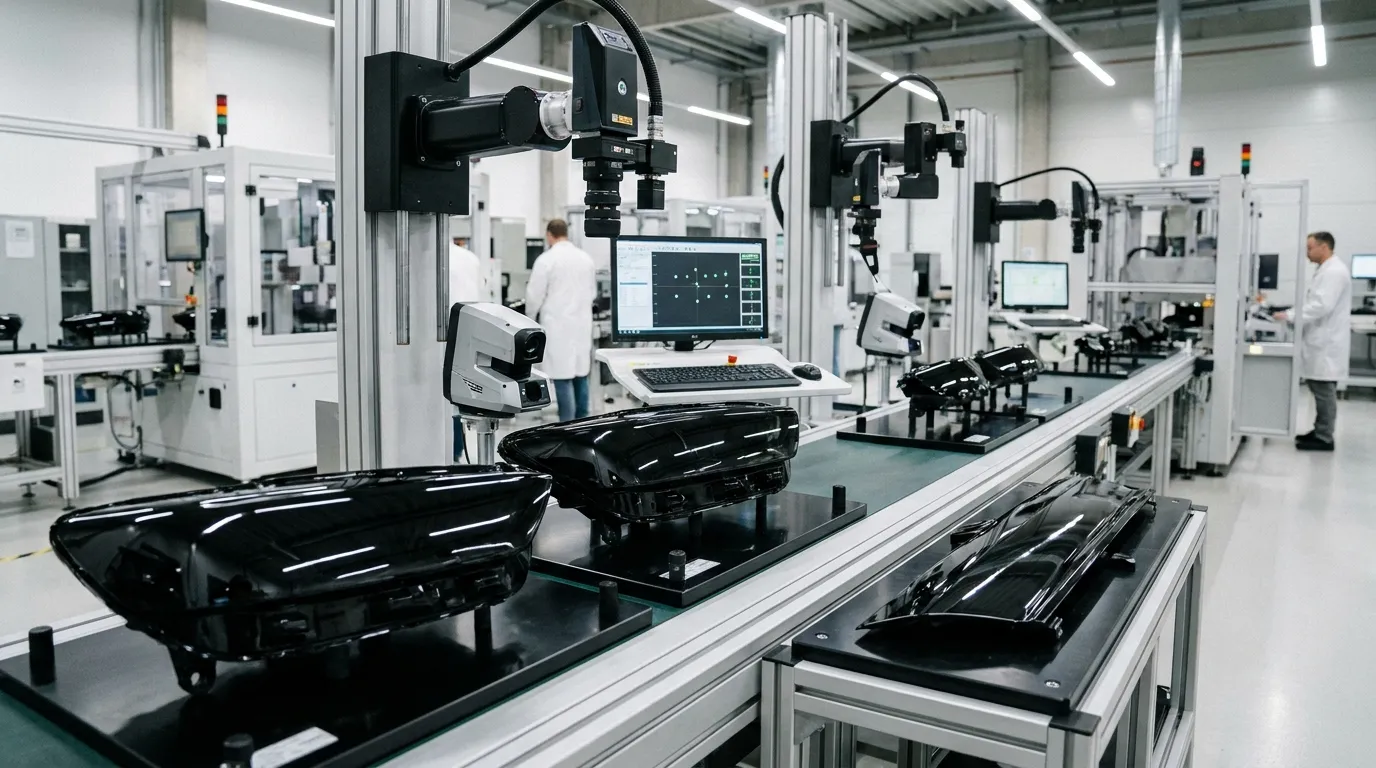
Automotive surface quality depends heavily on tooling precision. Proper polishing, ventilação, cavity alignment, and gate positioning help manufacturers reduce weld lines, gloss variation, and visible cosmetic defects across large production runs.
Cosmetic automotive parts require stable tooling surfaces. Poor polishing can create texture inconsistency, while weak venting may trap gases and leave visible marks on finished components.
Lamp housings provide a clear example. A supplier may choose a premium resin, but weak cavity polishing can still create uneven gloss reflection across the part surface. In automotive applications, even small cosmetic variation becomes noticeable under direct lighting.
Lista de Verificação de Acabamento de Superfície
- Manter padrões consistentes de polimento de cavidades
- Projete ventilação para reduzir marcas de gás aprisionado
- Portões de posição para minimizar a visibilidade das linhas de solda
- Desgaste de cavidades de monitoramento durante longas séries de produção
- Controle a temperatura do molde para níveis estáveis de brilho
Surface finish problems are often tooling problems, not material problems. A well-designed mold can improve appearance consistency even when production volume increases significantly.
For industries that also require tight cosmetic control, o Ferramentas de dispositivos plásticos resource shows how precision tooling supports clean surface quality.
How does production volume affect automotive tooling strategy?
Production volume changes nearly every tooling decision in automotive injection molding. Low-volume programs may justify softer tooling, while long-run automotive production usually requires hardened steel, preventive maintenance planning, and stable multi-cavity performance.
A prototype tool and a million-cycle automotive production mold serve very different purposes. Short-run programs often focus on speed and lower upfront cost. Long-run automotive programs prioritize consistency and predictable maintenance intervals.
Multi-cavity tooling becomes more important as production demand increases. When cavity balancing is poor, one cavity may fill differently from another. That variation can create dimensional inconsistency across the same production run.
Quando ferramentas multi-cavidade se tornam necessárias
Multi-cavity molds make sense when production demand is high enough to justify the added tooling complexity. They improve output efficiency, but they also increase the need for balanced flow paths and stable process control.
A trim panel production project highlights this issue well. One cavity produced slightly different shrinkage because the flow path was less balanced. The result was inconsistent fitment during assembly checks.
Tabela de Decisão de Ferramentas Automotivas
| Volume de Produção | Ferramentas Recomendadas | Vida Típica do Mofo | Aplicação Comum | Frequência de Manutenção |
|---|---|---|---|---|
| Under 10,000 parts | Ferramentas de alumínio | Curto prazo | Validação de protótipos | Baixo |
| 10,000 to 100,000 parts | Aço pré-temperado | Médio prazo | Produção de pontes | Moderado |
| 100,000+ parts | Aço temperado | Longo prazo | Produção automotiva completa | Manutenção preventiva programada |
Tooling revisions can also extend lead times significantly. De acordo com Evok Polytech e Ulitech, design changes during tooling development often increase production delays and adjustment costs.
What shortens the lifespan of automotive injection molds?
Automotive injection molds wear out faster when abrasive resins, poor maintenance practices, excessive injection pressure, or uncontrolled thermal cycling damage cavity surfaces and critical mold components.
Automotive molds operate under demanding conditions for long periods. Glass-filled engineering plastics are especially hard on cavity surfaces because the reinforcing fibers gradually erode softer tooling materials.
Thermal cycling creates another long-term issue. Repeated heating and cooling can affect cavity stability, especially if the mold lacks proper temperature management. Com o tempo, this may reduce dimensional accuracy or create flash issues around part edges.
Lista de Verificação de Falha de Mofo Automotivo
| Fonte do Desgaste | Sintoma visível | Causa Provável | Ação Corretiva | Prioridade de Manutenção |
|---|---|---|---|---|
| Desgaste por resina abrasiva | Deriva dimensional | Materiais preenchidos com vidro | Endurecer superfícies de cavidades | Alto |
| Má manutenção das ventilações | Marcas de queimadura | Armadilhas de gás | Limpar canais de ventilação | Alto |
| Pressão excessiva de injeção | Formação de Flash | Desequilíbrio de processos | Ajustar as configurações do processo | Médio |
| Tensão de ciclo térmico | Fissuração superficial | Controle de temperatura instável | Melhorar o gerenciamento de resfriamento | Alto |
| Desgaste por polimento de cavidades | Inconsistência de glossário | Longas séries de produção | Repolir superfícies de cavidades | Médio |
Preventive maintenance matters more in automotive molding than many buyers realize. De acordo com Escatec, tooling lifespan depends heavily on maintenance quality, operating conditions, e seleção de materiais.
Como os compradores devem avaliar um fornecedor de moldagem por injeção automotiva?
Choosing the right supplier requires more than comparing tooling quotes. Automotive programs need stable production systems, long-term maintenance capability, and consistent quality control.
A supplier should be able to explain how they manage dimensional stability, cavity wear, Balanço de resfriamento, and preventive maintenance. If those conversations stay vague, the tooling strategy may not be mature enough for demanding automotive programs.
Perguntas para fazer antes de aprovar ferramentas
- What mold steel is recommended, and why?
- How will the supplier manage cavity wear?
- What maintenance schedule is planned?
- Has mold-flow analysis been completed?
- How are dimensional tolerances verified during production?
A low tooling quote is not always the safest choice. Some suppliers reduce cost by using softer tooling materials or simplifying cooling design. That may work for short runs, but long automotive programs often expose those compromises later.
Buyers should also look for evidence of precision manufacturing discipline. Suppliers serving industries with tight tolerance requirements often develop stronger process controls. O Processo de fabricação de precisão page provides a useful example of how structured manufacturing practices support consistency.
Acertando o Próximo Passo
Automotive injection molding depends heavily on tooling quality, especially when parts must maintain appearance, Estabilidade dimensional, and long-term durability across large production runs. Mold steel selection, Balanço de resfriamento, Planejamento de manutenção, and cavity design all affect the final result.
Before approving a new automotive program, review how the supplier handles wear resistance, Controle de processos, and preventive maintenance. A stronger tooling strategy usually costs less over the full life of the program because it reduces rework, Deriva dimensional, and production interruptions.
Perguntas Frequentes
What is automotive injection molding?
Automotive injection molding is a manufacturing process that forms vehicle plastic parts by injecting molten resin into precision molds. It is commonly used for dashboards, Painéis de acabamento, Alojamentos de lâmpada, Churrasqueiras, and structural plastic components that require repeatable quality.
What plastics are commonly used in automotive injection molding?
Common automotive molding materials include ABS, polipropileno, Náilon, Policarbonato, e plásticos de engenharia preenchidos com vidro. Material choice depends on heat resistance, Resistência ao impacto, Qualidade cosmética, and dimensional stability requirements.
Quanto tempo duram moldes de injeção automotiva?
Automotive injection molds can last from hundreds of thousands to more than one million cycles depending on mold steel quality, Práticas de manutenção, Abrasividade da resina, e condições de operação. Hardened steel tooling usually provides the longest service life.
Why is hardened steel used for automotive molds?
Hardened steel is used because automotive production often involves high volumes, Materiais abrasivos, and strict dimensional requirements. It improves wear resistance, cavity stability, and long-term surface finish consistency.
What causes warpage in automotive molded parts?
A empenagem geralmente vem de resfriamento desigual, Colocação ruim dos portões, inconsistent material shrinkage, or unstable process settings. Balanced cooling channels and controlled mold temperatures help reduce distortion.
Quais peças automotivas são comumente moldadas por injeção?
Common injection molded automotive parts include dashboards, Para-choques, Painéis de acabamento, Churrasqueiras, Alojamentos de lâmpada, Componentes HVAC, and interior consoles. Many modern vehicles rely heavily on molded plastic components to reduce weight and improve manufacturing efficiency.
Compartilhe:


Escrito por Sunshine
Em Sol, Somos um fabricante e fornecedor profissional de componentes de moldes de precisão, oferecendo uma ampla variedade de produtos para aplicações de estampagem e molde por injeção. Nosso foco principal inclui a formação de matrizes, pinos e mangas ejetor, e postes guia e buchas. Com usinagem CNC avançada, Controle rigoroso de qualidade, e fortes capacidades de produção, Garantimos confiabilidade, Peças de alta precisão, juntamente com componentes padrão em estoque para fornecimento global rápido e eficiente.
NOTÍCIAS
RECEBA O SERVIÇO
Com peças de qualidade para todos os orçamentos e equipe amigável treinada para tornar sua visita informativa e sem complicações.
